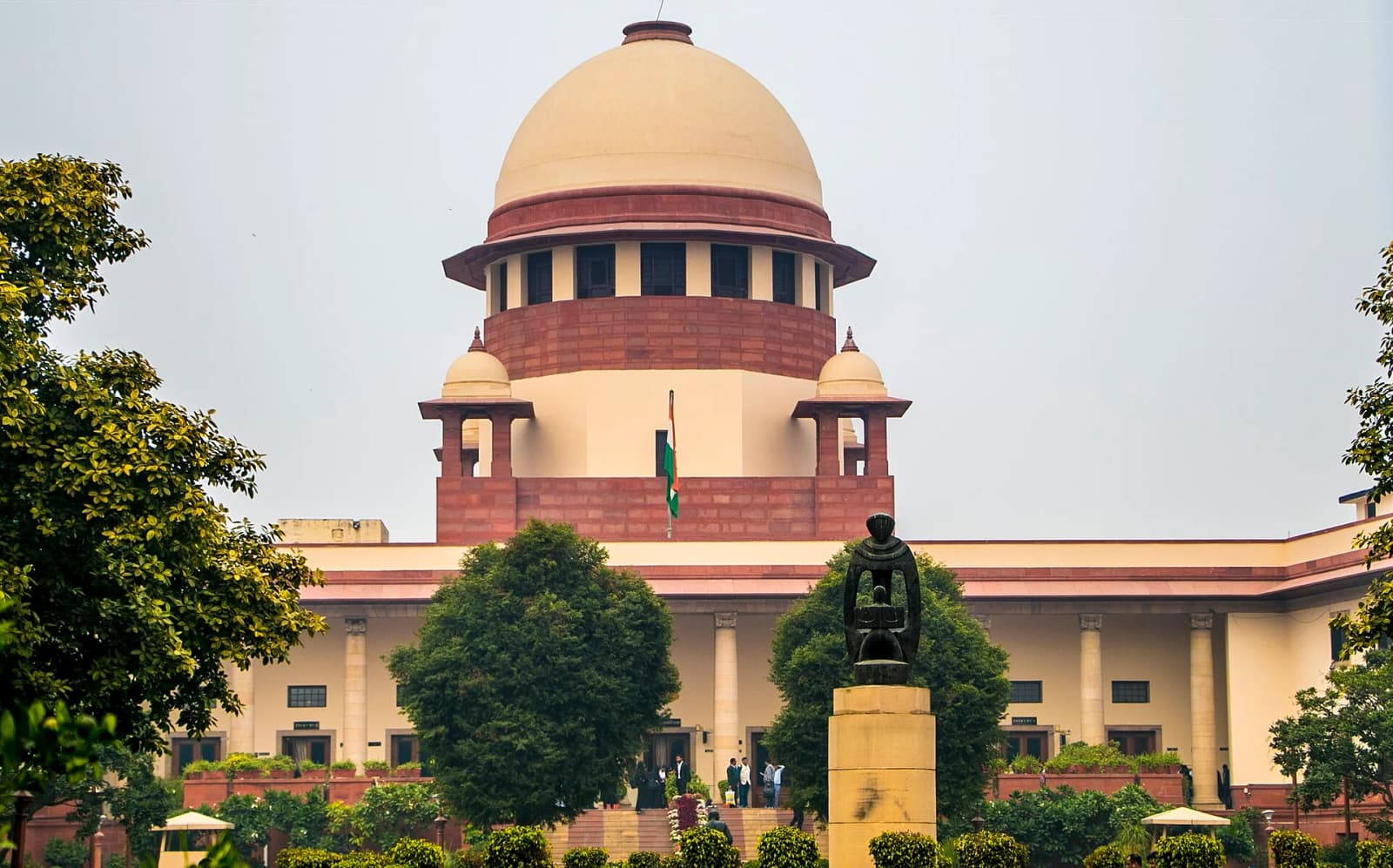
The Supreme Court of India on 18 November 2026 struck down two Uttar Pradesh laws that kept the years retired government employees spent in work-charged, temporary, daily-wage and muster-roll jobs out of their pension calculations, even after those employees were regularised. A bench of Justice Dipankar Datta and Justice Satish Chandra Sharma declared the Uttar Pradesh Qualifying Service for Pension and Validation Act, 2021 and the Uttar Pradesh Entitlement to Pension and Validation Act, 2025 unconstitutional, according to the judgment written by Justice Datta.
The case, Uttar Pradesh Ground Water Department Non Gazetted Employee Association (Regd.) and another v. The Chief Secretary and others, was brought by employee associations and individual employees and heard with connected appeals. The ruling was reported by legal news outlets on 19 and 20 November.
What did the Supreme Court decide?
The court held that once an employee is regularised under a valid scheme, the state cannot use the nature of the original appointment to deny pension for that earlier service. In the bench's words, "the act of regularisation obliterates the source or birthmark of the appointment simpliciter."
The bench said both Acts failed to remove the defect it had identified in its 2019 ruling in Prem Singh v. State of Uttar Pradesh. That judgment had held that service in a work-charged establishment must count as qualifying service for pension and had read down Rule 3(8) of the Uttar Pradesh Retirement Benefits Rules, 1961, which excluded such service.
How did the two laws try to get around the 2019 ruling?
The 2021 Act redefined "qualifying service" by tying it to appointments against temporary or permanent posts, and retrospectively validated pension decisions under Rule 3(8) going back to 1 April 1961. The 2025 Act introduced the idea of a "substantive appointee", limited pension on that basis, excluded certain past or present contributory or employees' provident fund subscribers, and again validated earlier denials.
The court said a legislature can retrospectively validate an action that a court has struck down only if it first cures the flaw behind the ruling; changing the wording is not enough. It found that both Acts simply kept the same exclusion under new labels. The bench relied on earlier precedents on validating laws, including Prithvi Cotton Mills, Indian Aluminium Co. v. State of Kerala and Madan Mohan Pathak v. Union of India.
What did the state argue?
Attorney General R. Venkataramani told the court that ruling for the employees would place an onerous financial burden on the state running into thousands of crores of rupees, according to a report by Law Trend. The bench described that submission as "entirely unpersuasive". No official figure for the number of employees affected has been published.
What happens next for retired employees?
The court laid down a timeline for claims:
- Eligible retired employees may apply to the competent authority with full details of their past service, and claims must be decided within six months.
- Arrears are generally limited to three years before the writ petition in the Prem Singh case was filed. This cap does not apply to legal heirs of employees who died before the 2019 judgment, though they must give clear proof of entitlement.
- No claim may be rejected without a hearing and a reasoned order, and successful claimants must get a statement showing each payment and its head.
- Benefits not paid within the deadline will carry simple interest of 9% a year.
The bench also set aside the High Court decisions under challenge in the connected appeals and gave the state a final six months to comply with Prem Singh in pending contempt cases, warning that continued non-compliance could amount to aggravated contempt.
Why it matters
The ruling closes, for now, a dispute that has run since 2019 over whether Uttar Pradesh can legislate its way past a Supreme Court pension decision. For retirees who spent years on work-charged or daily-wage rolls before being made permanent, it opens the way to have that service counted, with a fixed decision window and interest for delay. The Uttar Pradesh government had not publicly responded to the judgment at the time of writing.
Photo source · Subhashish Panigrahi, CC BY-SA 4.0