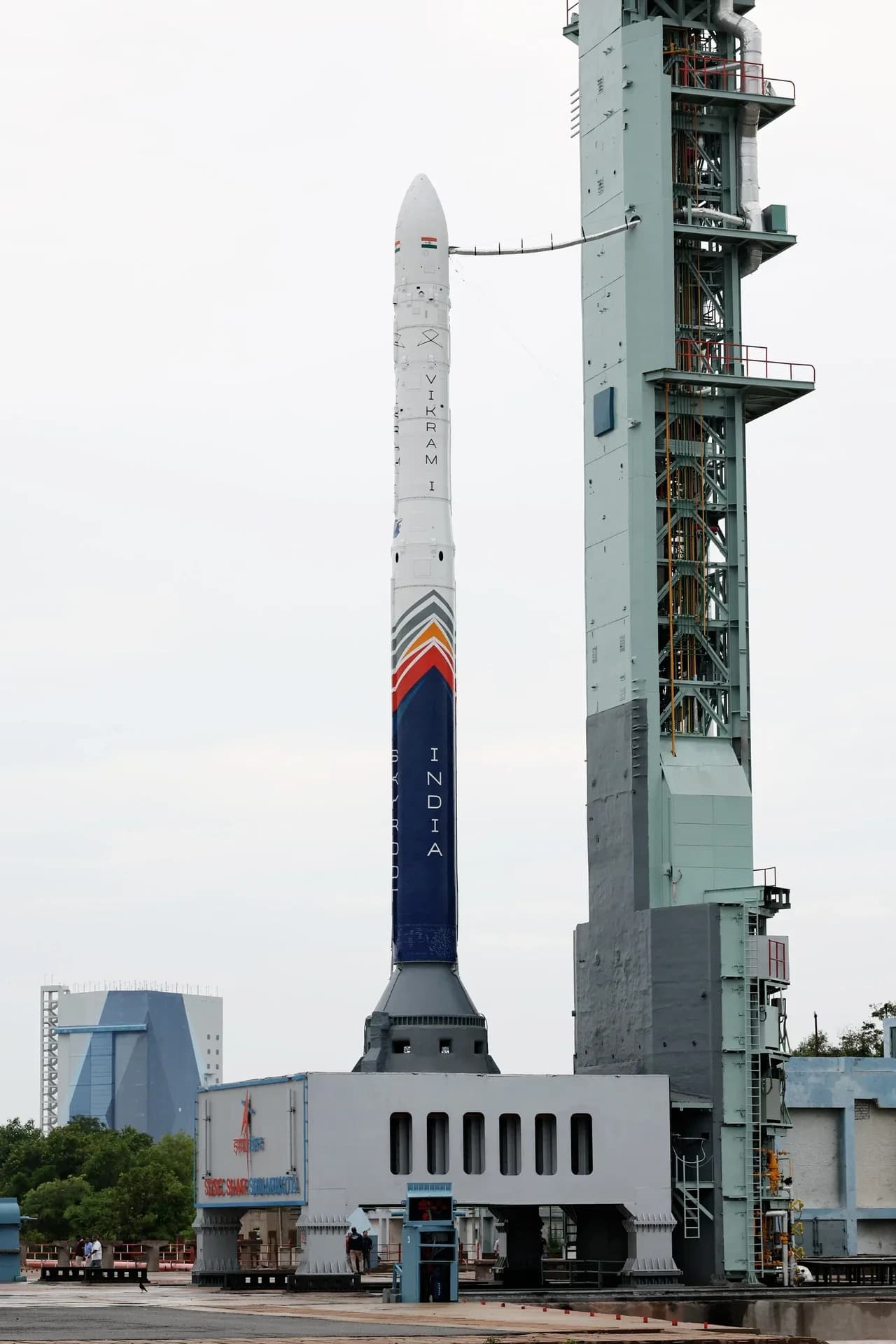
Hyderabad-based rocket maker Skyroot Aerospace has lined up its second Vikram-1 orbital flight with three partners from India, Germany and Italy: satellite builder HEX20, deployment company Exolaunch and propulsion start-up OhmSpace. The partnership was announced at Space Tech Expo Europe 2026 in Bremen, Germany, which ran from 17 to 19 November, and was reported on 20 November 2026.
The mission will bring a launch vehicle, two small satellites, a deployer and an in-space propulsion experiment from four companies onto a single flight. No launch date has been announced.
What will the second Vikram-1 carry?
The rocket will carry two CubeSats, small standardised satellites built from 10-centimetre units:
- SCOPE, a 4U satellite of Skyroot's own;
- NILA III, a 4U satellite built by HEX20, which is headquartered in Thiruvananthapuram, Kerala.
Germany's Exolaunch will supply an 8U deployer that holds both satellites and releases them once in orbit. Italy's OhmSpace will fly a high-temperature resistojet, a type of electric thruster that heats its propellant, as a hosted technology demonstration on board NILA III.
According to the reports, NILA III had originally been booked on a SpaceX Transporter rideshare mission through Exolaunch before it was moved to Vikram-1. Exolaunch said the collaboration and integration process took less than two months.
What did the companies say?
Pawan Kumar Chandana, co-founder and CEO of Skyroot Aerospace, said the four companies bring "complementary capabilities" to the flight. Amal Chandran, co-founder and CEO of HEX20, described the switch of NILA III to an Indian rocket as "a coming-of-age moment" for the country's space ecosystem.
Kier Fortier, Chief Revenue Officer of Exolaunch, said the deal "marks our first launch" on Vikram-1, while Federico Romei, founder and CEO of OhmSpace, said the flight gives his company "a direct route to orbit".
How did the first Vikram-1 flight go?
Vikram-1 became the first rocket built by a private Indian company to reach orbit when it lifted off from the Satish Dhawan Space Centre in Sriharikota, Andhra Pradesh, at 12:05:30 pm on 18 July 2026. According to the Indian Space Research Organisation (ISRO), the four-stage rocket, with three solid stages and a liquid upper stage, placed two satellites, SCOPE and Grahaa, into low Earth orbit on its first attempt.
ISRO said it provided solid motor casting and static testing facilities and supported integration on the First Launch Pad, while IN-SPACe, the national space promotion and authorisation agency, handled mission readiness reviews and launch clearances. Skyroot's earlier suborbital rocket, Vikram-S, flew from Sriharikota on 18 November 2022.
Why it matters
The deal brings foreign companies onto an Indian private rocket for only its second orbital flight: Exolaunch, which had handled NILA III's earlier SpaceX booking, said this will be its first launch on Vikram-1, and OhmSpace gets a ride to test its thruster in orbit. HEX20's decision to move its satellite from a SpaceX rideshare to Vikram-1 also shows an Indian satellite maker choosing a home-built launcher.
What remains unconfirmed is timing: neither the companies' statements nor the reports seen so far give a date for the second launch.
Photo source · ISRO, GODL-India