Indian Railways has completed excavation of Tunnel No. 10, the longest tunnel on the Sivok-Rangpo new railway line, on 27 November 2026, finishing digging work on all 14 tunnels of the project meant to give Sikkim its first rail link. The Ministry of Railways announced the breakthrough in a release issued on 28 November 2026.
What was achieved in Tunnel No. 10?
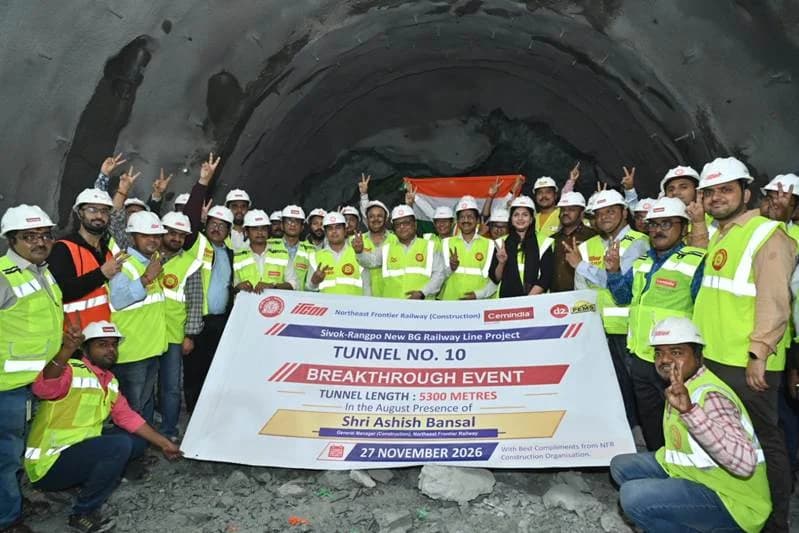
Excavation of the 5.3-km tunnel has been completed. According to the ministry, crews worked from both portals and also through two access tunnels, and the excavation fronts have now met. A photograph released with the announcement shows Northeast Frontier Railway (Construction) staff holding a banner marking the "breakthrough event" on 27 November 2026, giving the tunnel length as 5,300 metres.
With Tunnel No. 10 done, the ministry said excavation is complete in all 14 tunnels on the route.
What is the Sivok-Rangpo line?
The Sivok-Rangpo project is a 45-km broad gauge new line. It runs through Darjeeling and Kalimpong districts of West Bengal and Pakyong district of Sikkim, across difficult Himalayan terrain.
- Its 14 tunnels make up about 86 per cent of the total route length, the ministry said.
- The project also includes 23 bridges.
- Planned stations are Sivok, Riyang, Melli and Rangpo, along with an underground halt at Teesta Bazaar.
- At Sivok, the line will join the existing New Jalpaiguri-Alipurduar route, connecting Sikkim to the national railway network.
Why does it matter for Sikkim?
Sikkim does not yet have a railway connection. Once the line is operational, the ministry said, it will give residents and tourists a safer, faster and more reliable alternative to National Highway 10.
The ministry also said the rail link is expected to ease the movement of essential goods, give local businesses better access to markets and boost tourism in Sikkim.
The milestone adds to recent progress on Himalayan rail tunnels: as MapMyTimes reported, the Rishikesh-Karnaprayag project achieved a breakthrough in its 6.59-km Tunnel-14 in Uttarakhand.
What happens next?
Excavation is only one stage of tunnel construction. The ministry said the remaining work, including tunnel lining, track laying and installation of essential railway safety systems, will now move ahead. The release did not give a date for when trains are expected to start running on the line.
Photo source · Press Information Bureau (PIB), Ministry of Railways