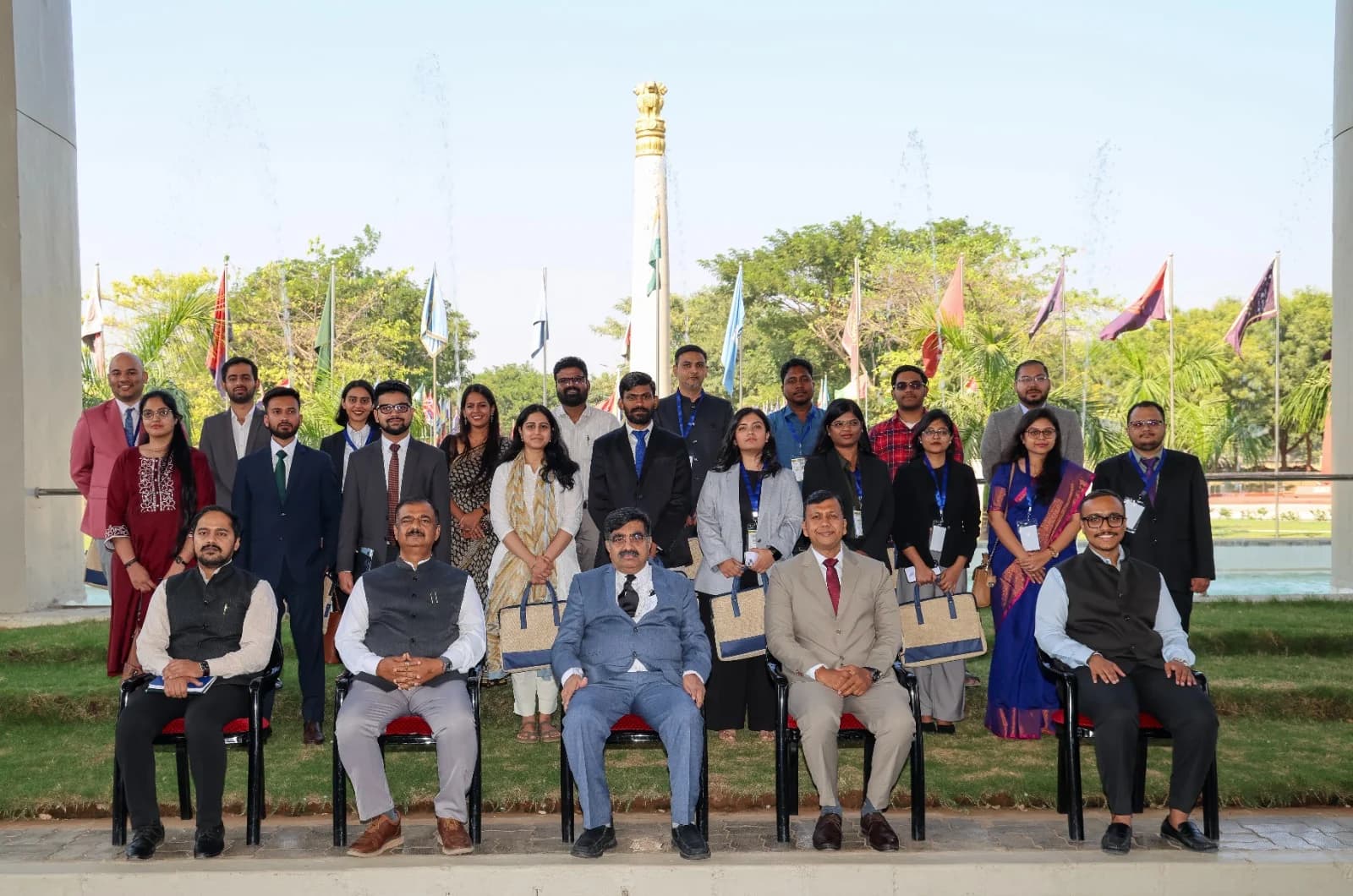
Rashtriya Raksha University (RRU) on 20 November 2026 opened the third edition of its International Moot Court Competition at its Lavad campus in Gujarat, where more than 90 law students in 31 teams from five countries will argue a fictional dispute over a digital payment network suspected of financing an armed group. The three-day contest asks how far governments can lawfully go when financial intelligence flags suspicious transactions on a system that also carries cross-border remittances.
Details of the competition and the inaugural session were published in a release issued by PIB Ahmedabad for the Ministry of Home Affairs.
Who is competing?
Twenty-five of the 31 teams are from India. Nepal has sent three teams, while Uzbekistan, Ethiopia and the United Kingdom have one each. The event is organised jointly by RRU's School of Criminal Law and Military Law and its School of Integrated Coastal and Maritime Security Studies.
What is the moot problem about?
Students represent two neighbouring States locked in a dispute over a shared digital payment system. They must argue which forum can hear the case, what the two States actually agreed to, and what the evidence supports. The problem sits at the meeting point of national security, financial surveillance and the everyday reliance of families and businesses on digital payments.
What did the speakers tell students?
Prof. Bimal N. Patel, RRU's Vice-Chancellor and a judge of the International Tribunal for the Law of the Sea, told participants to anchor every submission in legal authority. He asked them to keep three questions separate: what the States consented to, which issues fall within the court's jurisdiction, and whether a claim is admissible. He also urged close reading of treaties and statutes.
Speaking online, Deepak Garg, Vice President at the National Stock Exchange of India, said economic and technological change has widened the idea of security beyond territory to include financial systems, energy supplies, digital networks and data. He asked whether international law can evolve fast enough to govern emerging technologies and the power they create. Jigna Ashar, Associate Vice President at the Bombay Stock Exchange, also joined online.
Chief guest Justice Kaushal Jayendra Thaker (retd.), a former judge of the Allahabad and Gujarat High Courts, asked students to focus on the quality of their arguments, to remain courteous even in defeat, and to get to know peers trained in other legal traditions. Pro Vice-Chancellor Prof. Kalpesh H. Wandra spoke about the teamwork behind each oral submission, and Manish Kumar Singh, Director of the coastal and maritime security school, called the third edition a milestone for the competition.
Why it matters
The moot problem mirrors a live policy question: how States can police the misuse of payment networks without disrupting the legitimate money flows that run through them. Garg described the protection of financial systems, digital networks and data as concerns that increasingly connect States, and called for a balance between sovereign authority and international cooperation.
What next?
The rounds continue over the competition's three days. The release did not name the adjudicators or say when the winners would be announced.
Photo source · PIB