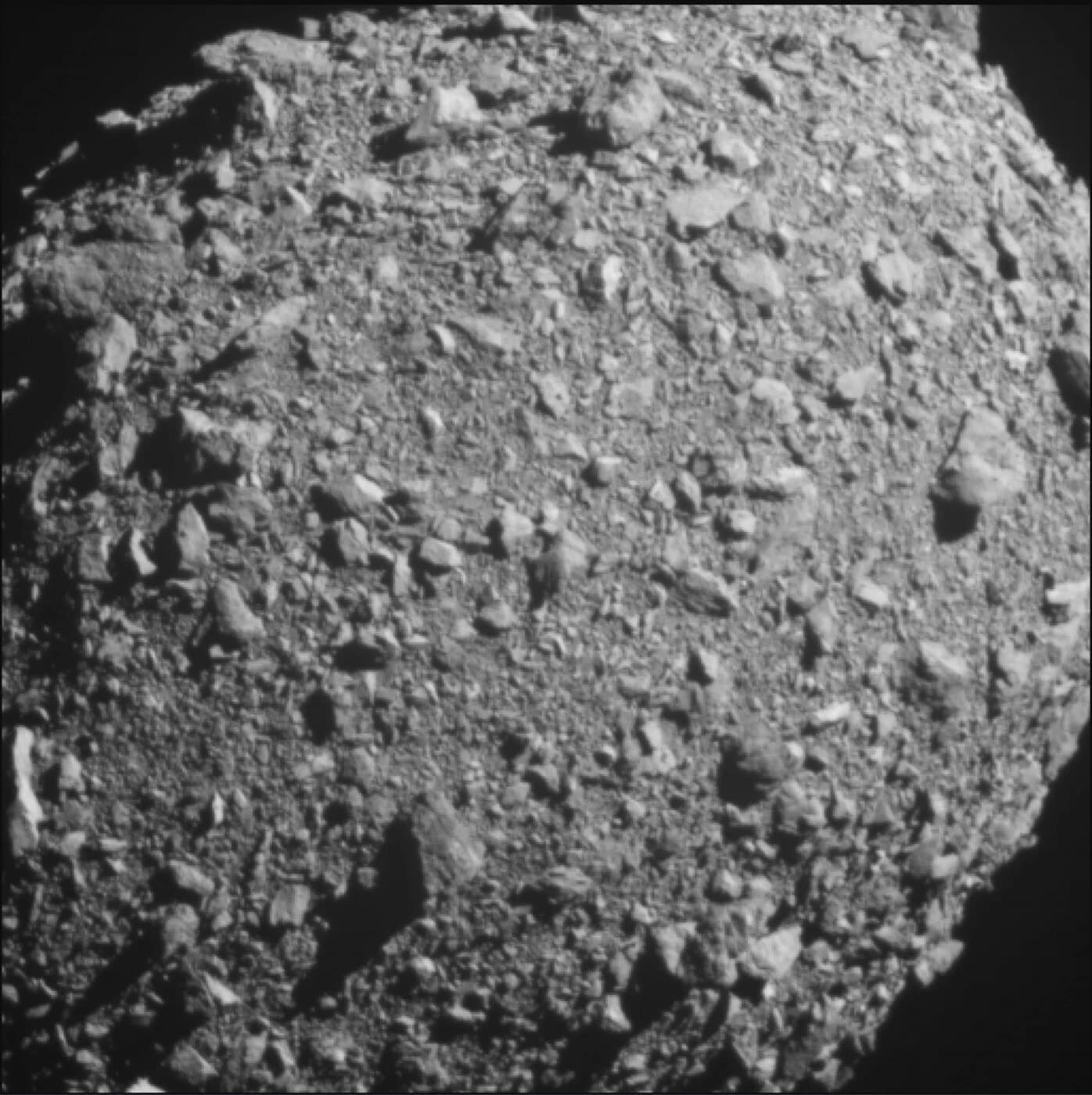
The European Space Agency (ESA) will show the first close-up images of Dimorphos, the small asteroid that NASA deliberately crashed a spacecraft into in 2022, at a live event in Berlin on 25 November 2026. ESA announced the unveiling on 19 November, as MapMyTimes reported. The pictures come from Hera, ESA's first planetary defence mission. Here is what Hera is, why it went back to a four-year-old crash site, and what it could mean for protecting Earth.
What is Hera?
Hera is ESA's first planetary defence mission, sent to study the aftermath of humanity's first attempt to change an asteroid's course. According to ESA, it has reached the binary asteroid system made up of Didymos, about 780 metres across, and its moonlet Dimorphos, about 151 metres across, after a two-year journey through deep space.
The spacecraft carries several instruments. ESA's 17 November update lists the Asteroid Framing Camera, used for both navigation and science; HyperScout H, which looks at the surface in 25 colour bands from red into the near-infrared to help work out what it is made of; and the Thermal Infrared Imager, supplied and operated by the Japan Aerospace Exploration Agency (JAXA), which maps surface temperatures. Hera also carries a pair of shoebox-sized CubeSats.
What did NASA's DART mission do?
NASA's Double Asteroid Redirection Test (DART) spacecraft deliberately crashed into Dimorphos on 26 September 2022, in the first full-scale demonstration of asteroid deflection technology. ESA says it struck at about 6.1 km per second.
NASA confirmed the result on 11 October 2022. In its release, it said the moonlet's orbit around Didymos had shrunk from 11 hours 55 minutes to 11 hours 23 minutes, a change of 32 minutes, with an uncertainty of about two minutes either way. NASA had set 73 seconds as the minimum change that would count as success, so DART beat that benchmark by more than 25 times. ESA now puts the shortening at about 33 minutes.
NASA also stressed that neither asteroid posed any danger to Earth, before or after the collision. Dimorphos was chosen as a safe target for a test, not because it was a threat.
Why is it in the news?
It is in the news because Hera is about to show what the crash site looks like up close. ESA will unveil the images at the Museum für Naturkunde in Berlin between 19:45 and 20:30 CET on 25 November, which is 00:15 to 01:00 IST on 26 November, with a stream on ESA WebTV and ESA's YouTube channel.
Early pictures already give a taste. The Asteroid Framing Camera photographed Didymos from 28.5 km away at a resolution of about 2.7 metres per pixel. Hera principal investigator Patrick Michel, of France's National Centre for Scientific Research (CNRS) and the Observatoire de la Côte d'Azur, described a surface "with boulder-rich area as well as clearer regions and traces of what might be landslides towards its central ridge". He added that "Didymos is spinning very rapidly for its size, rotating every 2.2 hours". Dimorphos itself was almost entirely in shadow in those visible-light images.
What is planetary defence, and how does it affect you?
Planetary defence means finding asteroids that could hit Earth and developing ways to stop them, and Hera's job is to make one of those ways reliable. The "kinetic impact" method DART tested simply rams a spacecraft into an asteroid to nudge its path. ESA says Hera's close-up data is meant to turn that approach into a well-understood technique that could be repeated if it were ever needed.
For people on the ground, the value is in preparation, not an immediate threat. Hera mission manager Ian Carnelli described the aim as "to help make Earth safer." ESA quotes Michel describing the DART experiment as "humankind's first planetary defence test".
What does Hera still need to find out?
Hera's science team wants to learn how the impact changed Dimorphos, how massive the asteroid is, and which of its properties explain how it responded to DART. Those answers matter because the same push could move a solid rock very differently from a loose pile of rubble.
Established: DART hit Dimorphos on 26 September 2022 and shortened its orbit by roughly half an hour; neither asteroid threatens Earth; Hera has arrived and is sending images.
Not yet known: what the new close-ups of Dimorphos show. ESA had not described their contents before the 25 November event.
What happens next?
Over the coming months Hera will fly closer to both asteroids for what ESA calls a "crash site investigation". Early in 2027 its two CubeSats are due to be released to get nearer than the main spacecraft, and ESA says the survey will eventually lead to a landing. "Next week's unveiling is only the start of Hera's exploration," Hera mission scientist Michael Kueppers said.