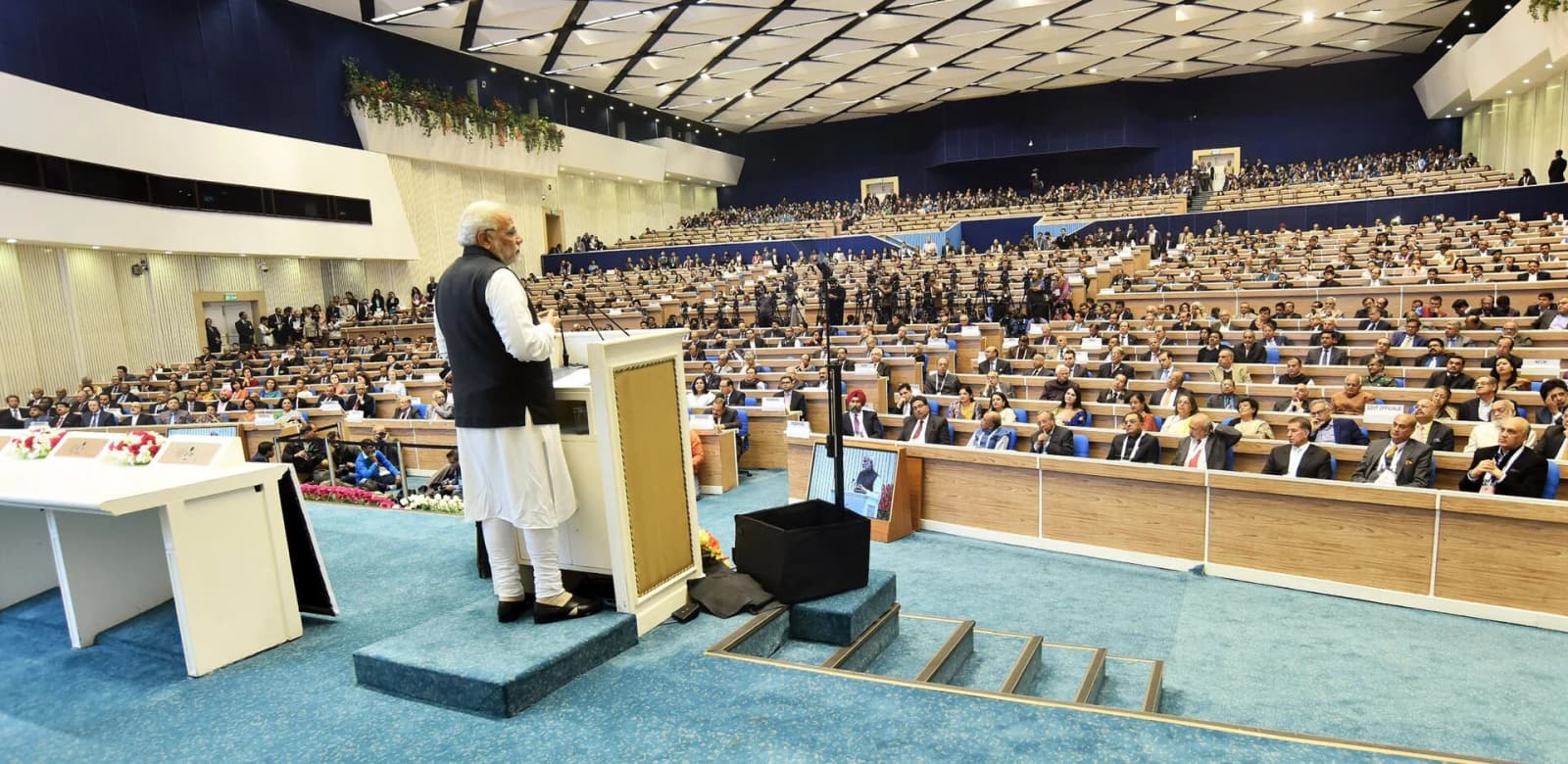
Prime Minister Narendra Modi on 19 November 2026 asked Indian industry to make "India First" the basis of its long-term investment decisions over the next two decades, speaking at the annual general meeting and convention of the Federation of Indian Chambers of Commerce and Industry (FICCI) at Bharat Mandapam in New Delhi. The address, reported by DD News, mixed praise for the chamber's near-century of work with pointed advice to business on imports, quality and consumers.
What did the Prime Minister ask industry to do?
He asked companies to treat the coming 20 years as the period in which they decide what Indian industry can achieve, and to put the national interest at the centre of investment choices, according to All India Radio. He linked this to Mahatma Gandhi's 1930 call for Swadeshi and self-reliance, urging industry to carry that message to every household.
Among the specific points he raised, as reported by DD News:
- Pharmaceutical imports: India is described as the "pharmacy of the world", he said, yet it still imports active pharmaceutical ingredients, bulk drugs and drug intermediates worth billions of dollars every year. He called for that dependence to be reduced.
- Consumers: He warned companies against assuming that India's 140 crore people are a guaranteed market for any product, and criticised the practice of marketing goods as "export quality".
- Agriculture and trade: He urged more industry investment in farming, products designed for overseas demand, and fuller use of the free trade agreements India has signed.
Which economic numbers did he cite?
Mr Modi said India is the fastest-growing major economy, with growth projected at about 7 per cent, and that goods exports in October were close to USD 50 billion, the highest for any month on record. He said Moody's, S&P Global, Fitch, the World Bank and the Asian Development Bank were revising their India growth forecasts upward.
Citing a recent World Bank report, he said about 50 crore Indians had moved out of poverty in the last 12 to 13 years. He contrasted this with the 1970s "Garibi Hatao" era, arguing that poverty could have been tackled then and blaming wrong policies and intent for the failure.
On taxation, he said the basic corporate tax rate had fallen from 30 per cent in 2014 to 22 per cent, that income up to ₹12 lakh is now exempt from income tax, and that refunds which once took eight months now arrive within about a week. He recalled telling Income Tax officials in 2001-02, after becoming Gujarat Chief Minister, not to treat every taxpayer as a thief.
Criticism of earlier governments
The Prime Minister described India's economic past in phases, naming the License Quota Raj, nationalisation, and the period when India was grouped among the "Fragile Five" economies. He told the audience that industry's experience with previous governments had been so bitter that he was now bearing the consequences, and invited business leaders to write to him openly about what needs to change. These are political claims made in a speech; no response from opposition parties had been reported in the sources reviewed.
Why does this FICCI meeting matter?
The convention, themed "Bharat 2047", opens FICCI's centenary phase. The chamber was founded in 1927 and completes 100 years on 7 April 2027, according to a DD News curtain-raiser citing the Prime Minister's Office. It represents more than 2.5 lakh companies directly and through over 300 affiliated associations, and more than 2,500 delegates, including chief executives, diplomats and policymakers, were expected at the event. Sessions were set to cover growth, competitiveness, the next phase of reforms, manufacturing and artificial intelligence.
The speech came a day after Chief Economic Adviser V. Anantha Nageswaran also addressed FICCI, as MapMyTimes reported.
What next
The Prime Minister's remarks on API imports and on using trade agreements are likely to feature in industry follow-ups during FICCI's centenary year. No new scheme or policy measure was announced in the speech, according to the reports reviewed.
Photo source · Prime Minister's Office, GODL-India