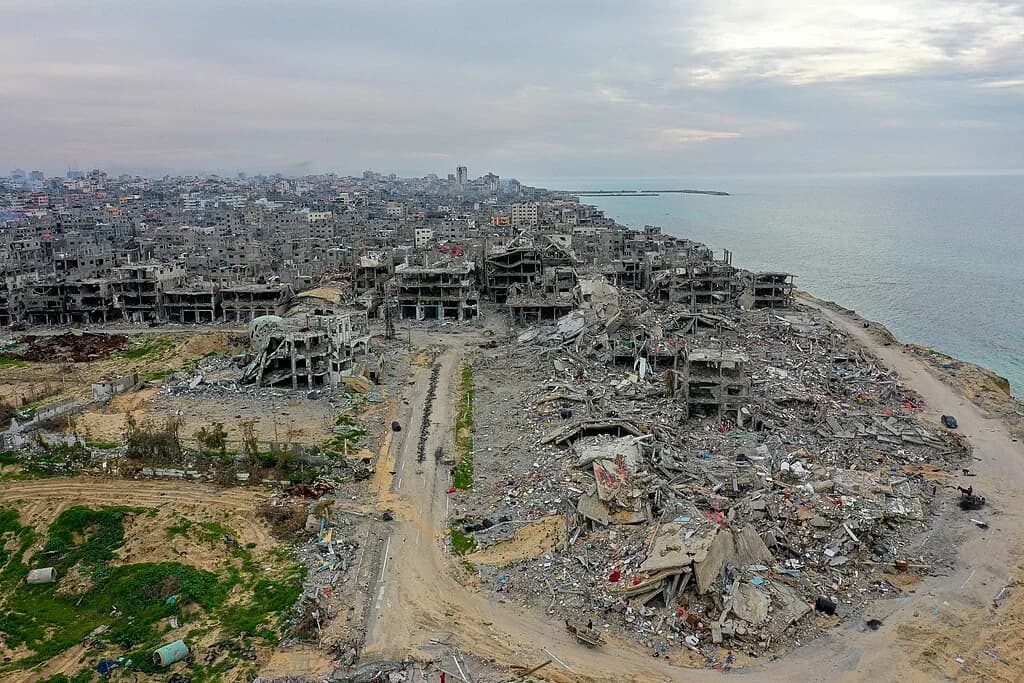
Israel's military campaign in Gaza has left contamination across almost the entire territory, with polluted water, soil and air that could endanger Palestinians for generations, according to a report released on 23 November 2026 by the aid group Oxfam and the UK-based Conflict and Environment Observatory (CEOBS). The report found at least one potential source of contamination across more than 99% of the Gaza Strip, Al Jazeera reported.
What does the report say?
Using satellite imagery, remote sensing, scientific analysis and other open-source data, the report concludes that contamination in Gaza is "widespread, severe and consequential", The Guardian reported. It points to heavy metals, explosive residues, asbestos from destroyed buildings and sewage as the main hazards.
Amitabh Behar, executive director of Oxfam International, described Israel's actions as "environmental war crimes threatening life now and for generations to come". He said people in Gaza were being exposed to toxins "through air, food, water and via direct contact with contaminated soils and debris", and that children and pregnant women faced the highest health risks.
How bad is the damage to water and sanitation?
Very severe, according to figures cited in the report. Al Jazeera reported that daily water supply fell by about 84%, from 334,107 cubic metres before October 2023 to 54,747 cubic metres in June 2024. By April 2026 it had recovered to 130,315 cubic metres, still 61% below pre-war levels. In July 2026, faecal coliform bacteria were found in 15 of 79 wells tested, or 19%, compared with 2% in a 2021 assessment.
All six of Gaza's wastewater treatment plants had been destroyed by April 2024, and about 40,000 cubic metres of raw sewage enter the Mediterranean Sea every day, the report says.
Rubble, farmland and health
The UN Environment Programme estimates that military operations have produced more than 61 million tonnes of debris in Gaza, roughly 29 tonnes for every resident. The report says more than 87% of cropland had been damaged by late 2025 and over one million olive trees had been uprooted by October 2024.
It also records more than 1.9 million cases of acute respiratory infection and about 81,000 cases of acute watery diarrhoea in January and February 2026. The war has killed more than 74,000 Palestinians, including over 1,500 since the October 2025 ceasefire, Al Jazeera reported.
The report's author, Lama Abdul Samad, a global water and sanitation specialist at Oxfam, said clean-up would be "highly challenging" because contamination is spread across rubble, farmland, water systems and soil, while unexploded ordnance blocks safe access to most areas. Abdul Samad called on Israel to allow a detailed on-the-ground environmental assessment.
What does Oxfam want?
Oxfam is calling for a full independent investigation, reparations where violations are established, and a five-stage recovery plan covering reduced exposure, contamination testing, site screening and repairs, treatment of contaminated sites, and rebuilding with long-term monitoring. Behar said environmental recovery must run alongside reconstruction and not be treated "as an afterthought".
What is not yet known
Neither outlet carried a response to the report from the Israeli government or military. The findings rely largely on remote and open-source data, and the authors say an on-the-ground assessment is needed to clarify the risks. Daily violence in the territory continues; read our report on a drone strike on a food van in Gaza City.
Photo source · Abedallah Alhaj/UNRWA, CC BY-SA 3.0 IGO