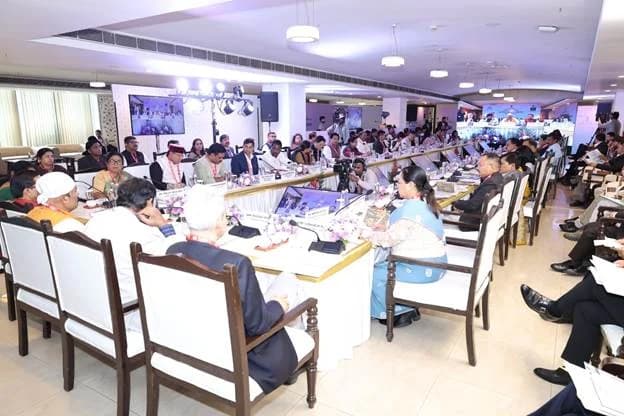
This is a MapMyTimes opinion piece. It responds to the action points agreed by the Centre and states at 'Samaveshi Niti Sankalp 2026', the two-day summit of the Ministry of Social Justice and Empowerment at Sushma Swaraj Bhawan in New Delhi, whose plenary session Prime Minister Narendra Modi chaired on 19 November 2026. We first reported the summit's outcomes here.
Among the commitments, one stands out because it can be counted: at least one de-addiction centre in every district by March 2029. It is a welcome target. Our view is that the country should also decide now how it will judge whether those centres actually help people recover, and publish that yardstick alongside the count.
What did the Centre and states agree?
They agreed on a set of time-bound steps for drug demand reduction. According to the Press Information Bureau release of 20 November 2026, the session on prevention, chaired by Himachal Pradesh minister Dr (Col.) Dhani Ram Shandil and co-chaired by Rajasthan minister Avinash Gehlot, listed three key action points: observing the 10th of every month from December 2026 as 'Nasha Mukti Sankalp Diwas'; making drug prevention a permanent agenda item in every gram sabha and municipal ward meeting; and setting up at least one de-addiction centre in every district by March 2029.
The Prime Minister called for the Nasha Mukt Bharat Abhiyaan to become a nationwide 'Jan Andolan', asked schools to run awareness activities and urged that parents be helped to spot early signs of substance abuse. He also stressed rehabilitation and reintegration, saying, according to PIB, that people who have overcome dependence show "that recovery is possible and that a life free from drugs is a life of dignity".
Why a count of centres is not enough
That last point is the right test for the district target. A building with a signboard is not the same as a place where a person can get sustained, respectful help and then find their way back to work, school and family. If March 2029 arrives with every district ticked off but no shared standard for what a centre must offer, the target will have been met on paper while the people it was meant for may still fall through the gaps.
The summit itself offers a starting point. PIB lists Haryana's 'Stars Rating' initiative for rehabilitation centres among the state practices shared at the meeting, alongside Chandigarh's Wada Club, Punjab's Soorma Ambassadors, Meghalaya's Dream Souls Home and Jammu and Kashmir's 100-day campaign. A rating approach, whatever its final design, points in the right direction: it asks how good a centre is, not merely whether it exists.
The strongest case against our view
There is a serious argument on the other side. Many districts may have little or no dedicated capacity today, and a simple, countable goal is what gets money sanctioned and officials moving. Adding quality benchmarks now, the argument goes, could slow the rollout, burden smaller states and turn a clear deadline into a paperwork exercise. Better to build first and improve later.
We take that seriously. Speed matters, and a perfect framework that delays every centre would help no one. But the two are not in conflict if the measures are kept few and simple. A centre that opens without basic standards may be harder to fix later than one that opens with them, and families deciding whether to trust a centre deserve to know what it offers.
What should happen next?
Minister of State B.L. Verma said the summit's conclusions would help shape a national action plan, according to PIB. That plan is the natural place to settle a few things before the building programme gathers pace:
- A short, common minimum standard for what every district centre must provide, developed with states rather than imposed on them.
- A public, district-wise progress tracker showing not only which districts have a centre but what services each one offers.
- A plain-language rating or review system, building on ideas such as Haryana's, so that families can make informed choices.
- A link to reintegration, so that recovery is followed up through the gram sabha and ward meetings that the summit has already put at the centre of prevention.
The summit has given India a date and a number. The national action plan can now give it a measure of success that matches the Prime Minister's own words about recovery and dignity. If the centres of 2029 are judged by the lives they help rebuild, the target will have been worth setting.
Photo source · Press Information Bureau