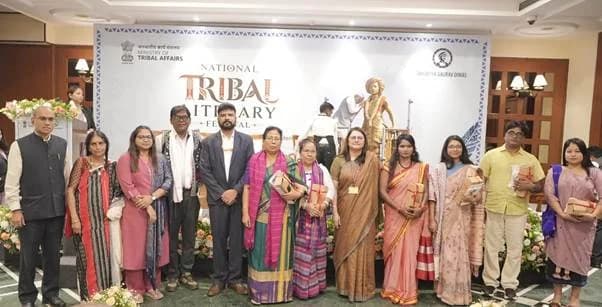
A two-day National Tribal Literary Festival organised by the Union Ministry of Tribal Affairs ended in New Delhi on Friday, 13 November, with calls to document oral epics, bring tribal languages into classrooms and open up publishing and university syllabi to tribal writers. The ministry said the festival, held at the India Habitat Centre, featured 27 languages, 23 of them tribal.
Held as part of the Janjatiya Gaurav Diwas celebrations, the festival ran on the theme "From Oral Tradition to Contemporary Tribal Literature" and gathered tribal writers, poets, researchers, linguists and scholars from across the country, according to a ministry release issued on Saturday.
Gond Ramayana, Bhil Mahabharata and Manipur's storytellers
The final day opened with a session on oral epics and heroic traditions, moderated by Prakash Jha, with Bhagwandas Patel, Upendra Anu and Mayanglambam Sadanand Singh. They discussed the oral literature of the Bhil and Gond communities, including the Gond Ramayana and the Bhil Mahabharata, as well as Manipur's Wari Leeba storytelling tradition and the Khamba-Thoibi epic. Speakers stressed recording these traditions on audio and video and through research, and recognising community storytellers as keepers of this heritage, the ministry said.
Mother tongues in the classroom
A second session examined how indigenous languages and community knowledge can make education more inclusive. Moderated by Dr K. Srinivasa Rao, former Secretary of the Sahitya Akademi, it featured Anil Kumar Boro, Sylvanus Lamare and Parvati Tirkey. The panel argued that oral narratives, traditional songs and community stories can enrich learning and strengthen children's bonds with their mother tongues, particularly in early childhood education, and discussed how documentation, translation and technology can support tribal languages.
New voices on stage
The last two sessions were given over to readings. In a story-reading session chaired by Mahadev Toppo, Neeta Kusum Bilung, Ramesh Karthik Nayak and Vasanth Kumar V.P. presented their work. A poetry session moderated by Jogamaya Chakma featured K. Vasamalli, Kriri Mog Chowdhury, Babu Sangda, Hirjir Ingti Katharpi, Gopi Krishna Soni, Marina Ekka, Sudha Chauhan and Anjali Belagal reciting original compositions on community life, memory, identity and present-day social realities.
Book fair space and music rights
At the valedictory session, Tribal Affairs Secretary Ranjana Chopra said lasting platforms are needed to promote tribal literature, support authors writing in indigenous languages and link them with publishers and readers. She pointed to two ministry initiatives:
- Living Roots Originals, developed with the Indian Performing Right Society (IPRS), to recognise and protect the creative rights of tribal musicians and performers.
- A dedicated tribal literature section at the National Book Trust's upcoming book fair at Pragati Maidan, where tribal authors and publishers can showcase their work.
Why it matters
Summing up, Dr Rao described tribal literature as an integral part of India's cultural heritage and said it needs a bigger place in university curricula, translation programmes and mainstream publishing to reach wider audiences. With the festival centred on oral tradition, documenting and recording these works came up across several sessions.
Deputy Secretary Ganesh Nagarajan, in his closing remarks, noted what he called a significant expansion of the ministry's cultural, linguistic and livelihood initiatives over the past year. The ministry said the festival reaffirmed its commitment to bringing indigenous literary voices into the national conversation. The next visible step for readers will be the tribal literature section at the National Book Trust fair in Pragati Maidan.
PS · Photo: PIB