Indian households now pay for a markedly smaller share of the country's health bill out of their own pockets, according to the National Health Accounts (NHA) Estimates for India 2023–24, released by the Union Ministry of Health and Family Welfare on Sunday, 15 November 2026.
The estimates show that out-of-pocket expenditure (OOPE) — money families spend directly at the point of care — fell to 42.7% of total health expenditure in 2023–24, down from 64.2% in 2013–14. That is a drop of 21.5 percentage points over the decade, the ministry said in its release.
Government spending more than triples
Over the same ten-year period, government health expenditure rose from ₹1,29,778 crore in 2013–14 to ₹4,14,196 crore in 2023–24, roughly a threefold increase. The government's share of total health expenditure went up by 14.9 percentage points, which the ministry described as an increase of nearly 52%.
On a per-person basis, public spending on health climbed from ₹1,042 to ₹2,959, about 2.8 times the 2013–14 level.
The most recent year also continued the trend. According to the ministry, the out-of-pocket share edged down from 43.4% in 2022–23 to 42.7% in 2023–24.
Primary care and insurance
Government expenditure on primary healthcare stood at about ₹1.53 lakh crore in 2023–24, the estimates show. The ministry linked this to the expansion of Ayushman Arogya Mandirs, which offer preventive care, screening for non-communicable diseases, essential medicines and diagnostics at the community level.
Social security expenditure on health — which includes government-funded insurance such as Ayushman Bharat–Pradhan Mantri Jan Arogya Yojana (AB PM-JAY), state insurance schemes, social health insurance and medical spending for government employees — rose from 6% to 11% of total health expenditure.
Private health insurance spending also grew, from 3.4% of total health expenditure in 2013–14 to 10.2% in 2023–24, which the ministry said points to deeper insurance penetration.
Why the numbers matter
Out-of-pocket spending is closely watched because it measures how exposed families are to the cost of illness. When a large part of the health bill is paid directly by patients, a hospital stay or long treatment can strain household finances. A falling OOPE share, alongside a rising public share, generally indicates stronger financial protection.
Even so, the latest figure means that families still directly pay for more than two of every five rupees spent on health in India, according to the estimates.
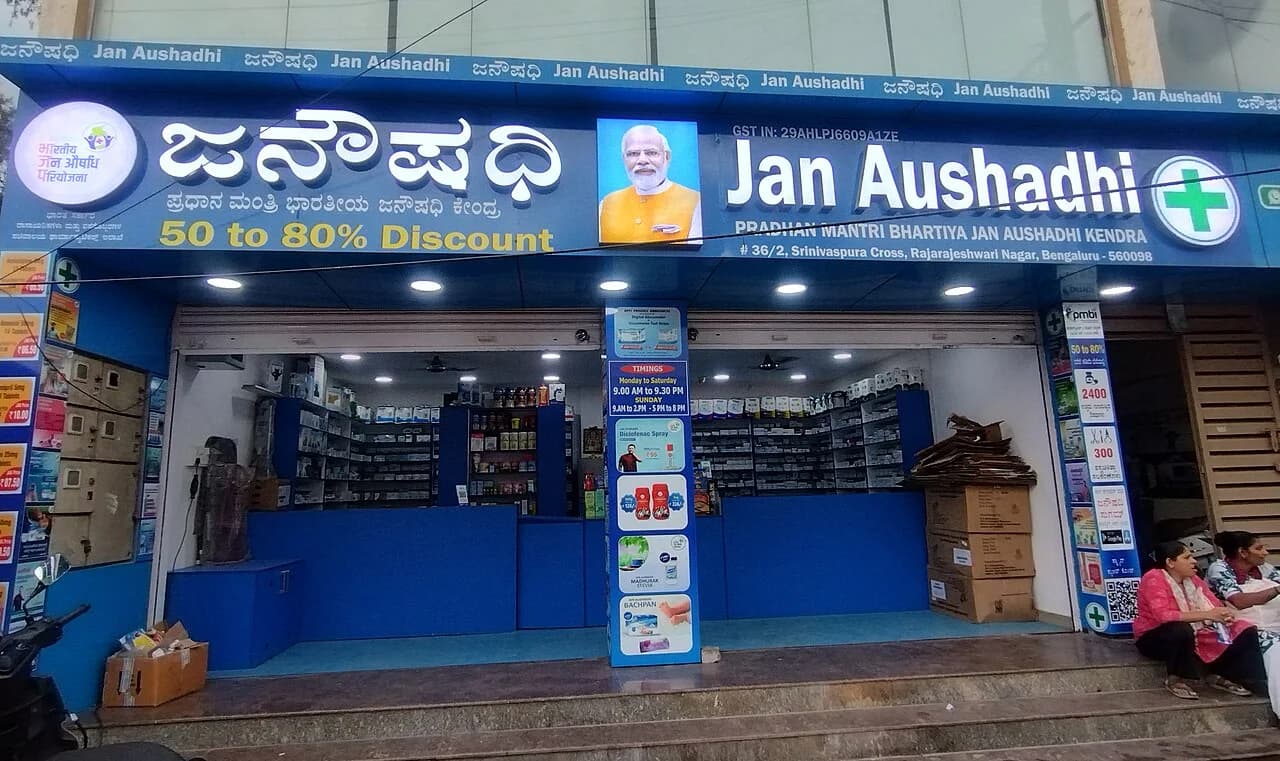
The ministry credited several programmes for the shift, including free drugs and diagnostics initiatives, the Pradhan Mantri National Dialysis Programme, Pradhan Mantri Bhartiya Janaushadhi Pariyojana generic medicine stores, AMRIT pharmacies and drug price regulation by the National Pharmaceutical Pricing Authority.
About the estimates
This is the eleventh round of NHA estimates, prepared by the National Health Accounts Technical Secretariat at the National Health Systems Resource Centre (NHSRC) under the health ministry. The accounts follow the internationally used System of Health Accounts 2011 framework, the ministry said.
The full 2023–24 estimates are available on the NHSRC website. Note that the data cover the financial year 2023–24; the effect of more recent policy changes will appear only in later rounds.
PS · Gpkp, CC BY-SA 4.0