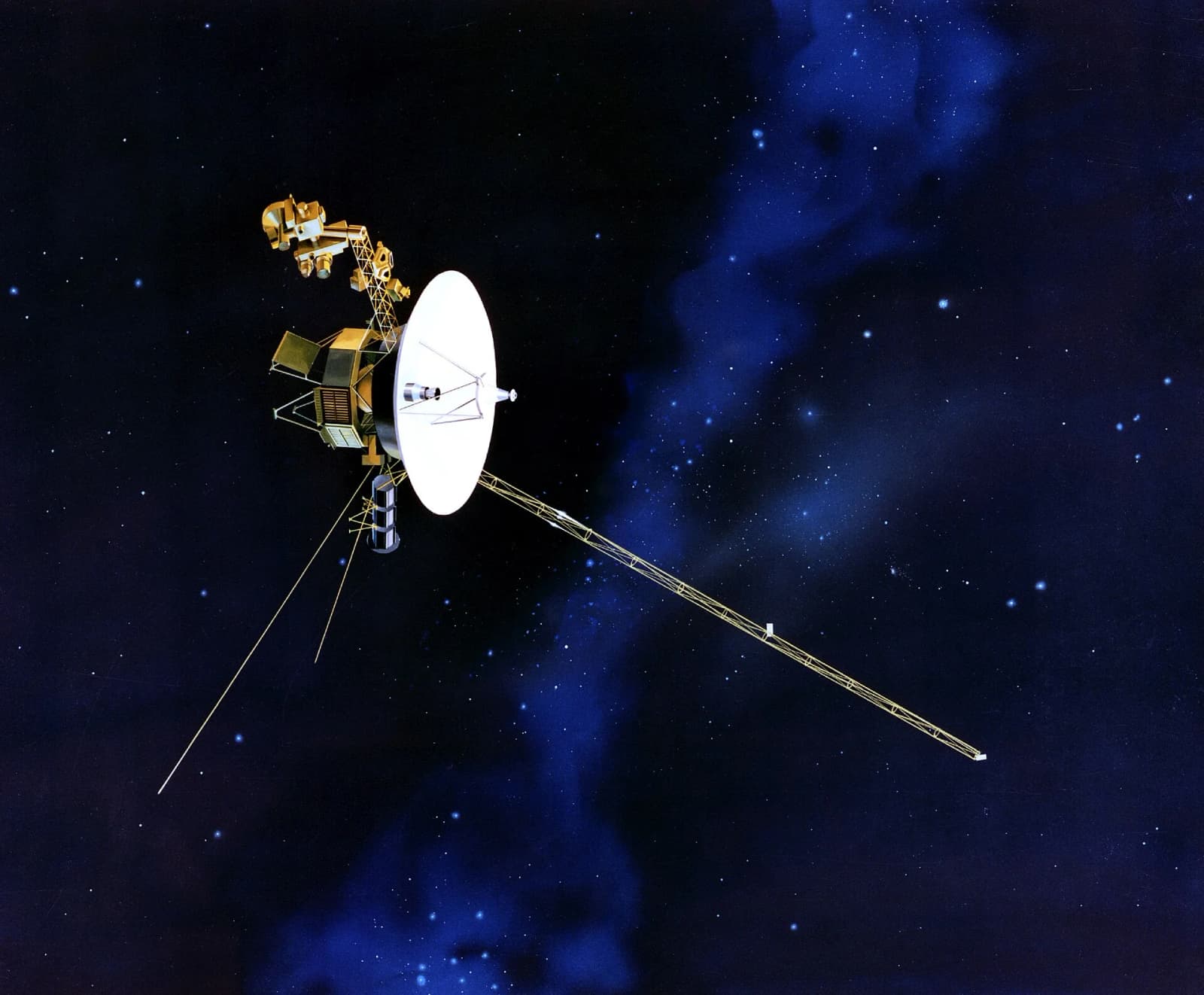
NASA's Voyager 1 spacecraft has become the first human-made object to reach a distance of one light-day from Earth — roughly 16.1 billion miles (25.9 billion kilometres) away — meaning radio signals now take a full 24 hours to travel one way between mission controllers and the interstellar probe, NASA announced on November 25, 2026.
Crossing the 24-Hour Signal Threshold
Voyager 1 passed the mathematical mark at 2:16 a.m. PST (5:16 a.m. EST) on November 18, 2026, and engineers at NASA's Jet Propulsion Laboratory (JPL) in Southern California confirmed the milestone 24 hours later upon receiving its carrier signal. Mission teams are investigating a brief pause in science and engineering telemetry that began on November 14 while keeping steady tracking links active.
Launched in 1977, Voyager 1 is speeding outward through interstellar space at about 38,000 mph (61,155 kph) after exiting the heliosphere in 2012. Its twin probe, Voyager 2, entered interstellar space in 2018 and is projected to cross the one light-day threshold around November 2035.
Cosmic Scale and Scientific Legacy
To put the milestone in perspective, sunlight takes just 1.3 seconds to reach the Moon and roughly four hours to reach Neptune, compared with 24 hours to Voyager 1 — while one light-year spans 5.88 trillion miles (9.46 trillion kilometres). NASA Heliophysics Division Director Joe Westlake, JPL Director Dave Gallagher, and Caltech President Ray Jayawardhana hailed the 49-year mission as a defining feat of human exploration.