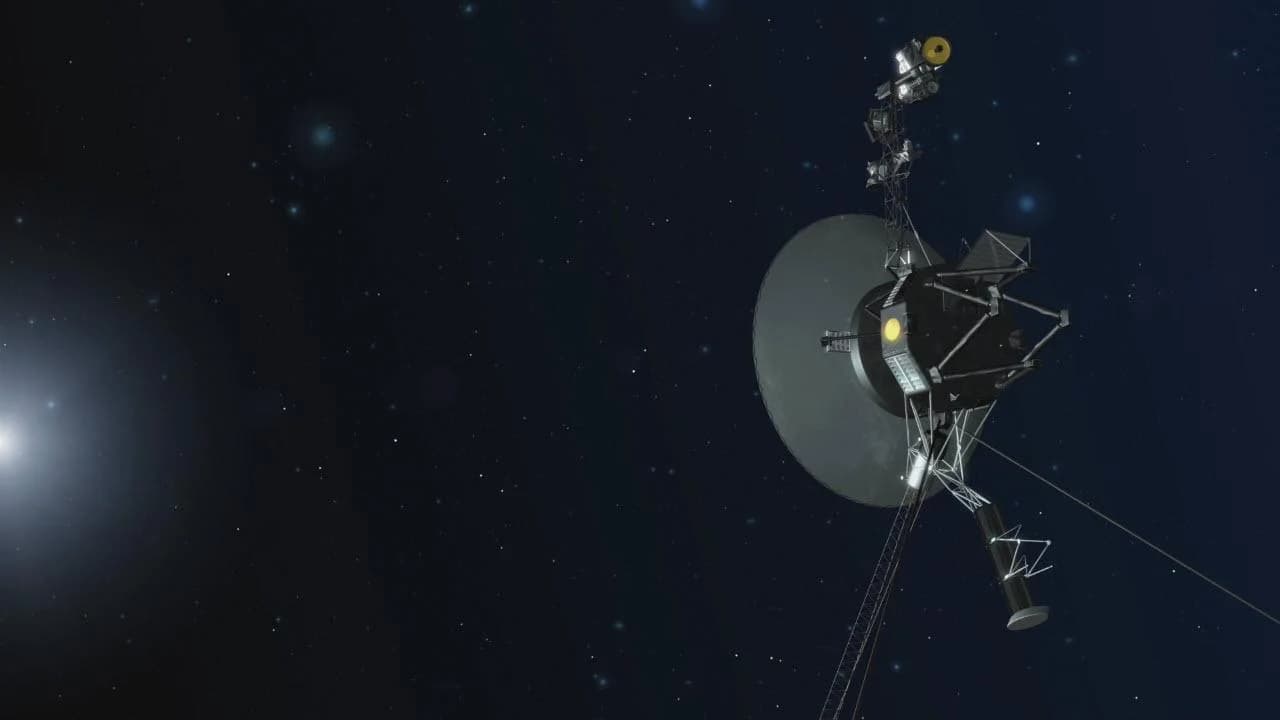
NASA's Voyager 1 spacecraft has become the first human-made object to reach one light-day from Earth, the United States space agency said on 19 November 2026. According to NASA's news release, the probe crossed the mark at 2:16 a.m. Pacific time (5:16 a.m. Eastern time, or 3:46 p.m. IST) on 18 November 2026, more than 49 years after it was launched from Cape Canaveral, Florida.
What is a light-day?
A light-day is the distance light travels in 24 hours, about 25.9 billion kilometres (16.1 billion miles), according to NASA. At that distance a radio signal from Voyager 1 takes a full day to reach Earth, and a command sent from Earth takes another day to arrive, so any exchange with the spacecraft now has a round-trip delay of about two days.
For comparison, NASA says a light-year, the unit astronomers use for distances to stars, is about 9.46 trillion kilometres. Voyager 1 is travelling at about 61,155 km per hour, the agency said.
How did NASA confirm the milestone?
The mission team at NASA's Jet Propulsion Laboratory (JPL) in southern California heard from the probe 24 hours after the crossing, the time its radio signal needed to reach Earth. NASA said the milestone was confirmed using the spacecraft's carrier signal and trajectory calculations, with contact made through the agency's Deep Space Network of large antennas at three sites around the world.
Joe Westlake, director of the Heliophysics Division at NASA Headquarters, said in the release: "Traveling a light-day is a singular feat for a spacecraft, but Voyager is so much more than a distant traveler." Suzanne Dodd, Voyager project manager at JPL, said: "We listen to Voyager 1 every day and send commands to the spacecraft weekly."
Is Voyager 1 still sending data?
Not at the moment. NASA said the team has not received science or engineering data from Voyager 1 since 14 November, and engineers are still analysing the problem. The milestone itself was confirmed from the carrier signal rather than from data.
The ageing probe runs on a radioisotope thermoelectric generator, which turns heat from decaying plutonium into electricity. NASA says both Voyager probes lose about 4 watts of power a year. Earlier in 2026, engineers switched off three devices on Voyager 1 and replaced them with lower-power alternatives, a move the agency described as risky. Only two of the spacecraft's original 10 science instruments are still working, according to a blog post by the Smithsonian's National Air and Space Museum.
Background: two probes, one alignment
Voyager 1 and its twin Voyager 2 were launched in 1977 to take advantage of a rare alignment of the outer planets, NASA says. Voyager 1 lifted off on 5 September 1977, 16 days after Voyager 2, but later overtook it, according to the National Air and Space Museum. Voyager 2 crossed into interstellar space in 2018 on a different path, after studying Uranus and Neptune earlier in its mission. Both probes continue to measure changes in the Sun's magnetic field.
Why it matters
Voyager 1 is the most distant spacecraft humans have built, and it is still sending back information from interstellar space, the region beyond the bubble created by the Sun's wind. Every day of operation adds measurements no other mission can make, which is why NASA has been switching systems off one by one to stretch its limited power.
What is confirmed and what is not
- Confirmed: Voyager 1 passed one light-day from Earth on 18 November 2026, and NASA received its carrier signal a day later.
- Not yet confirmed: the cause of the break in science and engineering data since 14 November, and when normal data return will resume.
What happens next
NASA says its latest energy-saving work is meant to keep the current science instruments on both probes running until at least their 50th launch anniversaries in 2027: 20 August for Voyager 2 and 5 September for Voyager 1, according to the National Air and Space Museum. The museum says scientists may receive the last signal from the spacecraft within the next decade. NASA has not given a date for when contact will end.
Photo source · NASA/JPL-Caltech, NASA media usage guidelines