The US space agency NASA on 18 November 2026 opened a new prize competition that asks American companies to design and build prototype mid-power Hall effect thrusters, a type of electric propulsion. The contest, called the Advanced Mid-Power Electric Rocket (AMPERE) Challenge, carries a total purse of $500,000 and is the first contest in NASA's new Tech Maturation Prize series, the agency said in an announcement.
What is the AMPERE Challenge?
It is a staged competition in which only US companies can take part. NASA wants industry to turn its electric propulsion know-how into thrusters that can be built and sold commercially. Up to two winning teams can each receive as much as $250,000.
The challenge is managed jointly by NASA's Glenn Research Center in Cleveland, Ohio, and the Jet Propulsion Laboratory (JPL) in southern California. It is funded by NASA's Research and Technology Mission Directorate. A firm called Yet2 runs the contest under a contract with the NASA Center of Excellence for Collaborative Innovation.
How will the three phases work?
- Phase 1: Teams send in a concept design along with a manufacturing plan and projections of cost and performance. NASA may pick two of them to go forward.
- Phase 2: The selected teams build prototypes while working with NASA staff. They can get licences, at no cost, to Hall thruster technologies developed by NASA that run on krypton propellant.
- Phase 3: The finished prototypes are tested at NASA Glenn, again free of charge for the teams.
What is a Hall thruster and why does it matter?
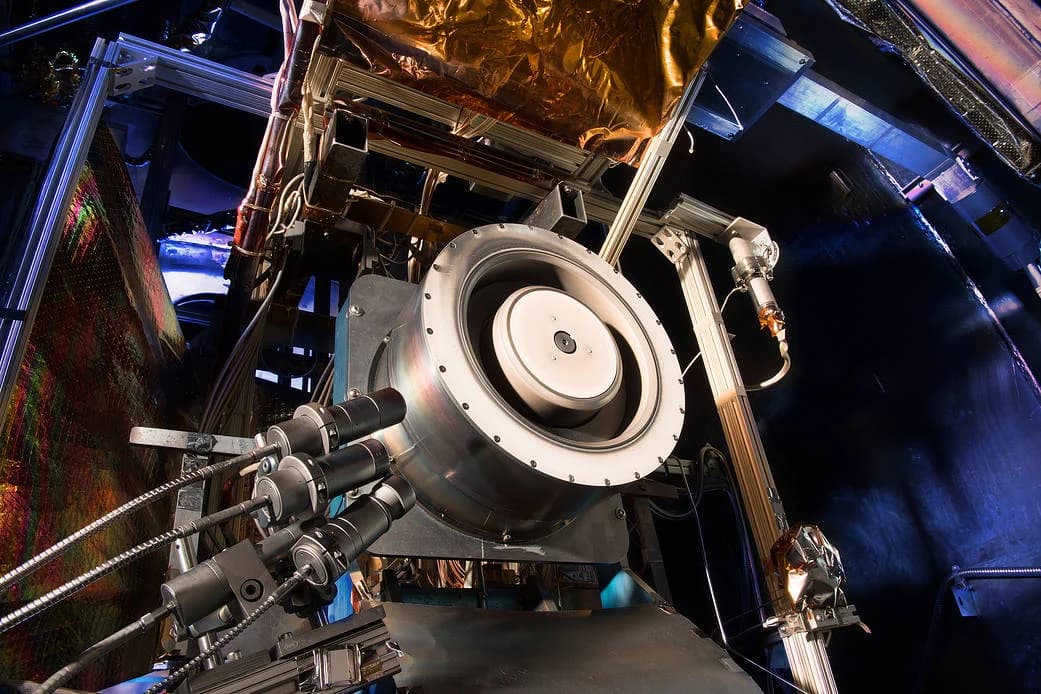
A Hall thruster is an electric engine for spacecraft. NASA describes this class of propulsion as important for future operations in space. In the caption of a file photograph accompanying the announcement, the agency notes that a Hall thruster forms part of a solar electric propulsion system that uses ten times less propellant than an equivalent chemical rocket. Lower propellant needs can make long missions lighter and cheaper to run.
By offering licences to its own krypton-fuelled designs and free use of its test facilities, NASA is trying to lower the cost and technical risk that usually keep companies from bringing such engines to market.
What has NASA said?
Dr Jason Frieman, AMPERE project co-owner at NASA Glenn, said in the release:
"This challenge approach seeks to remove key barriers and facilitate commercialization."
He added: "We hope participants will see this as an opportunity to demonstrate their capabilities to NASA."
Key dates
Registration is open until 5 pm Eastern Standard Time on 27 January 2027. NASA is also holding a virtual industry day for the challenge on Thursday, 19 November 2026, for companies that want to learn more. The full eligibility conditions and rules are published on the official AMPERE challenge website.
Why it matters beyond the US
The contest is closed to companies outside the United States, so Indian firms cannot enter. Still, it signals where large space agencies are heading: electric propulsion is increasingly seen as a practical way to move satellites and future deep-space craft with far less fuel, and NASA is now using prize money rather than conventional contracts to push the technology towards commercial production. NASA's prize programmes have drawn wide participation before, including the record-breaking Space Apps Challenge 2026, in which ISRO was a partner agency.
NASA has not yet said when Phase 1 winners will be named or when prototype tests at Glenn are expected to take place.
Photo source · NASA/Michelle M. Murphy