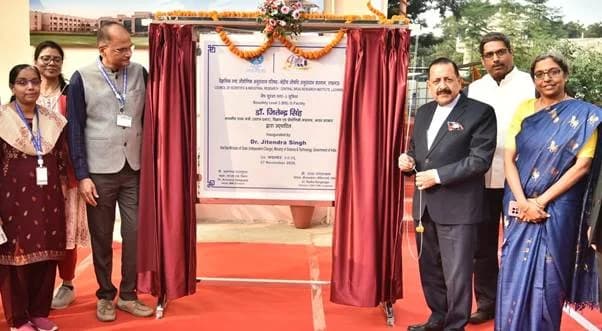
Union Minister of State (Independent Charge) for Science and Technology Dr. Jitendra Singh on 27 November 2026 opened a new Biosafety Level-3 (BSL-3) and Animal Biosafety Level-3 (ABSL-3) laboratory at CSIR-Central Drug Research Institute (CDRI) in Lucknow, Uttar Pradesh. The high-containment facility is meant for research on Mycobacterium tuberculosis and non-tuberculous mycobacteria, according to a release issued by the Ministry of Science and Technology.
The minister, who is also Vice President of the Council of Scientific and Industrial Research (CSIR), used the event to argue that India's drug industry should shift from being a major supplier of generic medicines to discovering new ones. He also inaugurated the Dr. B. Mukerji Lecture Theatre on the campus.
What will the new BSL-3 laboratory be used for?
The laboratory will let CDRI scientists work safely with tuberculosis bacteria and related non-tuberculous mycobacteria (NTM), including in animal studies. The ministry said the facility strengthens the institute's capacity to study challenging infectious diseases.
At the same event, CDRI signed collaboration agreements with the ICMR-National Institute of Research in Tribal Health in Jabalpur, the Uttar Pradesh University of Medical Sciences in Saifai, and Medanta Hospital in Lucknow. Dr. Singh said he expected the partnerships to speed up clinical translation of the institute's research.
Why does the minister want India to move beyond generics?
Dr. Singh said India ranks third in the world in pharmaceutical production by volume and 11th by value. According to the release, Indian firms meet more than half of Africa's demand for generic medicines and around 40 per cent of generic drug demand in the United States.
The next phase, he said, has to involve climbing the value chain to develop original therapies. He described drug discovery as costly and high-risk, and said public research institutions should generate strong proof-of-concept data on new targets while companies take promising candidates through clinical trials and to market. He called for better technology-transfer mechanisms, earlier industry involvement and wider use of artificial intelligence alongside biology, chemistry and computational science.
"At every stage of drug discovery and development, the ultimate beneficiary must be the patient," the minister said, according to the ministry.
What has CDRI delivered so far?
The ministry listed the institute's record as follows:
- 13 drugs that have reached the market and more than 80 licensed process technologies, plus six diagnostic technologies
- Over 12,000 research papers, more than 456 international patents and 586 Indian patents
- A compound library of roughly 90,000 molecules and more than 50 animal models
- More than 2,000 PhDs and over 10,000 trainees trained
Dr. Singh pointed to Centchroman (Ormeloxifene), a non-steroidal, once-a-week oral contraceptive developed at CDRI and added to the National Family Planning Programme in 2016. Over the past five years, more than 350 lakh strips have been distributed free through ASHA workers, and the current user base exceeds five lakh women, the release said.
What is in the pipeline?
A standardised extract of the herb Picrorhiza kurroa for metabolic dysfunction-associated steatotic liver disease (MASLD, formerly called non-alcoholic fatty liver disease) has completed Phase III trials, according to the ministry. Two other CDRI compounds, L-Ormeloxifene for contraception and S007-1500 for fracture healing, are in Phase I trials. The institute is also working on leads for malaria, cancer, neuropathic pain and age-related macular degeneration.
The minister noted CDRI's existing tie-ups with companies including Zydus, Cipla, Dr. Reddy's Laboratories, Himalaya and Themis Medicare, and urged it to deepen its role as a research partner for industry. The release did not give the cost of the new laboratory or a date for the first studies there.
The launch adds to a run of Indian research announcements in the pharmaceutical space this week, including NIT Rourkela's work on turning discarded pharma proteins into a wound-healing gel.