Researchers at the National Institute of Technology (NIT) Rourkela in Sundargarh district, Odisha, have turned proteins that drug makers usually throw away into a soft, water-absorbing gel that could one day be used to treat wounds, according to a release issued by the Press Information Bureau (PIB) in Bhubaneswar on 26 November 2026. The work was led by Prof. Harekrushna Sahoo, Prof. Monalisa Mishra and Prof. Devendra Verma.
What have the NIT Rourkela researchers made?
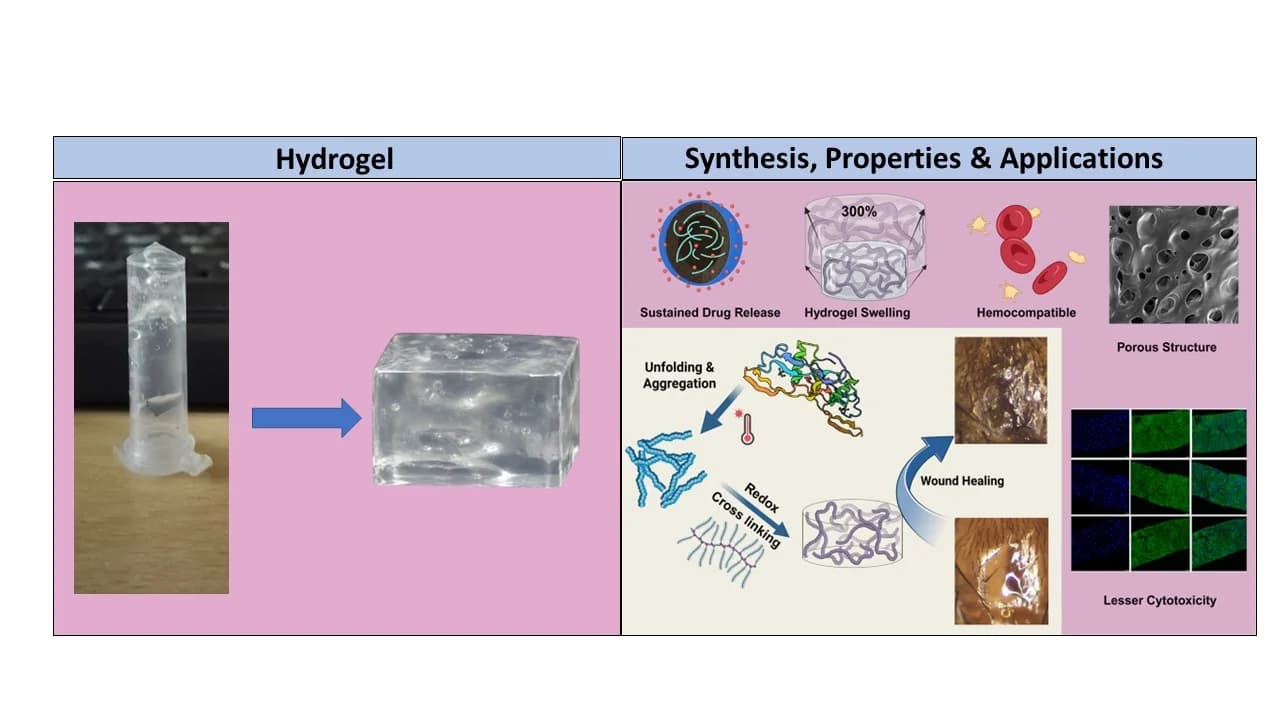
They have made a hydrogel, a jelly-like material full of tiny pores, from protein that had lost its useful shape. According to the institute, the gel can soak up water, hold medicines and interact with body tissue, which is why the team sees possible uses in wound healing, tissue regeneration and drug delivery.
Why do companies discard these proteins?
Proteins are fragile, and heat, chemicals or rough processing can make them unfold and lose their three-dimensional structure. The release explains that unfolded proteins tend to stick together into clumps called aggregates and stop working, so pharmaceutical and biotechnology firms generally discard them. The NIT Rourkela group set out to find a second life for this waste.
How does the process work?
The team worked with a protein called BMP-2. As described in the release, they heated it to about 85°C for ten minutes so that it unfolded, used chemical reactions to make the unfolded protein clump, and then added hydrogen peroxide and hyaluronic acid to turn those clumps into a gel.
Prof. Sahoo, of the Department of Chemistry, credited the combined effect of BMP-2 and hyaluronic acid, saying the acid's ability to retain water improved the gel's structure, its antioxidant activity and the slow, steady release of drugs.
What did the early tests show?
In laboratory tests, the researchers loaded the gel with the antibiotic ampicillin and checked how it released the drug, which they say points to possible use in targeted drug delivery. The gel also supported the growth of fibroblasts, the cells that help wounds close.
Wound-healing tests were carried out in fruit flies (Drosophila melanogaster). Prof. Mishra, of the Department of Life Sciences, said the results in this model were promising but that the gel's compatibility with the body still has to be proven in higher animals before any clinical trial.
Is it ready for patients?
No. The findings so far come from laboratory and fruit-fly studies only. Prof. Verma, of the Department of Biotechnology and Medical Engineering, said proving safety in higher animal models could take 10 to 12 months, and only if the gel is shown to be non-toxic would the path to clinical trials open. The team's next step is to build biological models to test how safe and effective the gel is as a therapy.
Where has the research been published?
The findings have appeared in the Royal Society of Chemistry's Journal of Materials Chemistry B (2026), according to the release. It also says the team has secured an Indian patent for the technology, citing application number 202531107839, dated 6 November 2025.
Why does it matter?
If later tests succeed, the approach could turn a waste stream from medicine manufacturing into a useful biomaterial. The institute describes the work as a step towards sustainable materials for wound care and tissue repair, though it remains at an early research stage.
Photo source · PIB / NIT Rourkela, GODL-India