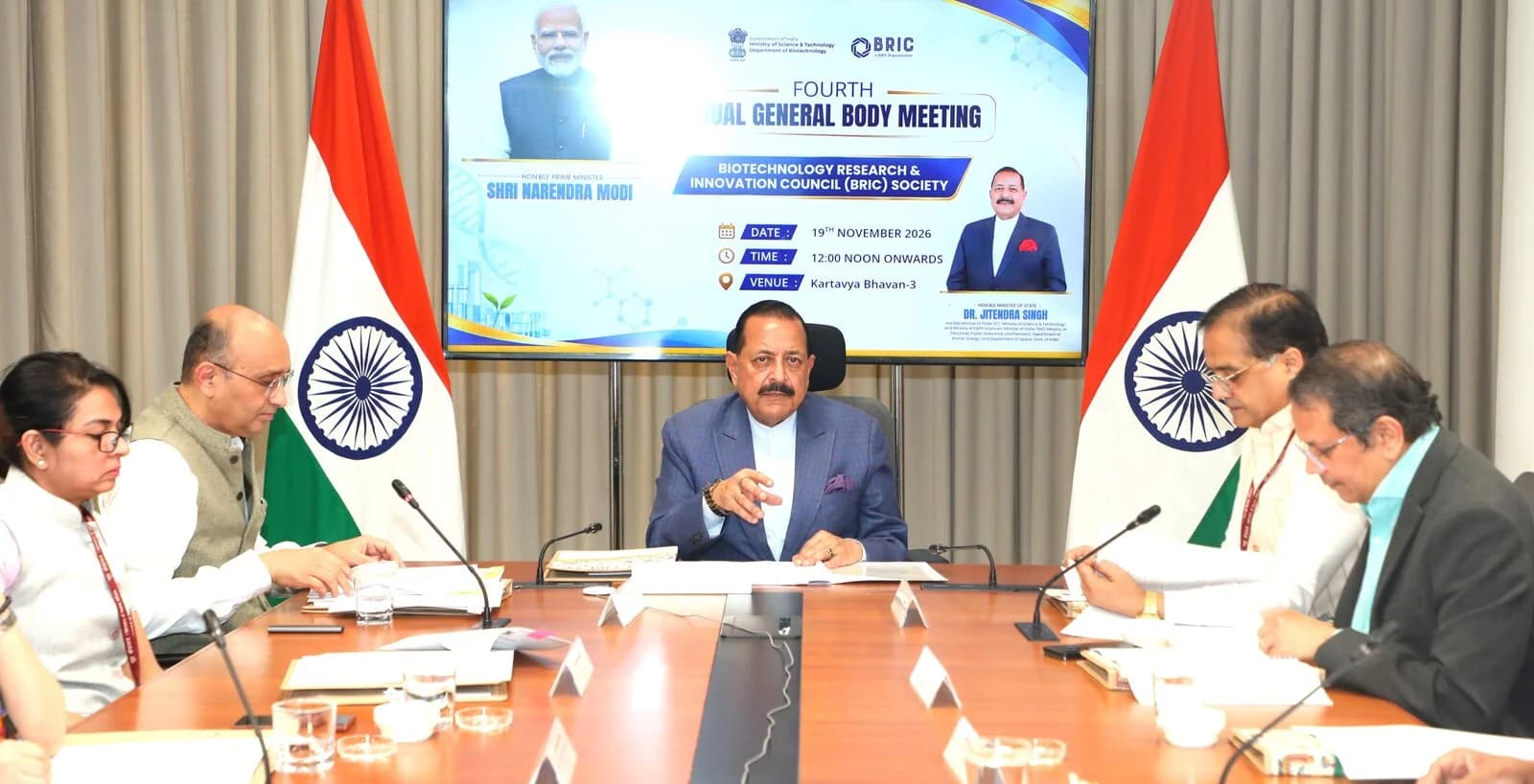
Union Minister Dr. Jitendra Singh has said the Biotechnology Research and Innovation Council (BRIC) is working towards a USD 300 billion Indian bioeconomy by 2030 and USD 1 trillion by 2047, according to a statement issued by the Press Information Bureau (PIB) on 21 November 2026. He made the remarks while chairing the fourth Annual General Meeting of the BRIC Society at Kartavya Bhawan in New Delhi.
Dr. Singh is Minister of State (Independent Charge) for Science and Technology and Earth Sciences, and also President of the BRIC Society. The PIB statement describes his remarks as made "today", while the meeting banner seen in official photographs carries the date 19 November 2026.
What is BRIC and why was it created?
BRIC is a council that brings the Department of Biotechnology's research institutions under one umbrella so they can share resources, run joint science and work under integrated governance while keeping their individual strengths. Dr. Singh called the integration one of the first initiatives of its kind in the Government of India and said it has since inspired similar approaches in other organisations.
Dr. Rajesh S. Gokhale, Secretary of the Department of Biotechnology (DBT) and Director General of BRIC, presented the council's achievements to members, some of whom joined online. The meeting reviewed institutional progress, scientific results, governance reforms, research collaborations and future priorities.
Where does India's bioeconomy stand now?
According to the minister, India's bioeconomy has grown from around USD 10 billion to over USD 195 billion. Reaching the 2030 goal of USD 300 billion would therefore require growth of more than half from the level he cited.
He said the country's biotechnology startup ecosystem now has more than 11,000 startups. He also noted that BRIC ranked first among government institutions in health sciences and second in biological sciences in India for the second year in a row, citing the Nature Index India.
From lab to market
A central message of the meeting was research translation. Dr. Singh said scientific achievements should not stay limited to publications and patents but should become technologies, products and solutions that help patients, farmers, industries and communities.
He said the journey from laboratory to market needs capital, mentorship, industry partnerships and a better understanding of market and regulatory pathways. He welcomed the Entrepreneur-in-Residence programme and collaborations aimed at biomanufacturing, technology scale-up and commercialisation, and urged BRIC institutions to help researchers turn discoveries into startups and products.
The PIB statement listed areas of work at BRIC institutions including novel therapeutics, diagnostics, disease detection, climate-resilient agriculture and sustainable biomaterials.
Talent and the scientific diaspora
Members who joined virtually spoke about opportunities at the meeting point of artificial intelligence and biology, and about attracting Indian scientists working abroad back to the country. One suggestion was to use platforms such as Vaibhav Connect to link the scientific diaspora with research openings at BRIC institutions. Members also suggested deeper engagement with the social sciences and more collaboration with entrepreneurs and industry.
Dr. Singh said the D.E.S.I.G.N. for BioE3 Challenge has drawn more than 6,000 proposals from school students and citizens across its two categories.
What changes are coming to BRIC's structure?
Members were briefed on a proposal to dissolve the existing societies of BRIC's constituent autonomous institutions and merge them with BRIC as part of ongoing restructuring. The PIB statement did not say when a final decision on the merger would be taken.
The minister also released the BRIC Handbook of Memorandum of Association, Rules, Regulations and Bye-laws, which is meant to serve as a single reference for how the council is governed. He welcomed the setting up of BRIC's Secretariat and recruitment against revived scientific positions.
What happens next?
Dr. Singh said the 2030 and 2047 bioeconomy targets will need greater scale in innovation, research translation, industry participation and talent development. He asked BRIC to grow into a globally recognised platform for collaborative science so that the benefits of biotechnology reach farmers, patients, industries and communities.
Photo source · PIB, GODL-India