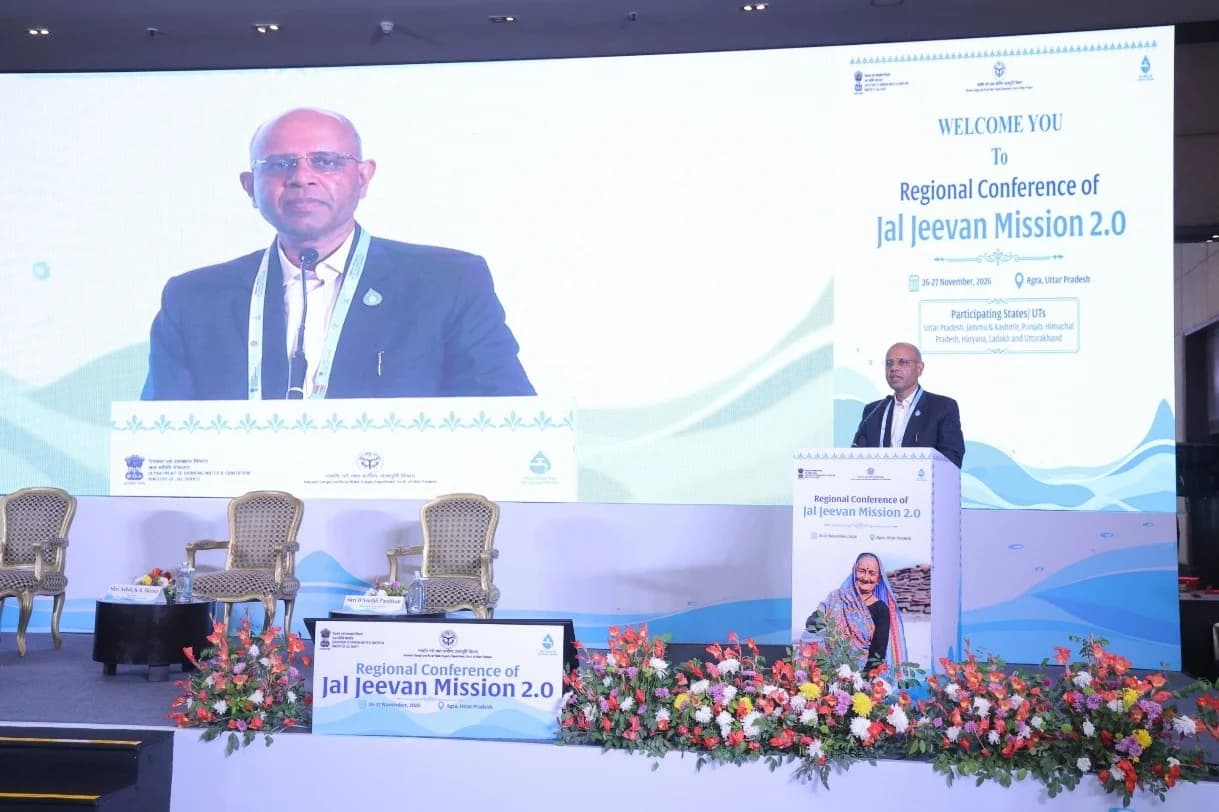
Seven northern States and Union Territories closed a two-day regional conference on Jal Jeevan Mission 2.0 in Agra, Uttar Pradesh, on 27 November 2026, with the Centre pressing them to hand day-to-day ownership of village drinking water schemes to Gram Panchayats and local communities. The meeting was organised by the Department of Drinking Water and Sanitation (DDWS) under the Ministry of Jal Shakti, according to a release issued by the Press Information Bureau.
The conference banner listed the participating States and UTs as Uttar Pradesh, Jammu and Kashmir, Punjab, Himachal Pradesh, Haryana, Ladakh and Uttarakhand. It was the second such regional meeting held for the mission's second phase.
What did the Centre ask states to do under Jal Jeevan Mission 2.0?
The Centre asked states to shift from building pipelines and taps to making sure those systems keep working, with village bodies in charge. DDWS Secretary Ashok K. K. Meena told the closing session that rural drinking water is essentially a local service, and that the financial, technical and institutional capacity of Gram Panchayats must be built up so they can run it.
He said new infrastructure has to be backed by proper management, regular water quality surveillance and community participation. He also called for coordination between the departments handling Panchayati Raj, rural development, skill development and drinking water, and pointed to the Jal Sanchay Jan Bhagidari initiative for protecting water sources.
Kamal Kishore Soan, Additional Secretary and Mission Director of the National Jal Jeevan Mission, called for digital mapping of all drinking water supply infrastructure. He said DDWS and the Ministry of Panchayati Raj have begun a joint effort to fold water and sanitation training into the existing Rashtriya Gram Swaraj Abhiyan programmes for sarpanches, panchayat secretaries and other grassroots staff.
What is Jal Arpan, and why does it matter for villagers?
Jal Arpan is the formal transfer of responsibility for village water infrastructure to the community. Meena described it as an important step in that handover, and officials were told to present it as shared responsibility rather than merely passing on assets.
As part of the conference, five teams of central and state officials visited water schemes in western Uttar Pradesh and joined Jal Arpan Diwas events. The sites were the Badhera (Bhadaira) scheme in Etah, Nagla Babu and Sultanpur schemes in Hathras, the Simrau scheme in Mainpuri and the Shahpur Qutub scheme in Aligarh. Meena also visited a 456 MLD water treatment plant in Etah.
The teams looked at treatment and distribution systems, met Village Water and Sanitation Committees, and watched trained women test water with field test kits. According to the release, Meena and Soan drank water straight from household taps during the visits to build public confidence in its safety, and urged officials to do the same on field visits.
Meena also said Gram Panchayats should be reassured that implementing departments will continue to provide technical support, especially for major repairs and breakdowns.
Practices flagged for other states
Meena highlighted two practices seen in Uttar Pradesh for possible wider use: solar power for rural water supply schemes, and command-and-control systems to monitor and operate water infrastructure.
Vijay Kumar, Director in the Ministry of Panchayati Raj, pointed states to the 16th Finance Commission framework. He urged them to map water assets on the e-GramSwaraj portal, include drinking water in Gram Panchayat Development Plans and use Finance Commission grants for operation and maintenance.
Summing up, DDWS Joint Secretary D. Senthil Pandiyan said sustainable rural water supply needs a whole-of-government approach involving the drinking water, Panchayati Raj, rural development, tribal affairs and skill development departments. He listed capacity building of Village Water and Sanitation Committees, digital monitoring through the Sujalam framework, water quality surveillance and source sustainability among the priorities.
What happens next
The release said participating States and UTs reaffirmed their commitment to speeding up implementation of Jal Jeevan Mission 2.0, and Pandiyan asked them to carry out the agreed reform measures and action plans on time. The ministry said the outcomes are expected to improve programme delivery and long-term water security in rural areas. No timeline for the next regional conference was given.