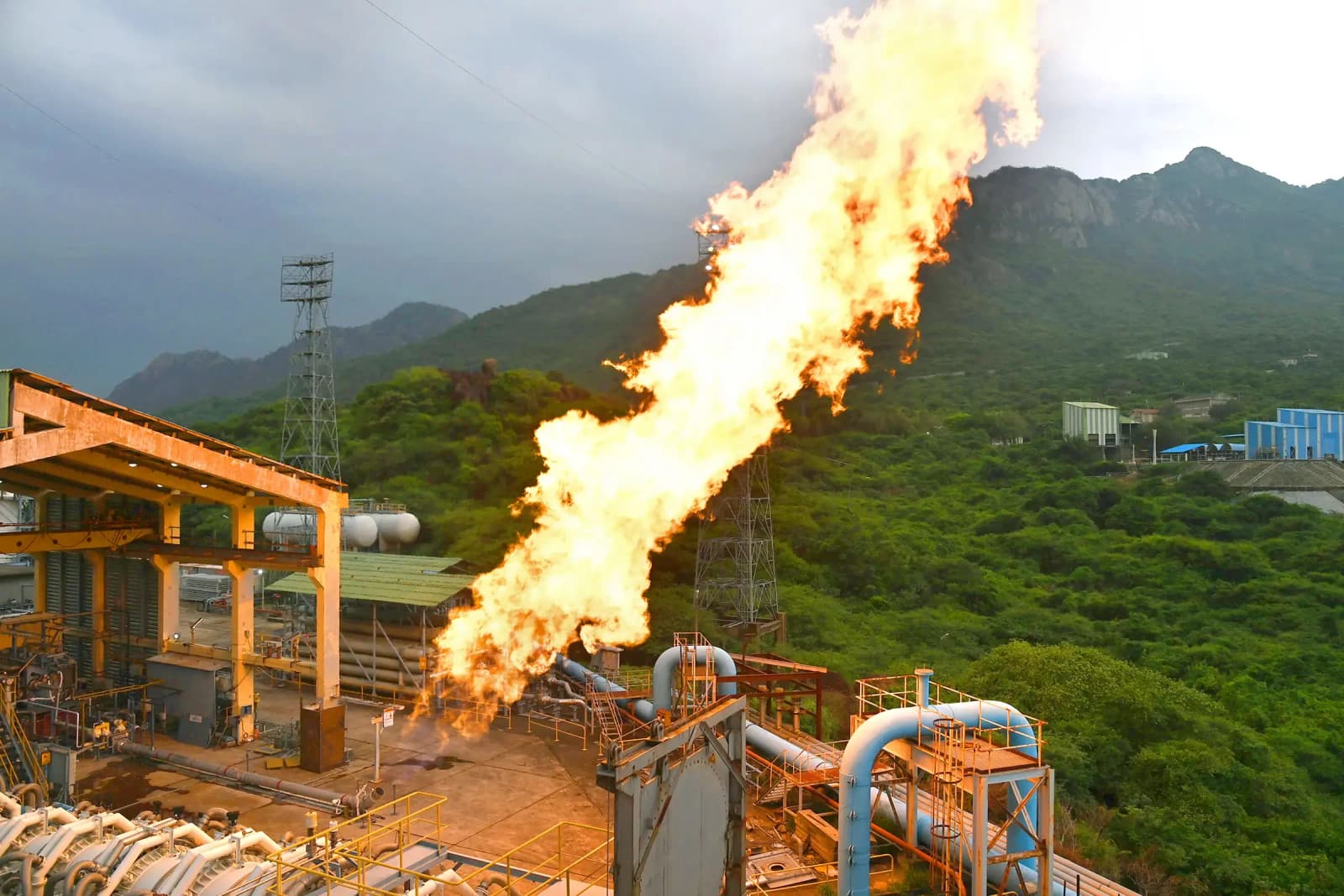
The Indian Space Research Organisation (ISRO) said on 27 November 2026 that it has run a 200-second ignition test of the gas generator for its high-thrust liquid oxygen (LOX)-methane rocket engine at the ISRO Propulsion Complex in Mahendragiri, Tamil Nadu. According to the ISRO update, the long-duration test was carried out on 14 November 2026, two days after engineers completed the first cold flow test of the engine's LOX pump assembly.
What did ISRO test at Mahendragiri?
ISRO tested the gas generator subsystem, the component that burns a small share of the propellants to produce hot, high-pressure gas. That gas spins a turbine, which in turn drives the turbopumps that push propellants into the engine's main thrust chamber.
The test simulated a steady chamber pressure of 31.5 bar in the gas generator, a condition ISRO says corresponds to roughly 60 per cent of the engine's thrust. The agency reported smooth ignition and stable combustion throughout the 200 seconds, and said the hardware's design had been shown to be adequate for that operating point.
The gas generator was built using additive manufacturing (3D printing) by an Indian industrial partner, according to ISRO.
What happened in the LOX pump test?
On 12 November 2026, ISRO completed the first cold flow test of the LOX pump assembly. The run studied how the pump behaves both with and without cavitation, the formation of vapour bubbles that can damage pumps and disturb propellant flow, in the configuration planned for the integrated engine. ISRO said the pump had earlier been spin-tested to its maximum operating speed and that its measured performance matched predictions.
Why does this engine matter?
ISRO has picked LOX-methane propulsion as the main engine technology for its Next Generation Launch Vehicle (NGLV). In an October 2026 overview of the programme, the agency described the LME1100, a gas-generator-cycle engine of 1,100 kN thrust that has been under formal development since 2023. It also cited clean combustion and low maintenance, which suit reusable designs, as advantages of methane fuel.
That overview also said ISRO is planning LOX-methane engines for a future heavy-lift vehicle meant for a crewed lunar landing targeted for 2040, and that design work is complete on a 2,400 kN full-flow staged-combustion engine for that rocket.
How far along is the programme?
The 14 November run builds on earlier work. The October overview said the first full-scale ignition test of the gas generator took place on 9 October 2026. It listed other completed work as sub-scale thrust chamber hot tests at Mahendragiri, a spin test of a 3D-printed LOX pump impeller, and hot tests of spark torch igniters.
With the latest results, ISRO says the spark torch ignition system, the scaled thrust chamber, the full-scale gas generator and the LOX pump have all finished their development test campaigns. Development is led by the Liquid Propulsion Systems Centre (LPSC), with the Vikram Sarabhai Space Centre (VSSC) also involved.
What comes next?
ISRO said the same gas generator hardware will now be used to confirm that the design works at other operating conditions beyond the 60 per cent thrust point tested so far. According to the October overview, the integrated LME1100 engine is expected to be ready for hot testing by the middle of next year. ISRO has not yet announced a date for a full-engine hot test.
Photo source · ISRO