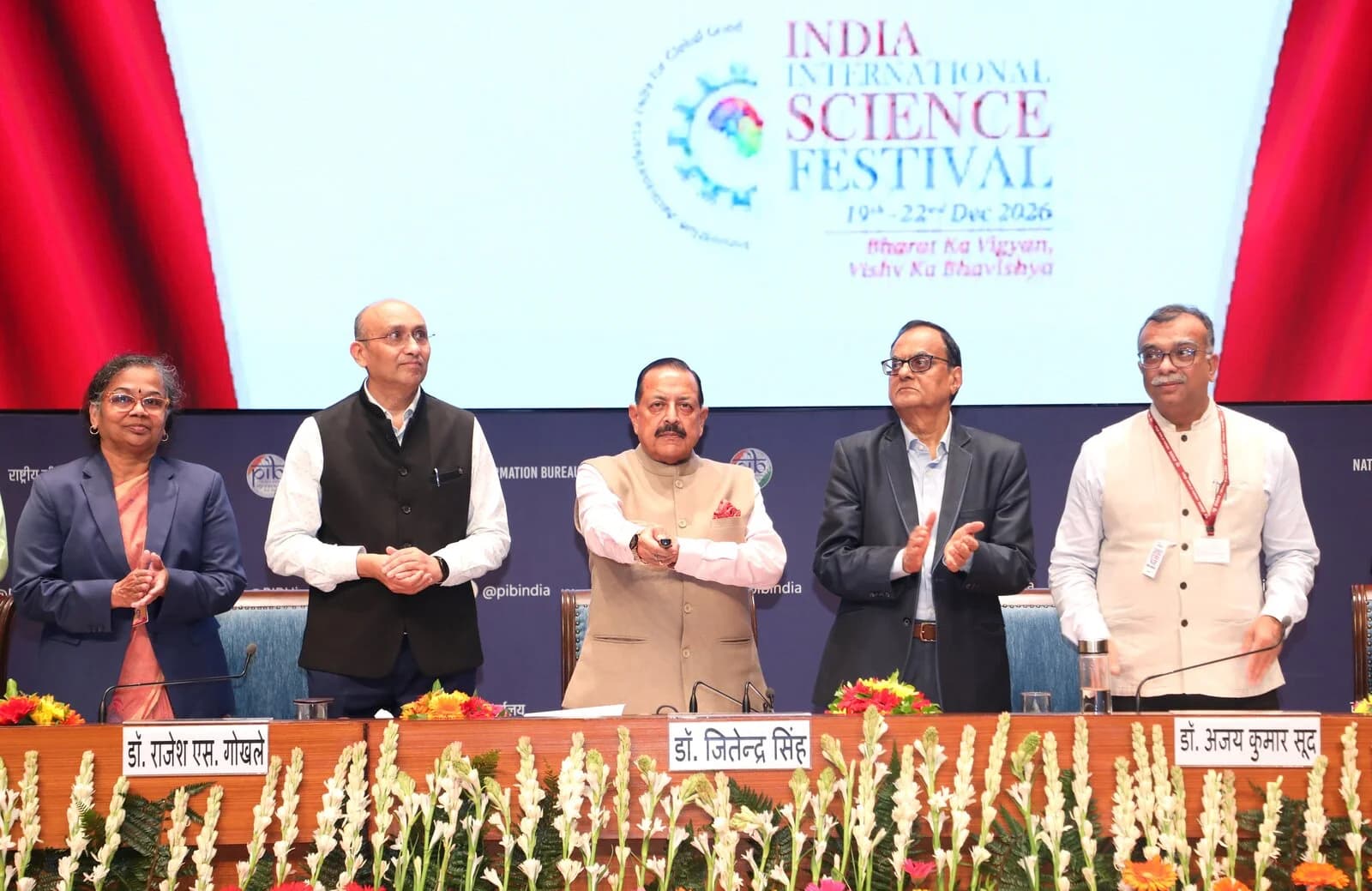
The 12th India International Science Festival (IISF) will be held in Pune from 19 to 22 December under the theme "India's Science, World's Future" (Bharat ka Vigyan, Vishwa ka Bhavishya), Union Minister Jitendra Singh announced on 18 November as he launched the festival's curtain raiser, website and brochure at the National Media Centre in New Delhi, the Ministry of Science and Technology said.
This is the first time the festival is going to Pune. Earlier editions rotated through Chandigarh, Hyderabad, Goa and Delhi, the minister said, adding that Pune was chosen for its academic, research and industrial base.
Five campuses, 26 programmes
Under the banner "One Nation, One Science Festival", IISF 2026 will be spread across five neighbouring campuses in Pune: BRIC-National Centre for Cell Science (NCCS), CSIR-National Chemical Laboratory, IISER Pune, the Indian Institute of Tropical Meteorology and COEP Technological University, according to a blueprint presented by NCCS director Thomas Pucadyil.
The four-day event will run 26 programmes at 17 working laboratory venues, with seven Union ministries and departments and 16 national institutions taking part, the ministry said. Planned events include:
- a Global Summit on Biomanufacturing linked to the government's BioE3 policy, and a clinicians-academia conclave;
- "The New Nalanda" science and technology village for 1,800 students and 200 teachers, and a student-scientist interaction programme for 1,200 students;
- a teachers' workshop called "The Gurukula" and an eight-zone "Science Safari";
- a public science, technology, defence and space expo featuring Chandrayaan-3, Gaganyaan, INS Vikrant and Mission Shakti, along with national missions on quantum technology, semiconductors and deep-ocean exploration.
Nobel laureate Sir Tim Hunt, who shared the 2001 prize, will deliver a special lecture, the minister said. The festival will also host hackathons and B2B meetings for startups and industry, and a walk-through 3D model of a cell.
Policy outcomes promised
Organisers listed a "Vision Sansad" for 150 heads of institutions, a science diplomacy conclave, a global science and technology alliance spanning three continents, and a meet of 150 NGOs. Sessions titled Nari Shakti and Vigyanika are also planned, along with SHIV-DURG, which will showcase the engineering heritage of Maratha forts.
The ministry said the festival is expected to produce a Vision Sansad Declaration 2026, a declaration from the NGO meet, an IISF 2026 statement on science diplomacy with a bio-diplomacy roadmap, and a National Roadmap for Biomanufacturing. Promising student innovations will be picked out for mentoring and incubation.
Why the government is backing two flagship events
Jitendra Singh said the government had decided to replace scattered, repetitive gatherings, including the former Indian Science Congress, with two flagship national events. One is the Emerging Science, Technology and Innovation Conclave (ESTIC), an academic conclave in New Delhi that the Prime Minister inaugurates every year; the other is IISF, which he described as festive and public-facing.
Principal Scientific Adviser Ajay Kumar Sood said the festival aims to bring young people into science and build scientific temper beyond research laboratories. Department of Biotechnology Secretary Rajesh S. Gokhale said IISF, held since 2015, links society, government and the market through science, and that the 2026 edition brings in the Department of Atomic Energy and NITI Aayog's Atal Innovation Mission alongside the main science departments.
What happens next
Ahead of the Pune festival, Vijnana Bharati (VIBHA), which is co-organising the event with the Department of Biotechnology, is holding curtain-raiser events in 13 cities, including Chennai, Kolkata, Bengaluru, Mumbai, Hyderabad, Imphal, Indore and Ahmedabad, the ministry said. The festival itself opens on 19 December.