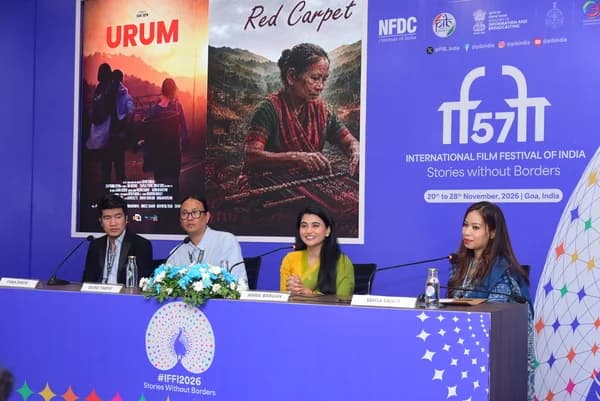
Two films from India's Northeast, an Assamese documentary about Karbi handloom weavers and a Nishi-language feature about a grieving father in Arunachal Pradesh, were presented to the media at the 57th International Film Festival of India (IFFI) in Goa on 22 November 2026. Directors Aimee Baruah and Duyu Tabyo spoke about using cinema to keep indigenous crafts and languages alive, according to a Press Information Bureau release.
Baruah's Red Carpet is screening in the Indian Panorama non-feature section, while Tabyo's Urum is part of the Indian Panorama feature film category. The press conference was moderated by Smita Saikia.
What is 'Red Carpet' about?
Red Carpet follows a handwoven fabric made by the Karbi community of Karbi Anglong in Assam, a weaving tradition the film presents as centuries old and under pressure from modernisation and changing lifestyles. The documentary traces a traditional weaver's journey from the village of Donkamokam to the red carpet at Cannes, showing how one piece of cloth became a marker of identity and pride.
Baruah, an actor, producer and filmmaker who is also pursuing a PhD, said international attention on the attire had brought more visibility to the region's indigenous heritage. She praised the skill of local weavers and urged young people to take pride in their language, culture and traditions and carry them forward.
What is 'Urum' about?
Urum is set in a remote mountain community in Arunachal Pradesh. It follows a father trying to come to terms with the death of his young daughter as he struggles with guilt, disturbing visions and buried truths. The film draws on grief, memory and indigenous belief.
Tabyo, an independent writer-director from Arunachal Pradesh, said the story grew out of an incident he witnessed as a child in Ziro, involving a father who had lost his daughter. The memory stayed with him for years. He said he wanted to explore the father's psychological and emotional state rather than deliver a moral message.
Why does the language of the film matter?
Tabyo said making Urum in the Nishi language was a deliberate choice, meant to keep the film authentic and give the language wider exposure. He said younger generations were steadily losing touch with indigenous languages and described the film as an effort to preserve the Nishi community's linguistic heritage.
He called the film's selection at IFFI a significant recognition for Arunachal Pradesh's young film industry and said he hoped it would encourage more filmmakers from the state to tell their own stories. He described the Northeast as a largely unexplored cinematic landscape that is drawing growing interest from mainstream filmmakers and production houses, and said cinema could drive social awareness and change beyond entertainment.
Where do these films fit at IFFI 2026?
The 57th IFFI runs in Goa from 20 to 28 November under the theme "Stories Without Borders". The Indian Panorama section, which opened on 21 November with 'Dhurandhar' and the Ladakhi film 'Becoming', showcases features and non-features chosen by separate juries. The selection of Red Carpet and Urum adds Assamese and Nishi-language stories to a lineup that also features the Ladakhi film Becoming.
The festival's dates for public screenings of the two films were not given in the release.
Photo source · Press Information Bureau