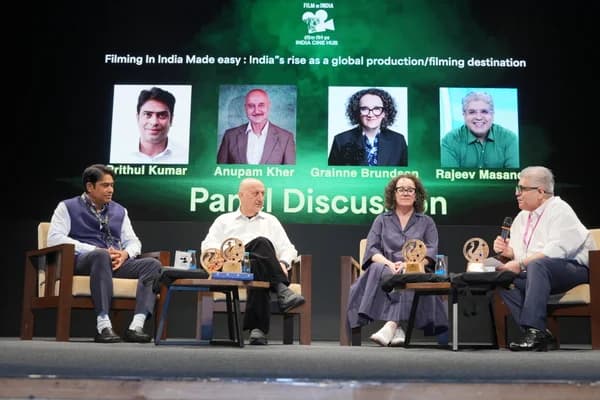
Foreign film productions seeking to shoot in India now take an average of 18 days to get permission, against a stipulated 28 days, an Information and Broadcasting Ministry official said at the 57th International Film Festival of India (IFFI) in Goa on 22 November 2026. Joint Secretary Prithul Kumar made the remarks at a panel on India Cine Hub, the government's single-window portal for filming clearances, according to a Press Information Bureau release.
The session, titled "Filming Made Easy: India's Rise as a Global Filming and Production Hub", also featured Grainne Brundson, chief operating officer of Screen Australia, and actor-director-producer Anupam Kher. Film critic Rajeev Masand moderated.
What is India Cine Hub, and what can filmmakers do on it?
India Cine Hub is a digital single-window platform led by the I&B Ministry and run by the National Film Development Corporation (NFDC). Kumar said State governments have now been integrated into the portal, so a filmmaker can use one common application form to seek clearances from several authorities, including municipal bodies, traffic departments, Indian Railways and the Archaeological Survey of India.
About 32 services have been mapped onto the platform, he said. Applicants can follow their applications on a dashboard, and fees, where they apply, are paid through secure payment links. Work is under way to bring in drone permissions that are currently handled through the Digital Sky platform.
How fast are permissions coming through?
Kumar said international shooting permissions, which have a 28-day processing window, have been cleared in an average of 18 days since 2015. He pointed to Madhya Pradesh's "deemed approval" rule, under which an application is treated as approved if no decision is communicated within 15 days.
He said the number of international productions approaching India for filming and co-production has grown from about 25–30 a year to between 100 and 200 a year, and urged production professionals and service providers to register on the portal so that overseas filmmakers can find them.
What did Screen Australia and Anupam Kher say?
Brundson said India's varied locations, talent and emotional connection with audiences made it attractive for international partnerships. She said more people in Australia watched an Indian film than an Australian film last year, and pointed to the growing Indian-origin population and educational, sporting and business ties as openings for joint storytelling, including diaspora stories. "Every film is a start-up and a miracle," she said, adding that good co-productions involve creative exchange, not only shared finance and risk.
Kher said getting filming permissions had become considerably easier and that India's landscapes, food, costumes and cultural settings gave filmmakers a wide creative range. "Emotions don't have any different nationalities. The only thing that you need is the possibility of shooting," he said. He said the single-window system helps newcomers, writers and aspiring directors as well as established producers, but warned against middlemen who might exploit filmmakers by claiming to arrange permissions.
Why it matters
The panel presented streamlined permissions, along with diverse locations and creative collaboration, as central to India's pitch to international productions. The discussion comes during a festival that has already seen India and Spain begin talks on updating their 2012 film co-production agreement. The release did not say when drone permissions would be added to the portal.
Photo source · Press Information Bureau