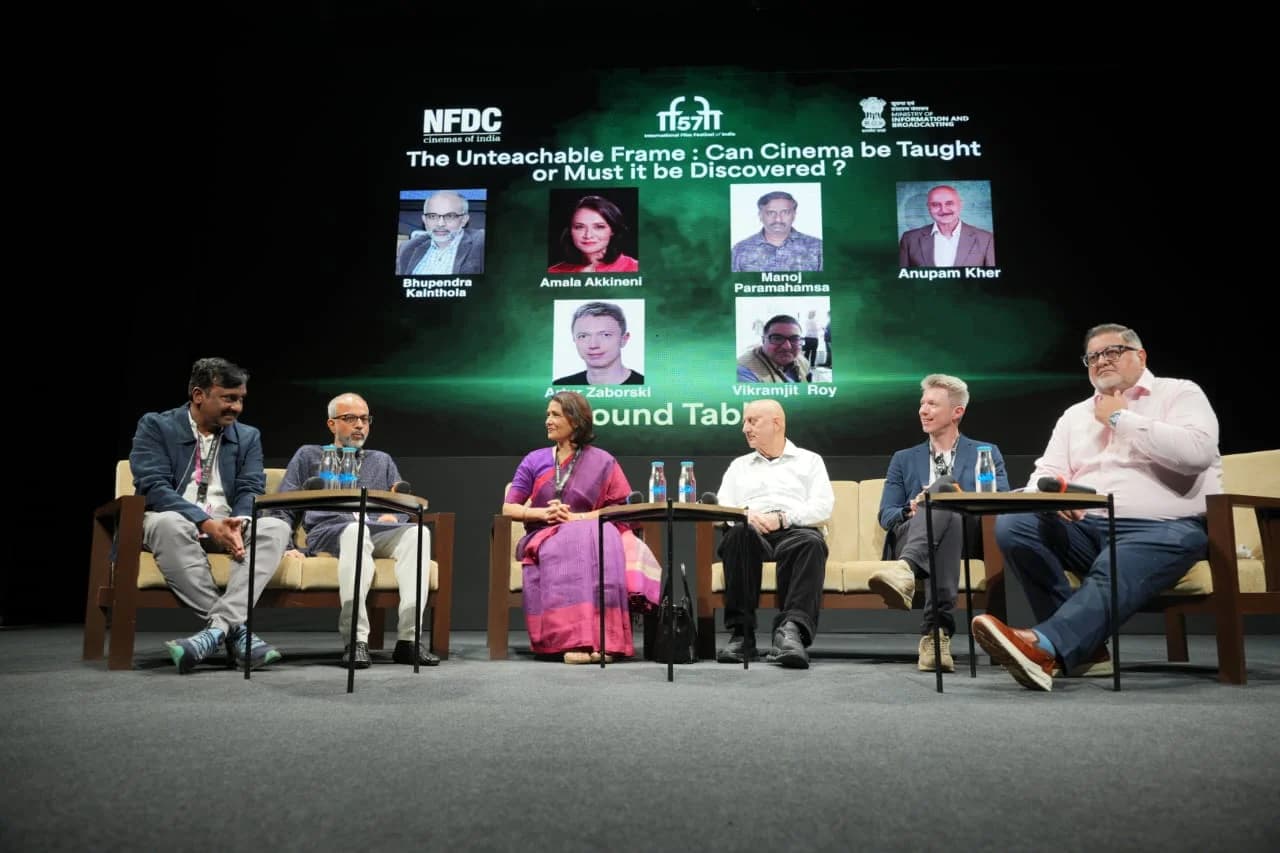
Actor Anupam Kher told a panel at the 57th International Film Festival of India (IFFI) in Goa on 22 November 2026 that he "would not have been sitting here" without his training at the National School of Drama (NSD), as film educators and practitioners debated whether cinema can be taught at all. The session, titled 'The Unteachable Frame: Can Cinema Be Taught or Must It Be Discovered?', was held alongside the festival's screenings, according to a release from the Press Information Bureau (PIB).
Who was on the panel?
The speakers were actor Amala Akkineni, who heads Annapurna College of Film and Media; Anupam Kher, founder of the acting school Actor Prepares; Artur Daborski, vice-rector for international cooperation at Warsaw Film School in Poland; Bhupendra Kainthola, former director of the Film and Television Institute of India (FTII); and cinematographer Manoj Paramahamsa, founder of Cinema Factory Academy. Vikramjit Roy, who has held senior roles at Sony Pictures India and the National Film Development Corporation (NFDC), moderated.
Can cinema be taught?
Most panellists argued that the craft can, even if the spark cannot. "Art can be discovered, but craft has to be taught," Kainthola said, adding that creativity needs to be backed by discipline and structured learning. Drawing on his time at FTII, he said many students choose film school against their families' expectations, and that publicly funded institutes have a duty to nurture that ambition.
Kher linked his debut role in Saaransh, in which he played a 65-year-old man at the age of 28, to his NSD training. He named observation, imagination and emotional memory as an actor's three essential qualities and described acting as working with the nine emotions, or Navarasas. He also warned young actors that competence can become an obstacle to brilliance if they stop trying to improve.
Akkineni said film schools teach students to work together and to understand how different departments depend on each other. She urged educators to challenge stereotypes and encourage more women to train professionally in filmmaking.
Why practise in school rather than on set?
Daborski said students at Warsaw Film School are encouraged to experiment and make mistakes in a supportive setting, because errors on a professional set can be costly. He said training should also cover the business side, including pitching to producers and raising funds, and that exposure to film festivals is part of that preparation. European festivals, he said, value films that engage with subjects young filmmakers find troubling or hard to accept.
Paramahamsa made a similar point, saying professional sets work under too many practical constraints to leave room for trial and error. Beyond technique, he said, film schools teach students to manage people and coordinate teams.
What did the panel say about AI?
The discussion also turned to artificial intelligence (AI). Paramahamsa said AI is increasingly used to handle repetitive tasks, draft preliminary storyboards and streamline production, and that technology now lets filmmakers change backgrounds after shooting. Kher accepted the need to adapt but said AI-generated avatars cannot replicate "the heart and soul" that people bring to acting.
What's next at IFFI?
The festival runs in Goa until 28 November 2026. On the same day, officials at the festival said foreign shoots are now cleared in 18 days on average, while actor Karla Sofía Gascón held a masterclass on cinema's emotional reach.
Photo source · PIB