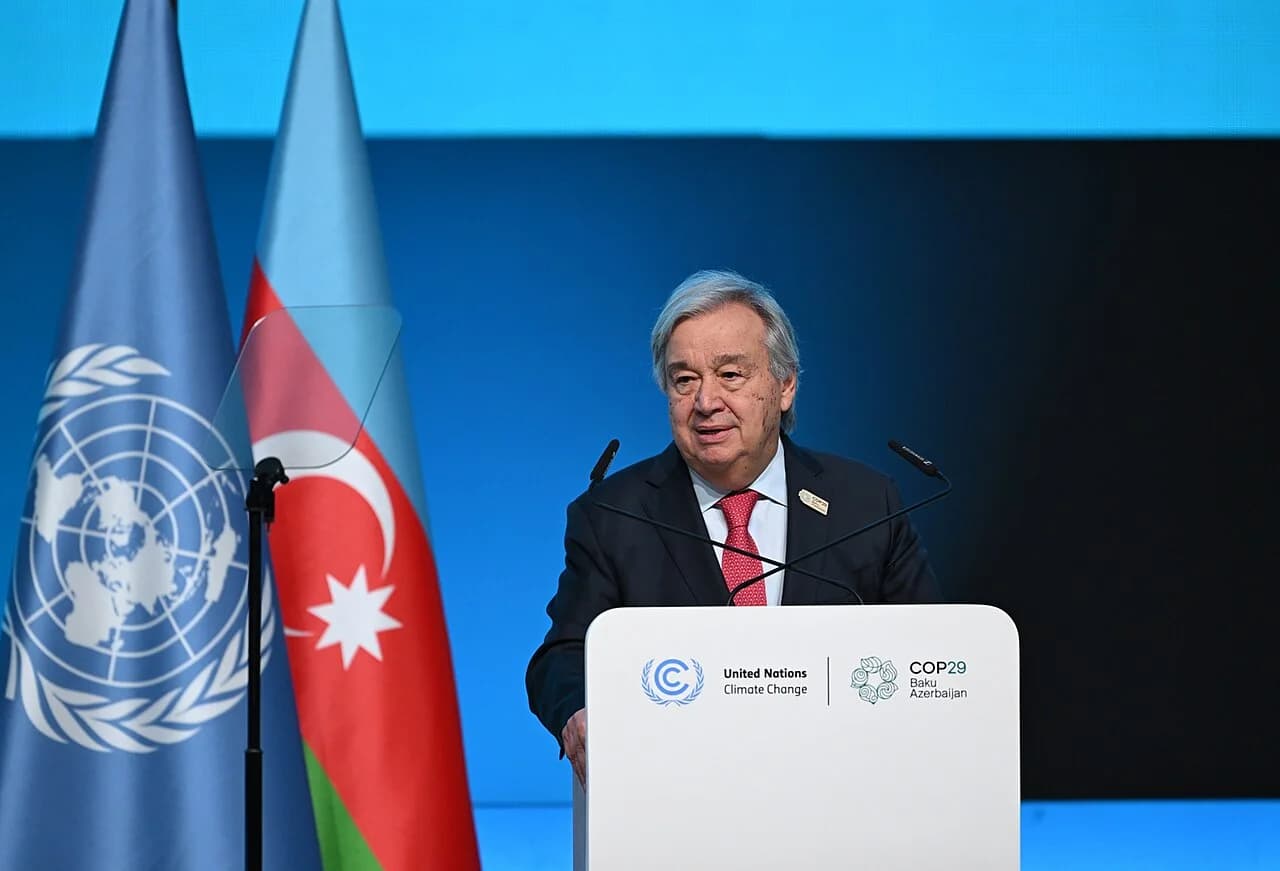
United Nations Secretary-General António Guterres on Monday, 23 November 2026, asked UN member states to begin talks on a multilateral framework for managing the risks of artificial intelligence (AI), warning that the technology is driving "the biggest transfer of power in the history of humankind". He spoke at the close of the Bridgetown Special Summit on AI Safety in Barbados, co-hosted by the UN and the Barbadian government.
What is Guterres proposing?
Mr Guterres called for a common foundation for AI safety rather than a finished treaty, according to UN News. The elements he listed include shared safety measures, common testing approaches, clear safeguards and standards, basic transparency requirements, and independent evaluation and oversight of advanced AI models, along with support so that every country can apply them.
He also proposed a Global Fund for AI Capacity-Building, saying countries' ability to manage AI risks "remains deeply unequal". Xinhua reported that he urged member states to develop the framework within a year and to put credible, independent oversight in place, and that he said greater transparency about serious incidents and near misses would let countries learn from each other.
Why does he call it a transfer of power?
Mr Guterres said power is shifting "from States, from governing institutions to a small number of companies and persons", and that governments "are playing catch-up" on the risks, UN News reported. He summed up the danger as: "Technology without accountability. Capability without safeguards. And power without responsibility." He repeated his support for a ban on autonomous weapons, calling it "absolutely unacceptable" for a machine to decide whom to kill, and said AI development "cannot go faster than the capacity to control their safety".
What did other leaders say?
Barbados Prime Minister Mia Mottley said small states often have no voice in rules that affect them, and that every country should be able to build, test and use AI on its own terms, according to UN News and Xinhua. In a conversation with Mr Guterres, she agreed that AI developers should pay if their agents cause harm, and that governments should have a "kill switch" to cut off access to models in an emergency.
French President Emmanuel Macron, speaking by video, said the Paris Call for AI Security had been signed by 18 heads of state or government and 11 AI leaders. Microsoft Vice Chair and President Brad Smith said AI is in some ways moving faster than safety work and that its spread in the Global South needs to accelerate.
What did the summit agree?
The summit issued the Bridgetown Call to Action on AI Safety for Humanity, which urges governments, companies, financial institutions and foundations to invest more in AI capacity in the Global South, Xinhua reported. Participants also proposed shared regional pools of graphics processors (GPUs) to give countries a basic level of computing power.
A day earlier, the UN's Independent International Scientific Panel on AI released a brief urging countries to test AI systems in their own languages. Panel member Vukosi Marivate of the University of Pretoria said models perform far worse in many languages, including African languages and Caribbean creoles, UN News reported.
Why it matters
The push for testing in local languages and wider access to computing touches the concerns of many developing countries. Mr Guterres noted that 111 countries taking part in the first Global Dialogue on AI Governance in July 2026 had never before joined any AI discussion. AI policy has been in the news in India too; MapMyTimes recently reported on the row over Sarvam's Token Factory.
What happens next
Member states have been asked to start discussions on the framework. UN News did not report any fixed dates for the talks or the proposed fund. Mr Guterres leaves office at the end of December 2026, so any negotiations would continue under his successor.
Photo source · Press Service of the President of the Republic of Azerbaijan, CC BY 4.0