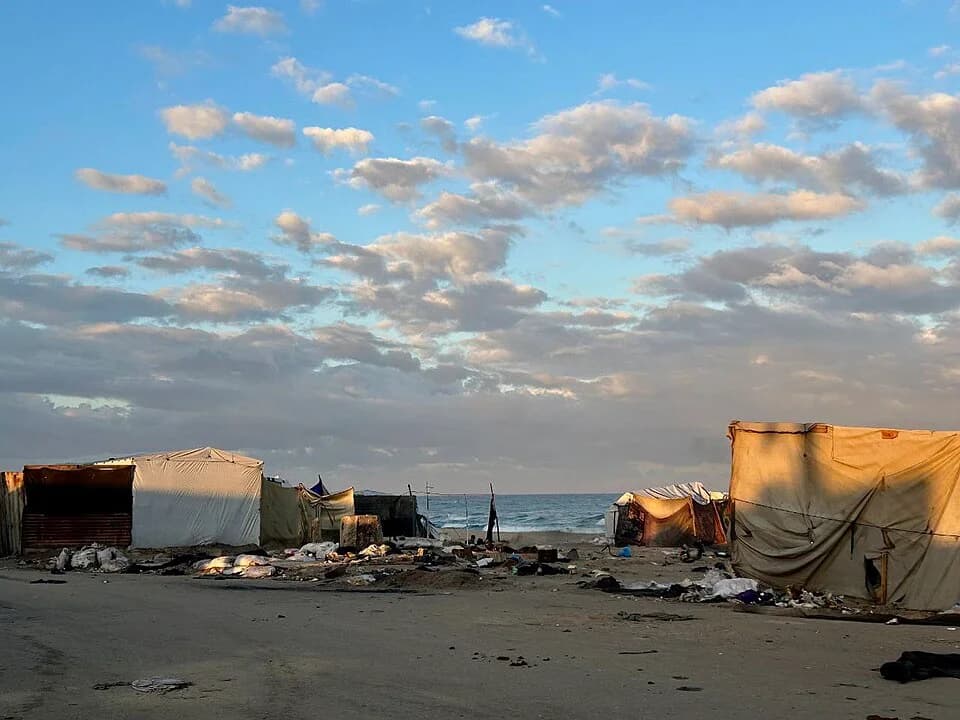
The United Nations and its humanitarian partners on Friday, 13 November, issued an urgent appeal for winter supplies to be allowed into the Gaza Strip without delay, saying the deaths and destruction caused by last weekend's rainstorm were "preventable" and that "lives are at stake".
The statement came from the Humanitarian Country Team (HCT) for the Occupied Palestinian Territory, a forum led by the UN Humanitarian Coordinator that brings together heads of UN agencies and international and Palestinian non-governmental organisations. It said children and adults had been killed, services suspended and thousands of family shelters flooded, swept away or torn apart, "not by the storm alone, but by policy decisions".
150,000 tents waiting outside Gaza
According to the HCT, more than 150,000 tents procured by aid agencies and member states are sitting outside Gaza, ready for dispatch, most of them in Al Arish, around 50 kilometres from Khan Younis. Inside the Strip, it said, each new storm destroys more tents and adds to the number of replacements needed.
The partners said that months ago they had presented a plan to help Palestinians prepare for the 2026-27 winter, covering shelter, health and protection services, drainage and sandbag reinforcement, and listing items such as tents, warm clothes, blankets and equipment to pump water, clear debris and remove explosive ordnance.
The statement said Israel, as the occupying power, is obliged to ensure the basic needs of Gaza's population, but that Israeli policies continue to obstruct the entry of critical items and access to most of Gaza's land, including areas away from the coast that are less prone to flooding. Supplies, it said, face multiple approval requirements, limited crossing capacity and unpredictable or narrow delivery windows.
The HCT called on Israeli authorities to let supplies in every day through every available crossing, lift restrictions, allow repairs to water and wastewater networks, let all humanitarian partners operate, including Palestinian NGOs, and permit meaningful commercial activity. It urged member states to use their influence and provide funding without delay. "Winter will last for months," the statement said, adding that access to longer-lasting shelter must not be made conditional on political progress.
A deadly week
The first heavy rains of the season struck Gaza from the night of Friday, 6 November. UN News, citing the UN aid coordination office OCHA, reported that an infant reportedly drowned and that five people, including three children, were killed when a sand dune collapsed onto tents at Al Berka Reservoir, west of Deir Al Balah. By 8 November, more than 6,000 family shelters had reportedly been destroyed and 17,400 damaged, and more than 3,900 households had no shelter at all.
OCHA estimates that around 65 per cent of Gaza's population, some 1.4 million people, live in tents or makeshift shelters. UN News also reported on 12 November that a nine-month-old baby had reportedly died of the cold after days of rain and flooding, and that an Israeli airstrike on Nasser Hospital on the night of 11 November had killed six people and injured 27.
On 11 November, UN relief chief Tom Fletcher said governments had told him progress would be hard until after Israel's elections and were now asking him to wait for a new government to be formed, which he said was not an acceptable excuse under international humanitarian law.
Israel's position
Israel's military has said its winter preparedness plan is being carried out with the Board of Peace, the UN, aid groups and donor countries. According to figures it released on 9 November, as reported by Israeli media, more than 91,000 tents and over 8,200 trucks carrying tarpaulins, blankets, winter clothing and other items had entered Gaza, and more than 850 requests had been approved. It said about half of the approved requests had not yet been carried out by the UN and international organisations, and that it aims to improve conditions while preventing the effort from being exploited by armed groups.
What happens next
With more storms expected over the winter, aid agencies say the key test will be whether the tents and shelter materials already waiting at the border reach families in the coming days, and whether donors close the funding gap for the winter plan.
PS · Hla.bashbash, CC BY-SA 4.0