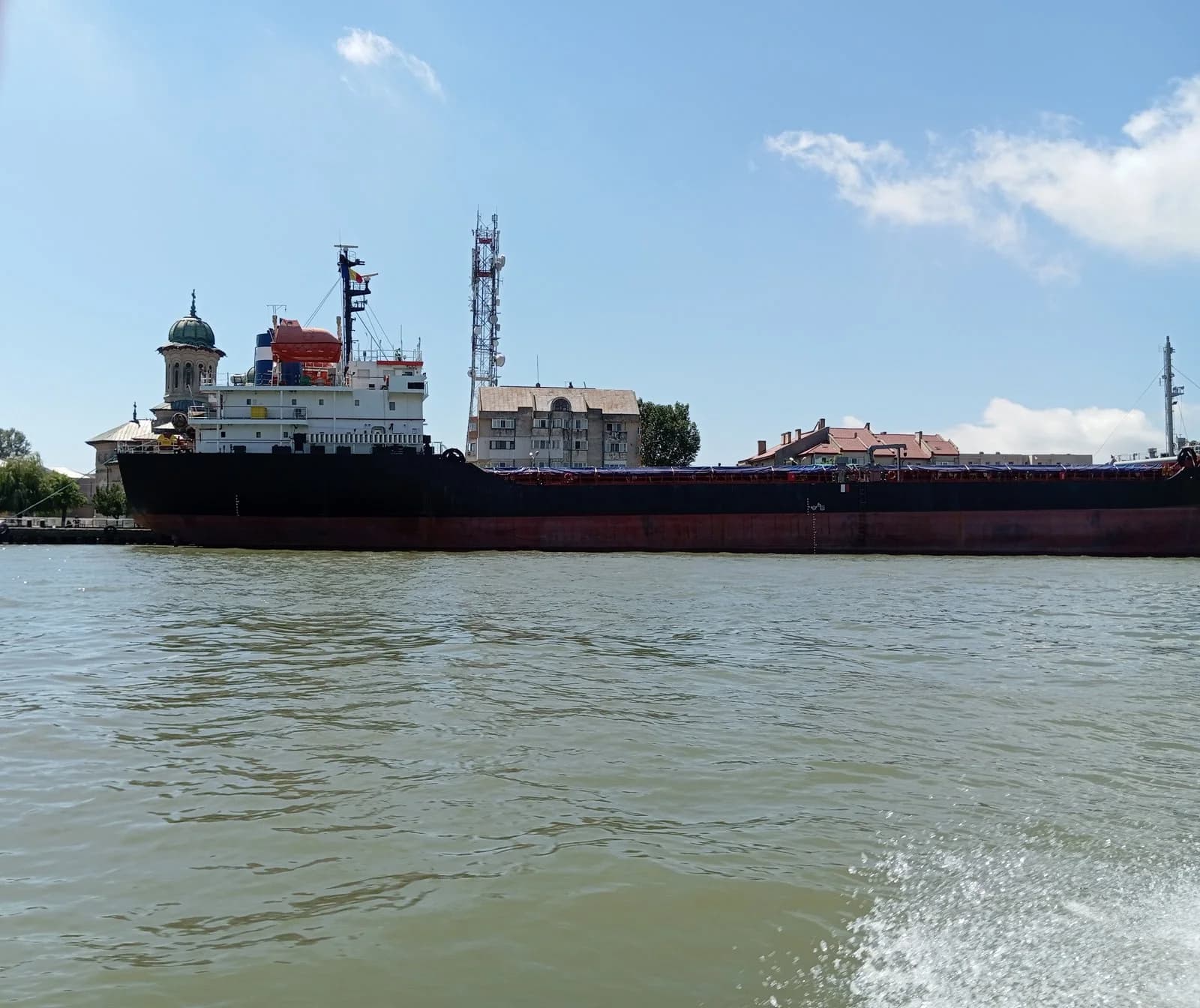
Drones have struck commercial ships off Romania's Black Sea coast on two consecutive nights, setting fire to vessels close to the mouth of the Danube and forcing Romania, a NATO member, to scramble fighter jets twice. No one was hurt, Romanian officials said, but the incidents on 13 and 14 November extend a weeks-long run of attacks on merchant shipping that has already cost sailors' lives, including those of Indian seafarers earlier this year.
This is an explainer. Read our news report: Drones hit ships near Romania's Sulina canal in the Black Sea.
What happened
The first strike came on the night of Friday, 13 November. According to reports by Anadolu Agency and the Kyiv Independent, which cited Romanian outlets Digi24 and HotNews, the Palau-flagged cargo ship Larissa 1 was hit at about 9:40 pm local time roughly 12 km off the coast near Sfântu Gheorghe. The ship was heading for the Romanian port of Sulina, with Ukraine reportedly its final destination. A drone damaged a cargo crane; the captain reported that no crew member was injured and there was no fire.
The next evening, Saturday 14 November, two more vessels were hit near Sulina. Romania's Defence Ministry, as reported by news agency News.ro and cited by the Kyiv Independent, said the Greek-flagged tanker Evia Petrol V was struck at about 9:10 pm some 4 nautical miles east-southeast of Sulina, and the bulk carrier Marsol was hit about 35 minutes later near the Sulina Canal. Both ships caught fire, and their crews put the fires out.
On Sunday, Prime Minister Luca Niculescu confirmed the attacks and said Romania had scrambled fighter jets twice, Reuters reported. Defence Minister Ștefan-Radu Oprea said there were no casualties and that the crews had brought the fires under control.
Romania's military response
The Defence Ministry said its radar picked up an aerial target east of Snake Island, and two F-16 jets were sent up to monitor the situation, according to the Kyiv Independent. Oprea said on 14 November at the Constanța military port that authorities had been notified of the first incident and an investigation was under way. He also said drone activity was being monitored and that at least two drone alerts had been issued to residents of Tulcea county on 13 November.
Romanian authorities have not identified where the drones came from.
Background: a dangerous autumn on the Black Sea
Romania borders Ukraine along the Danube and has repeatedly tracked drone activity near its territory since Russia's full-scale invasion of Ukraine, according to Anadolu. The waters off Sulina and Constanța have been hit repeatedly in recent weeks.
- 23 October: The Comoros-flagged cargo ship Khoryv, carrying 13 Ukrainian and Azerbaijani sailors, was hit by a drone about 13 nautical miles off Romania's port of Constanța, just outside Romanian territorial waters, Al Jazeera reported. One crew member was killed and three were missing; nine were rescued.
- Al Jazeera reported at the time that at least seven cargo ships had been hit and 30 sailors killed or missing in the preceding two weeks.
- 28 October: A vessel heading towards Constanța was struck by drones in Bulgarian territorial waters, according to the Kyiv Independent.
- 13–14 November: The latest strikes near Sfântu Gheorghe and Sulina.
After the Khoryv sinking, Romanian President Nicușor Dan called it "a new example of the tragic consequences of Russia's aggression against Ukraine", and Prime Minister Niculescu wrote on Facebook that the attack was "unacceptable and constitutes a flagrant violation of international law", Al Jazeera reported. European Commission President Ursula von der Leyen called the attacks "reckless". Russia did not immediately comment on that sinking, and it has previously denied responsibility for deadly drone attacks in the region, the report said.
NATO said in October it would send more maritime patrol aircraft, radar systems and drones to the Black Sea, after Ukraine, Romania and Bulgaria asked the alliance to fast-track extra surveillance to protect commercial shipping.
Why this matters for India
Indian seafarers have already paid a heavy price in this sea. On 19 July, the Guinea-Bissau-flagged bulk carrier Golden Leo was hit by a Russian missile strike near Odesa. Ten of its 17 crew were killed, four of them Indian, The Independent reported. India condemned the attack, and The Tribune reported that the Ministry of External Affairs summoned Russia's Chargé d'Affaires in New Delhi, Vladimir Ladanov, on 21 July. Russia did not apologise and claimed, without offering evidence, that the vessel was carrying military goods, according to The Independent.
In late July, the Directorate General of Maritime Administration (DGMA) issued Circular 41 of 2026, a security advisory for Indian-flagged vessels and foreign-flagged vessels carrying Indian seafarers. It told them to "exercise the highest degree of caution while operating in the Black Sea" and to carry out voyage-specific security risk assessments, The Tribune reported. The external affairs ministry separately described the corridor as "highly volatile" and urged Indians to "carefully assess the prevailing security risks before accepting such assignments", The Independent reported.
The Tribune reported in July that there had been ten attacks involving Indian seafarers on foreign-flagged ships in the Black Sea since April. Seafarers' unions have demanded a stronger response; Manoj Yadav, general secretary of the Forward Seamen's Union of India, asked, "Why is the Indian government silent?", according to The Independent. The union has also said one Indian chief officer, Sagar Gupta, was killed when the MV Omorfi was hit in what it called a "Ukrainian drone attack" at Novorossiysk in Russia — a reminder that crews face danger from both sides of the conflict.
Reports on the 13–14 November strikes do not give the nationalities of the crews on board, and there is no indication so far that any Indian national was involved. For Indian families with relatives at sea, and for crewing agencies, the DGMA and MEA advisories remain the main guidance.
What is established
- Romania's government confirmed that commercial ships were struck by drones off its Black Sea coast near Sulina on the evening of 14 November, and that fires broke out on board.
- Romanian ministers said there were no casualties and crews controlled the fires.
- Prime Minister Niculescu said Romania scrambled fighter jets twice; the Defence Ministry said two F-16s were deployed after radar detected a target east of Snake Island.
- Romanian authorities have not identified the origin of the drones.
What remains uncertain
- Which ships were hit, and when. Reuters, quoting the Romanian government, listed three ships struck on Saturday near Sulina: Evia Petrol V, Marsol and the Saint Kitts and Nevis-flagged tanker Ali Najafov. The Kyiv Independent and Anadolu count three ships across two days, including Larissa 1 on Friday, and do not name the Ali Najafov. It is not yet clear whether four ships were hit in total or whether the reports describe the same incidents differently.
- Who launched the drones. Romania has not named a culprit for these strikes. Romanian and European officials blamed Russia for the October sinking of the Khoryv, while Russia has previously denied responsibility for deadly drone attacks in the region. An Indian seafarers' union has separately blamed a Ukrainian drone for a deadly strike on the Omorfi at a Russian port, so attribution for any single attack cannot be assumed.
- Crew details. The nationalities of the sailors on board have not been published.
What happens next
Romania's Defence Ministry has said investigations are under way, and Romanian jets continue to monitor drone activity near the Danube delta. The strikes come as NATO steps up surveillance in the Black Sea following requests from Romania, Bulgaria and Ukraine. For shipping companies and for seafarers, including Indians serving on foreign-flagged vessels, the key questions are whether the route to Sulina and Ukraine's Danube ports stays open and whether insurers and regulators tighten conditions further. Indian seafarers can follow updates from the DGMA and the Indian missions in the region.
PS · Oly23lid, CC BY-SA 4.0