Yemen's Houthi movement said on Tuesday, 17 November, that it had sent five drones against two pumping stations on Saudi Arabia's East-West oil pipeline, the overland route the kingdom has leaned on to move crude to the Red Sea while shipping through the Strait of Hormuz remains badly disrupted. Saudi Arabia has not confirmed any damage. The claim, reported by Reuters, the Associated Press, DPA and Xinhua, came as the Saudi-led coalition announced a major air campaign in Yemen and the Houthis fired cruise missiles towards Riyadh on Wednesday.
What happened on 17 November
Houthi military spokesman Yahya Saree said in a statement, carried by the group's Saba news agency and posted on X, that three drones were aimed at Pumping Station No. 9 in two waves and two more at Pumping Station No. 8. Both stations lie on the pipeline west of Riyadh. Saree claimed "direct and precise hits" and said the strikes set off large fires, according to Xinhua and International Business Times.
None of these details has been independently verified. Xinhua and IBTimes both reported that Saudi authorities had not confirmed the attack, and IBTimes noted there was no independent confirmation of fires, damage or any interruption to crude shipments. Coalition spokesman Turki al-Maliki said on X that the coalition had intercepted and destroyed a Houthi drone heading towards the Riyadh region, but gave no details about its target, Xinhua reported. A DPA report on Wednesday said the coalition had also repelled Houthi drone attacks near the capital on Monday and Tuesday.
The Associated Press reported on Wednesday that the coalition had launched a major air campaign across Houthi-held territory from Tuesday. Maj. Gen. al-Maliki said the strikes hit the capital Sanaa and three other provinces, targeting ballistic missile warehouses and drone workshops; DPA quoted the coalition as saying 60 "legitimate military targets" were destroyed. A spokesman for the Houthi-run health ministry, Anees al-Asbahi, told AP that one strike hit a sponge factory in Hodeida, killing at least 15 people, and that at least two more were killed in Saada. On Wednesday, al-Maliki said Saudi air defences destroyed two Houthi cruise missiles aimed at Riyadh, AP reported.
Why this pipeline matters
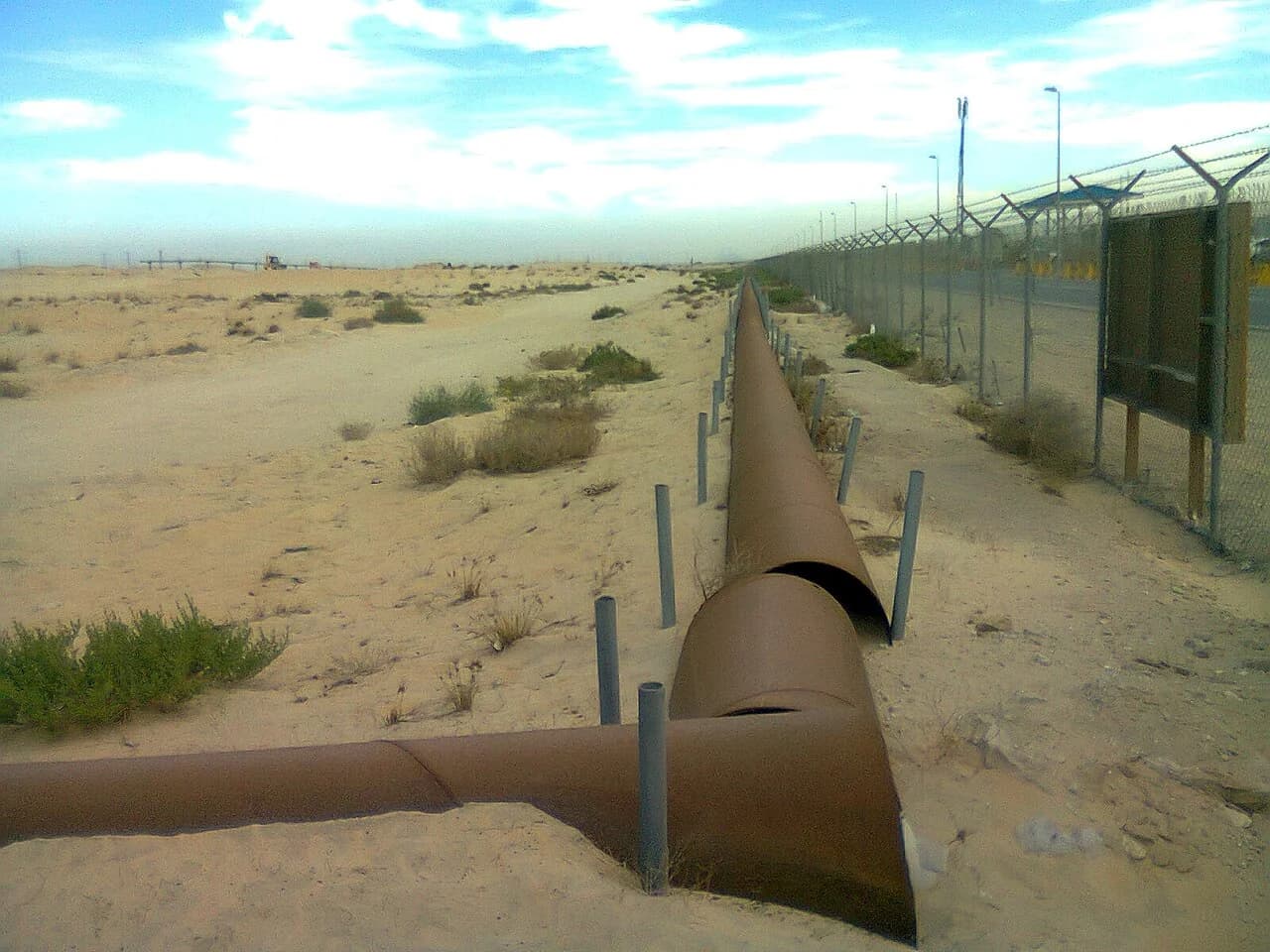
The East-West pipeline runs for about 1,200 km across the Arabian Peninsula, from the kingdom's eastern oil region to the Red Sea port of Yanbu, letting Saudi crude avoid the Strait of Hormuz, according to Al Jazeera and IBTimes. Since the regional war choked traffic through Hormuz, Riyadh has been sending roughly 4 million barrels of crude a day through the line to Yanbu, which Al Jazeera, citing Reuters, put at about 4% of global supply. Oilprice.com reported that the line can carry up to 7 million barrels a day.
That makes the pipeline a single, long and exposed artery. Oilprice.com, citing Reuters columnist Ron Bousso, said the Red Sea has been Saudi Arabia's main export hub since the Iran war began in February, and that crude loaded at Yanbu for Asian buyers must pass through the Bab el-Mandeb Strait at the southern end of the Red Sea.
Timeline: a month of strikes on Saudi energy sites
- September: Saudi Arabia shut the pipeline after a drone attack that Riyadh and Baghdad said came from Iraq. Oilprice.com reported the line stayed shut until 22 September.
- 7 November: According to a tally by FDD's Long War Journal, the Houthis began daily missile and drone attacks on Saudi Arabia, saying they were retaliating for Saudi air strikes in Yemen.
- 8 November: An Aramco building in Riyadh's financial district was damaged; the Saudi energy ministry attributed it to "falling shrapnel" with no casualties, the Long War Journal reported.
- 9 November: An energy ministry official told the Saudi Press Agency that an attack in the Medina region caused a "limited fire" on the pipeline that was put out, and that "pipeline operations were unaffected", Al Jazeera reported.
- 11-13 November: Saree claimed further strikes on pumping stations, including one at Yanbu and Pumping Station No. 7. Saudi officials did not confirm damage to the pumping station, IBTimes reported.
- 15 November: The coalition said it intercepted two ballistic missiles heading for Riyadh and three drones over the Eastern Province, according to IBTimes.
- 17-18 November: The five-drone claim on stations No. 8 and No. 9, the coalition's air campaign, and cruise missiles fired towards Riyadh.
The numbers markets are watching
So far, oil prices have not jumped on the pipeline claim. A morning note from Cornerstone Futures, published at 6:45 am US Eastern time on Wednesday, put January Brent at $92.67 a barrel, down 0.5%, and said both main benchmarks were on course for a monthly fall of about 20%. The same note said prices had settled higher on Tuesday as attacks on ships intensified, and that the Houthi claim had not been independently confirmed.
What each side says
The Houthis describe their campaign as retaliation. The Long War Journal reported that the group linked its attacks to Saudi air strikes on a market in Taiz on 6 November and on Sanaa's Bani Hushaysh district on 7 November, which Houthi officials said killed dozens. The group has vowed "siege for siege, airport for airport, and escalation for escalation", Oilprice.com reported.
Saudi Arabia and the coalition have largely reported interceptions and, where damage occurred, described it as limited. The coalition says its strikes in Yemen hit military targets such as missile stores and drone workshops.
The two sides' accounts of the strikes in Yemen differ. The coalition spoke of 60 targets destroyed; Saree said the Saudi air force hit more than 80 targets within 24 hours, including in Taiz and Marib, DPA reported. Casualty figures come from the Houthi-run health ministry and Saba and have not been independently verified.
Why it matters for Indian readers
India's crude supply has been shifting back towards the Gulf. Bloomberg, citing Kpler data and reported by Oilprice.com on 12 November, said India had so far in November imported more crude from the Persian Gulf, about 2.1 million barrels a day, than from Russia, about 1.8 million, for the first time since the Iran war began. Gulf-to-India flows had dropped to as little as 247,000 barrels a day in April.
Saudi Arabia is part of that shift. ThePrint reported on 16 November, based on preliminary Kpler figures, that higher purchases from Saudi Arabia helped offset lower Russian supplies, and that the kingdom has stepped up exports from its Gulf terminals because Yanbu faces repeated Houthi attacks. Analyst Natalia Katona told ThePrint that India's nearness to those Gulf terminals shortens voyages and cuts freight costs, making it an attractive destination for Saudi sellers. ThePrint put India's total crude imports for November at about 5.2 million barrels a day, against a record 5.7 million in October, and cautioned that the figures could change.
In practical terms, the Houthi campaign is one more risk to a supply route Saudi Arabia built to get around Hormuz. If attacks on the pipeline or at Yanbu were to cut flows, Saudi barrels would rely even more on Gulf terminals that face the Hormuz disruption. For now, though, there is no confirmed interruption, and prices fell on Wednesday morning.
What is established
- The Houthis publicly claimed a five-drone attack on Pumping Stations No. 8 and No. 9 on 17 November, a claim reported by several news agencies.
- The Saudi-led coalition said it intercepted a Houthi drone heading towards the Riyadh region, and on 18 November said it destroyed two cruise missiles aimed at Riyadh.
- The coalition carried out air strikes across Houthi-held parts of Yemen from 17 November, which both sides acknowledge.
- Saudi Arabia's energy ministry confirmed an earlier attack on the pipeline in Medina province on 9 November, saying it caused a limited fire and did not disrupt operations.
What remains uncertain
- Whether any Houthi drone actually reached Pumping Stations No. 8 or No. 9, and whether there were fires or damage: the Houthis say yes, Saudi Arabia has not confirmed it, and no independent confirmation has emerged.
- Whether crude flows to Yanbu were affected at all on 17-18 November.
- How many targets the coalition hit in Yemen (60 by its count, more than 80 by the Houthis' count) and the full civilian toll, which comes only from Houthi-run bodies.
- How much of Saudi Arabia's export shift towards its Gulf terminals is caused by the Houthi threat to Yanbu, as against other market factors.
What happens next
The immediate signals to watch are any statement from Saudi Arabia's energy ministry or Aramco on the pumping stations, further Houthi claims, and whether the coalition's air campaign widens. On the market side, final Kpler data for India's November imports and the Hormuz shipping picture will show whether Saudi crude keeps moving towards Indian refiners through Gulf terminals, or whether the Red Sea route comes under heavier strain.