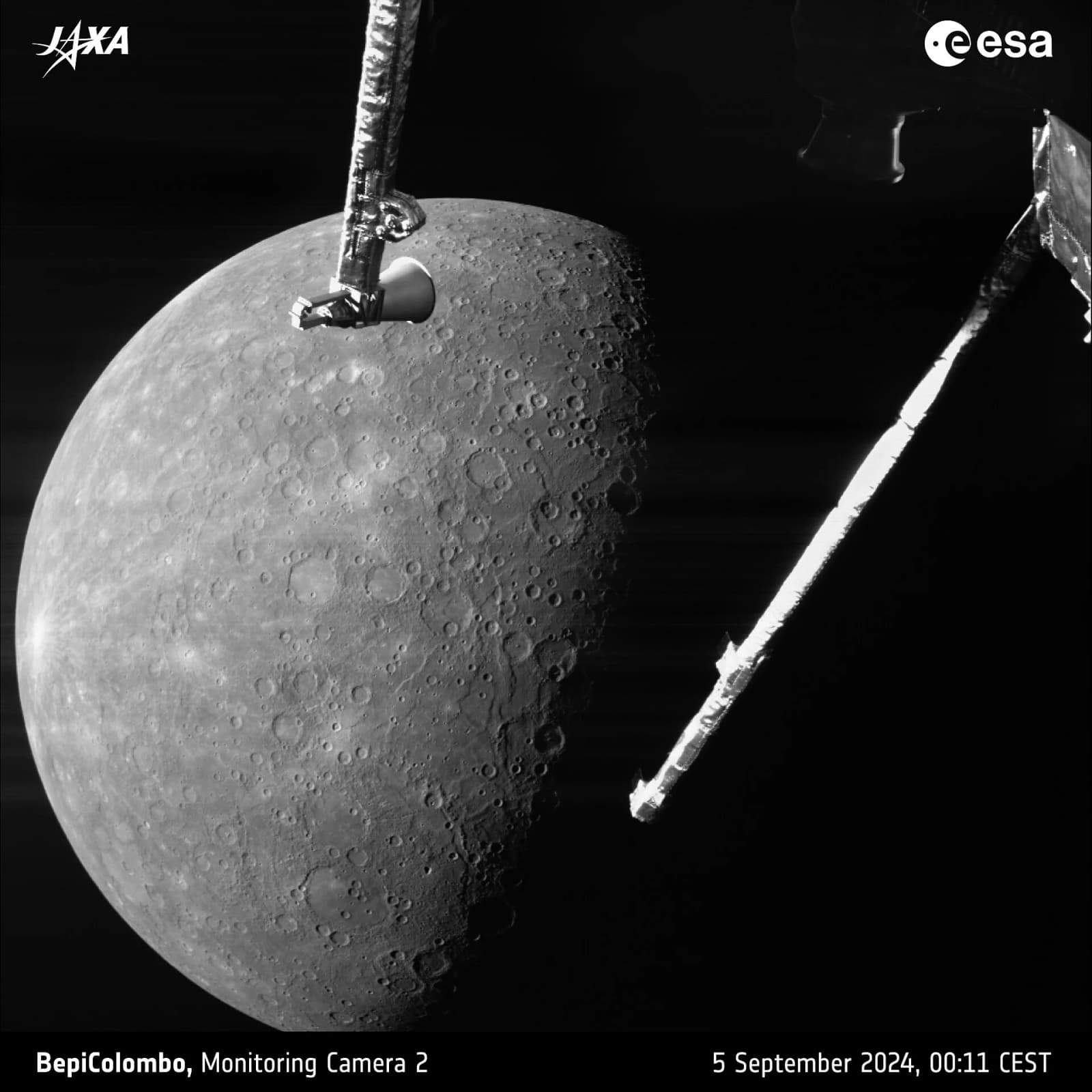
Darmstadt: After eight years of travelling through the inner Solar System, the joint European Space Agency (ESA) and Japan Aerospace Exploration Agency (JAXA) BepiColombo mission has entered orbit around Mercury, even after a software glitch cut short a key thruster burn and placed the spacecraft temporarily into safe mode.
First Planetary Weak Stability Capture Orbit
Starting at 18:24 UTC on November 21, 2026, BepiColombo became the first planetary spacecraft to enter orbit around another planet using “weak stability capture,” an energy-saving technique previously attempted only on missions to Earth’s Moon. When controllers at the European Space Operations Centre (ESOC) in Darmstadt re-established radio contact after a scheduled blackout, telemetry showed the craft had entered safe mode following an early interruption during its thruster manoeuvre.
Working alongside prime contractor Airbus and Japanese mission partners, ESA engineers traced the premature cutoff to a software glitch. Instead of the originally targeted 58-hour orbit, the composite stack settled into a 75-hour orbit around Mercury.
Trajectory Adapted Ahead of December Orbiter Separation
ESA confirmed that mission planners had built flexibility into the arrival sequence specifically to absorb such anomalies. Engineers have already adapted the remaining manoeuvre sequence to the new 75-hour orbit without needing extra thruster burns, keeping the separation of ESA’s Mercury Planetary Orbiter (MPO) and JAXA’s Mercury Magnetospheric Orbiter (Mio) firmly on track for December 9–10.
The arrival builds on months of in-flight milestones. Following the separation of the Mercury Transfer Module (MTM) on September 3, controllers conducted a joint “first light” instrument test on September 15 during which the BELA laser altimeter emitted over 700,000 pulses across 21.5 hours, the MERTIS spectrometer downlinked roughly one gigabit of calibration data, and the SIMBIO-SYS optical camera captured its first space image. MPO then fired its axial thrusters for 8 minutes and 42 seconds on September 24 for an 11.4 m/s course correction, while ground teams concluded arrival simulation campaigns on October 29 ahead of MOSIF sunshield separation slated for December 16 and full science operations in April 2027.