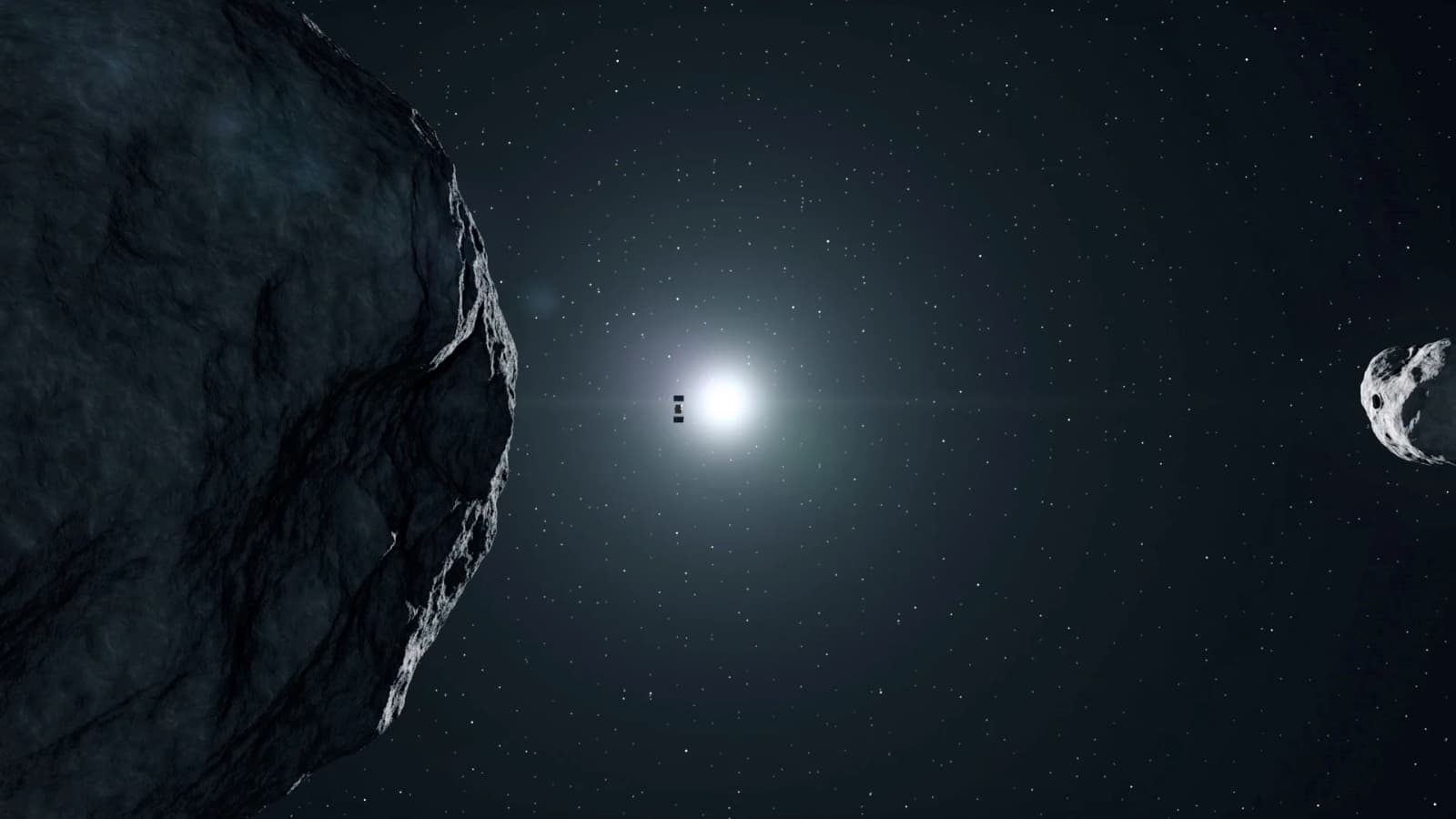
First close-up images captured by the European Space Agency's (ESA) Hera spacecraft reveal that NASA's 2022 DART kinetic deflection impact flattened one entire face of the asteroid moonlet Dimorphos into a stadium-sized crater and knocked it into a chaotic tumble.
Released on November 25, 2026 during an unveiling at Berlin's Museum für Naturkunde, the observations from 25 to 30 kilometres away show hundreds of previously unknown metre-scale boulders orbiting the binary system formed by 151-metre Dimorphos and its 730-metre companion Didymos, currently 193.5 million kilometres from Earth.
A Shattered Face and Tumbling Spin
On September 26, 2022, NASA's half-tonne Double Asteroid Redirection Test (DART) probe struck Dimorphos at over 13,000 mph, shortening its orbit around Didymos by 33 minutes. Until Hera arrived this month after launching on October 7, 2024, researchers did not know whether the collision carved a crater, reshaped the entire rubble-pile body, or left it largely intact.
Hera principal investigator Patrick Michel said Dimorphos managed all three at once: the struck face collapsed into an elongated crater stretching across the body's width, while boulder fields on its opposite side remain virtually unchanged. Mission scientist Michael Kueppers added that Dimorphos is now tumbling unpredictably rather than keeping one face locked toward Didymos.
Closer Approaches and Two CubeSats in January
Hera—built by a consortium of 18 ESA member states led by OHB in Germany—has collected its initial findings using its monochrome Asteroid Framing Camera, 25-colour Hyperscout H imager, and Japan's JAXA-built Thermal Infrared Imager.
Next month, engineers will bring the spacecraft down to around 13 kilometres before releasing two shoebox-sized CubeSats in January 2027: Luxembourg-led Juventas, carrying low-frequency radar to probe the asteroid's interior, and Italy-led Milani, designed to examine surface dust and mineral composition.