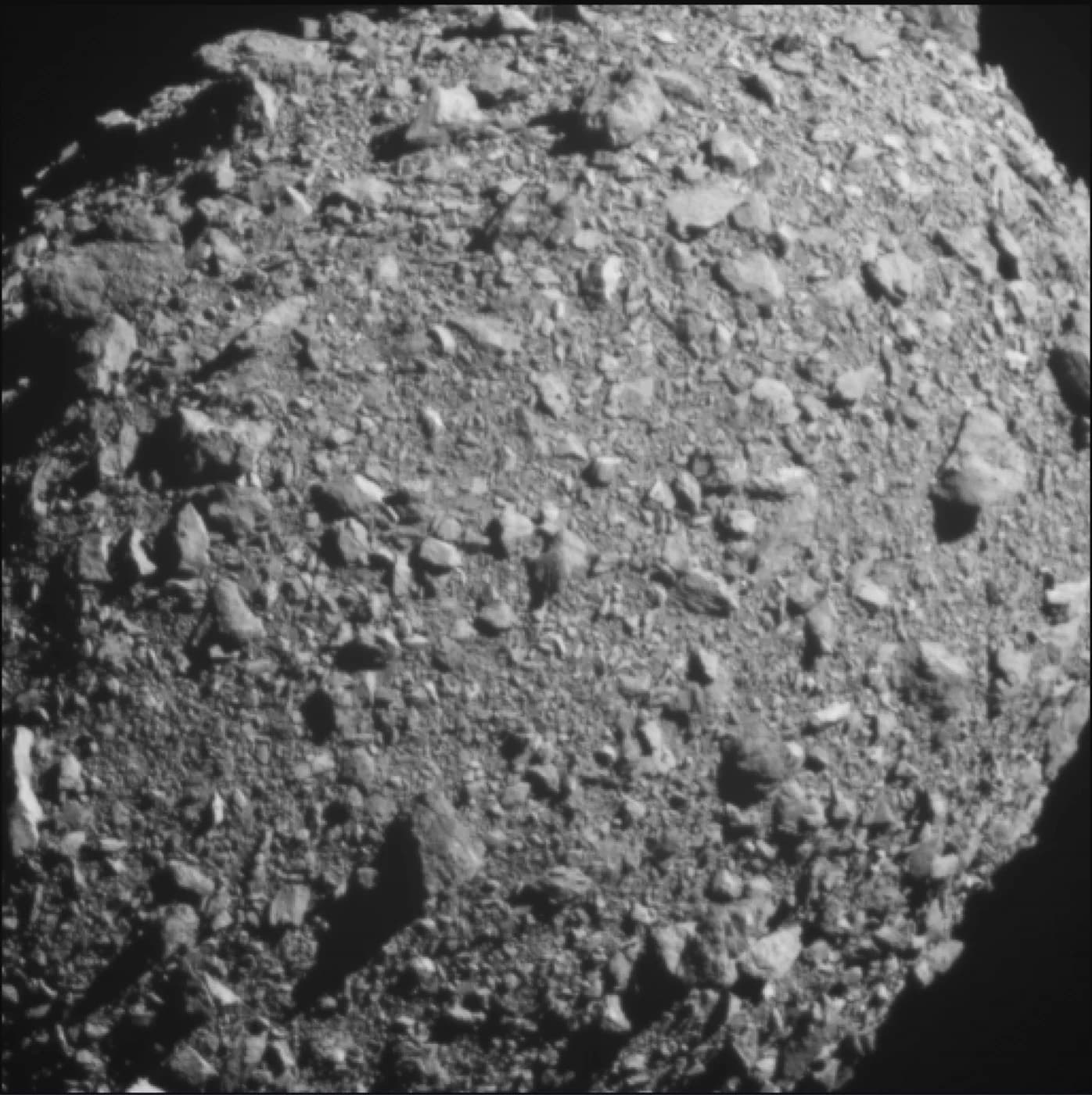
The European Space Agency (ESA) on 25 November 2026 released the first close-up images of the asteroid Dimorphos taken by its Hera spacecraft. They show that NASA's deliberate collision with the asteroid in 2022 flattened one side of it and left a crater as wide as the side that was hit.
Dimorphos is a small moonlet, about 151 metres across, that orbits a larger asteroid, Didymos, which is about 730 metres wide. The two are around 1 km apart, according to ESA's image release.
What do the new Hera images show?
The images show a stadium-sized impact crater stretching across the whole face of Dimorphos that NASA's Double Asteroid Redirection Test (DART) spacecraft struck. ESA said the crater contains unusual structures, including what looks like a cigar-shaped feature near its centre.
The featured frame was captured by Hera's Asteroid Framing Camera on 7 November from a distance of 29 km, with a resolution of 2.7 metres per pixel, ESA said.
The images also revealed hundreds of previously unknown boulders around the pair of asteroids, and showed that Dimorphos is now tumbling chaotically in its orbit, Physics World reported.
What did DART do in 2022?
DART, a 580 kg spacecraft, crashed into Dimorphos on 26 September 2022 at about 6.1 km per second. The impact shortened the moonlet's orbit around Didymos by 33 minutes, give or take a minute, far more than predicted, ESA has said. It was the first test of whether hitting an asteroid could change its path.
Hera, which launched in October 2024, was sent to study the aftermath in detail. Its first close-up image of Didymos was released earlier in November.
What scientists said
Michael Kueppers, ESA's Hera mission scientist, said the newly found boulders are something the team "will have to take account of" in the coming weeks, according to Physics World.
Hera mission manager Ian Carnelli noted that "NASA's DART mission demonstrated that we can change an asteroid's orbit."
Why it matters
Hera is a planetary defence mission. By measuring exactly how Dimorphos was changed by the impact, scientists hope to understand how reliably a spacecraft collision could push a dangerous asteroid off course in the future. The shape of the crater, the loose boulders and the tumbling motion all give clues about how the asteroid's material responded to the hit.
What next for Hera?
Hera is currently orbiting the asteroid pair at about 25 to 30 km. Over the next few weeks it will move closer to take higher-resolution images, and in January it will release two shoebox-sized CubeSats that will fly closer still, according to Physics World.