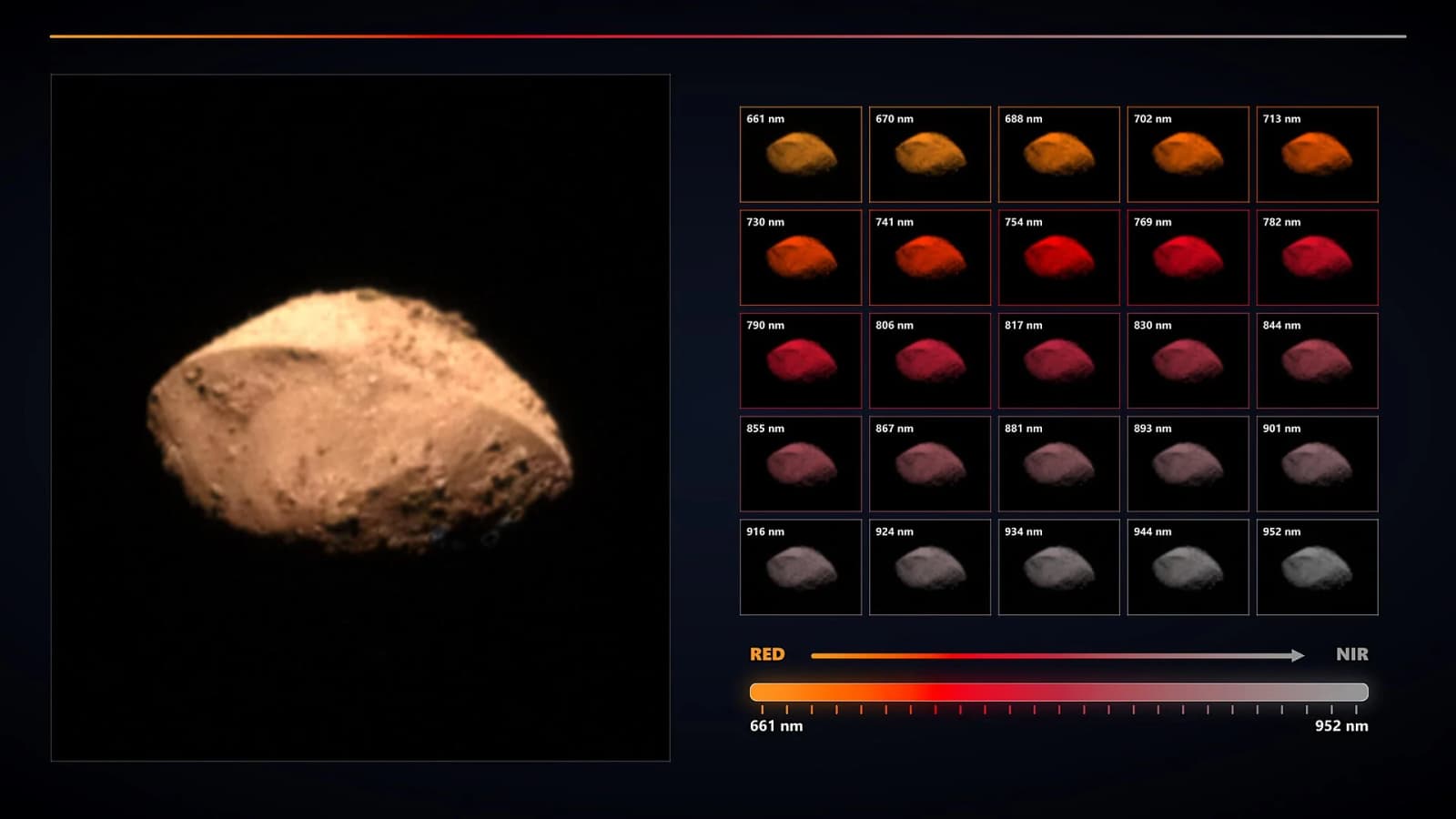
The European Space Agency (ESA) has released views of the asteroid Didymos taken by its Hera planetary defence spacecraft in visible, multispectral and thermal infrared light, and said on 18 November 2026 that the first close-up images of Dimorphos, the small moonlet that NASA deliberately struck in 2022, will be shown at a livestreamed event in Berlin, Germany, on 25 November.
What do the new images show?
They show the larger asteroid, Didymos, from just 28.5 km away, seen through three of Hera's instruments. In an ESA article published on 17 November, the agency said the Asteroid Framing Camera, used for both navigation and science, captured the asteroid at a resolution of about 2.7 metres per pixel. A second instrument, HyperScout H, records the surface in 25 different hues from visible red into the near-infrared, letting scientists compare the reflected light with laboratory measurements of meteorites and minerals to work out what the asteroid is made of. A third, the Thermal Infrared Imager supplied and operated by the Japan Aerospace Exploration Agency (JAXA), maps surface temperatures, which can indicate whether the ground is solid rock, porous or broken material, or loose dust.
Patrick Michel, Hera's principal investigator and director of research at the CNRS and the Observatoire de la Côte d'Azur, said the view "reveals the variety of surface features across the spinning-top-shaped Didymos, with boulder-rich area as well as clearer regions and traces of what might be landslides towards its central ridge". He added that because Didymos rotates every 2.2 hours, its fast spin "might actually be encouraging this migration of material towards the equator, helping form this ridge."
Dimorphos, which is 151 metres across and orbits the 780-metre Didymos, is almost entirely in shadow in these frames, ESA said. Only in the thermal image is the whole moonlet visible.
Why does Dimorphos matter?
It was the target of the first test of whether a spacecraft can nudge an asteroid off course. On 26 September 2022, NASA's 580-kg Double Asteroid Redirection Test (DART) spacecraft hit Dimorphos at 6.1 km per second, shortening its orbit around Didymos by about 33 minutes, according to ESA. Scientists still do not know whether the impact left a crater or reshaped the moonlet, what its mass and internal structure are, or why the deflection was much larger than simulations had predicted. Answering those questions is Hera's job, so that this "kinetic impact" method can become a well-understood way of protecting Earth.
What happens on 25 November?
ESA's media advisory says the Hera team will share the first close-up images of Dimorphos at the dinosaur hall of Berlin's Museum für Naturkunde. The livestream runs from 19:45 to 20:30 Central European Time on 25 November, which is 00:15 to 01:00 IST on 26 November, on ESA WebTV and ESA's YouTube channel.
"This event will share the first images showing how people altered the Dimorphos asteroid," said Hera mission manager Ian Carnelli.
What comes after that?
Closer passes and two small satellites. ESA mission scientist Michael Kueppers said the team will fly closer to the asteroids over the coming months and, early in the new year, release two shoebox-sized CubeSats to "venture even nearer than the main spacecraft". ESA says the survey will eventually progress to a landing.
Photo source · ESA, CC BY-SA 3.0 IGO