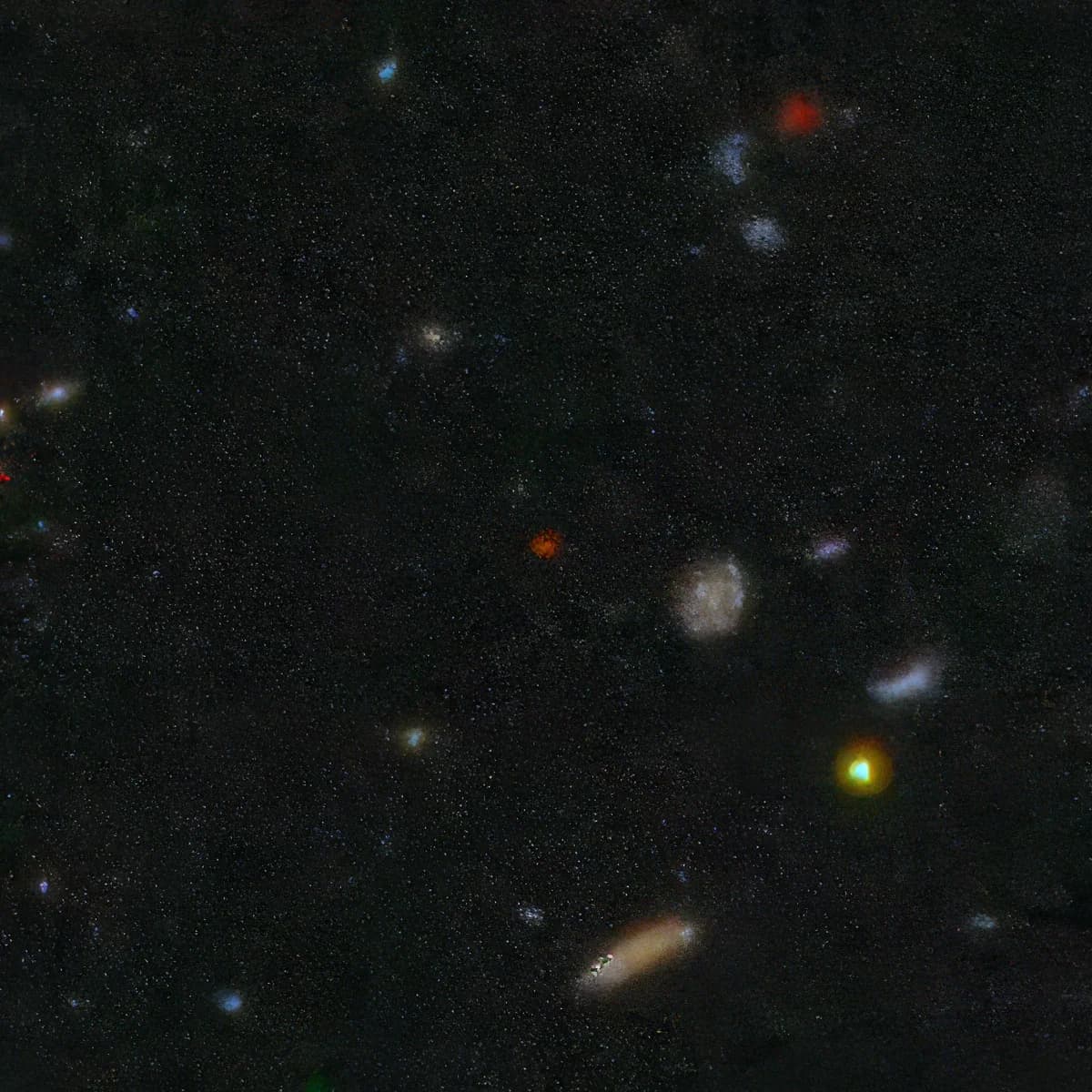
The European Space Agency (ESA) said on 24 November 2026 that its Euclid space telescope has found the most distant quasar known so far: a bright, feeding supermassive black hole of about 360 million times the mass of the Sun, seen as it was roughly 630 million years after the Big Bang. The object breaks a record that Euclid itself set only a few months earlier, pushing the view back by about 40 million years.
The quasar, catalogued as J1504+6252 and nicknamed Dún Aonghasa, sits at a redshift of 8.13, according to ESA's announcement. ESA said it is the first quasar identified beyond redshift 8. The light reaching us today left it about 13.1 billion years ago, when the Universe was only about 5% of its present age.
What is a quasar, and why does this one matter?
A quasar is the brilliant core of a young galaxy powered by a supermassive black hole that is pulling in gas, and the most distant ones help astronomers test how such giants formed so early. In this case, ESA said the black hole is unusually massive for its era but is currently growing slowly. That suggests it must have bulked up through very rapid bursts of growth before the moment Euclid captured, which the agency said puts pressure on existing models of how early black holes formed and grew.
How did Euclid find it?
ESA said the quasar was picked out from among millions of objects in about 18 months of Euclid survey data. Its distance and mass were then confirmed with follow-up observations from the W. M. Keck Observatory and the Large Binocular Telescope Observatory, as well as the NASA/ESA Hubble Space Telescope and the NASA/ESA/CSA James Webb Space Telescope. Webb's observations revealed the black hole's mass of about 360 million Suns, the agency said.
The findings are described in a paper led by J. Wolf and colleagues, published in the journal Astronomy & Astrophysics on 24 November 2026.
How does it compare with Euclid's earlier record?
In July 2026, a team led by Daming Yang, a PhD candidate at Leiden Observatory in the Netherlands, reported 31 quasars from Euclid data, including 12 new ones at redshift 7 or higher, according to Leiden University. The record-holder then was EUCL J172902.75+641018.1 at a redshift of 7.77, seen when the Universe was about 670 million years old. The newly announced quasar is seen around 40 million years earlier still.
ESA said Euclid has now announced 31 ancient quasars in about one and a half years and has found 12 new quasars beyond redshift 7, more than doubling the number known at that distance.
Why it matters
Very distant quasars are rare. ESA said quasars at redshift 8 are so scarce that only a few tens are expected across Euclid's entire survey. Each one gives astronomers a rare snapshot of the first billion years of cosmic history, when the earliest galaxies and black holes were taking shape. A black hole this heavy, this early, narrows the range of theories about how quickly such objects could have formed.
What happens next?
Euclid's sky survey is continuing. As more data come in, astronomers expect to find further quasars at similar distances, which would show whether Dún Aonghasa is an outlier or part of a wider population of early, overweight black holes.
Photo source · ESA/Euclid/Euclid Consortium/NASA, Wolf et al. 2026, CC BY-SA 3.0 IGO