The Directorate of Revenue Intelligence (DRI), working with the Bihar State Police, has seized 19.39 kg of elephant ivory and caught four people near the India-Nepal border in West Champaran district, Bihar, the Ministry of Finance said on 26 November 2026. According to the ministry, the four were stopped a day earlier, on 25 November, while riding on two two-wheelers.
What did the DRI find?
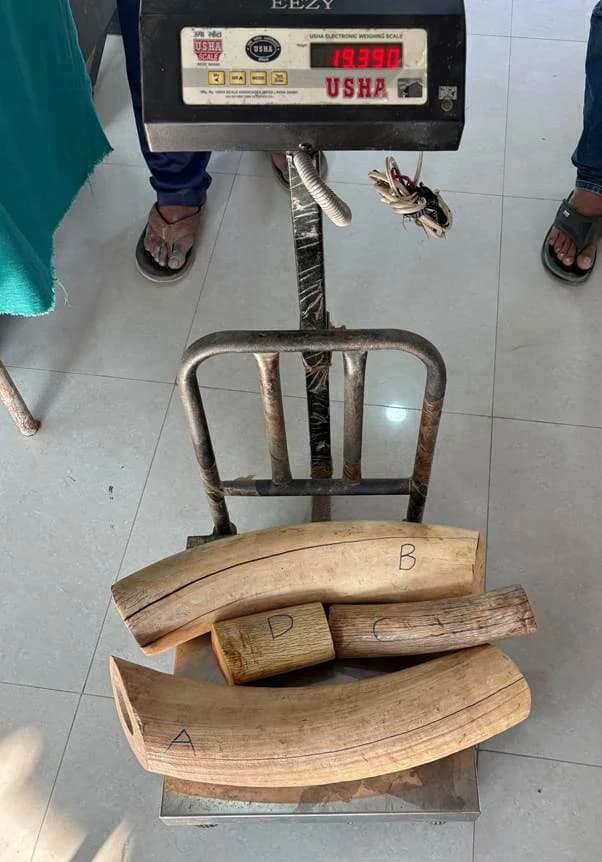
The DRI found 19.39 kg of elephant ivory in a bag that one of the four suspects was carrying, according to the Ministry of Finance press release. The ministry said the operation was based on intelligence. It said the suspects tried to run away and resisted the officers, but all four were caught. The ivory was seized under the Wildlife (Protection) Act, 1972.
A photograph released with the statement shows four pieces of tusk, marked A to D, on a weighing scale reading 19.390 kg.
Why is ivory trade illegal in India?
Trade in ivory is banned under Indian law because elephants are protected under Schedule I of the Wildlife (Protection) Act, 1972, the ministry said. The release also noted that elephants are listed in Appendix I of the Convention on International Trade in Endangered Species of Wild Fauna and Flora (CITES), the global treaty that controls trade in threatened species.
The ministry described illegal trafficking as a serious threat to elephant conservation and biodiversity. Elephants have been in the news this week for other reasons too: an Awadh-Assam Express train was stopped in Assam's Hojai so a wild herd could cross the tracks. Another recent case, a tigress found dead in a snare in Madhya Pradesh's Panna, also points to pressure on protected animals.
Why the border location matters
West Champaran sits on Bihar's border with Nepal, and the ministry stressed that the seizure was made near that border. It said the case shows the DRI's effort to break up networks that trade in protected species, using intelligence and working closely with other law enforcement agencies.
What is not yet known
The ministry's statement does not name the four people, say where they were taking the ivory, or give an estimated value. It also does not say which court the accused will appear before or whether more arrests are expected. MapMyTimes will update this report if officials release further details.
What happens next?
The case will proceed under the Wildlife (Protection) Act, 1972, under which the ivory was seized. Any charges against the four will be decided through the legal process, and they have not been convicted of any offence.
Photo source · Press Information Bureau (handout), Government of India