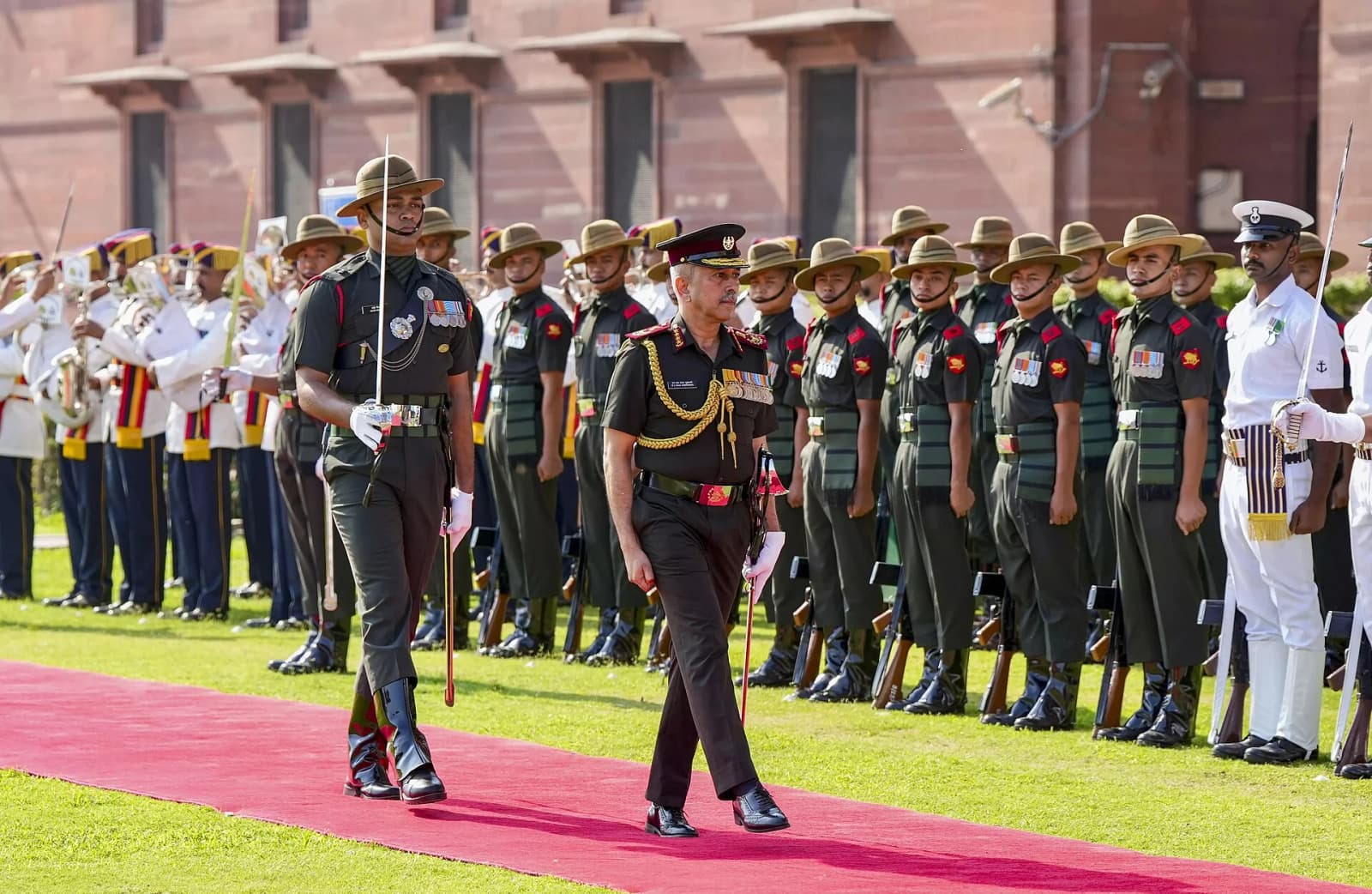
Chief of Defence Staff General N.S. Raja Subramani said on 27 November 2026 that India is being subjected to "cognitive warfare" by its adversaries "in an insidious way", and that the line between war and peace has blurred into what he called a "continuous state of contestation". He was speaking in New Delhi at a seminar hosted by the think-tank Vivekananda International Foundation (VIF) on the future of warfare and India's preparedness for multi-domain operations, according to a report by All India Radio News and the Press Trust of India (PTI).
What did the CDS say about cognitive warfare?
He said adversaries are already using cognitive warfare against India to sow division in society, create internal rifts and weaken the will and morale of the nation, PTI reported. He did not name any country or give specific examples. General Subramani argued that information warfare is "not a supporting function" but a "primary function of the commander", and that a commander today must devote as much time to the information domain as to operations.
He described cyber, space, electronic and cognitive warfare as activities that begin before a conflict, continue during it and outlast it. "So, we cannot say that we are either in a state of peace or war; we are in a continuous state of contestation," he said, according to PTI. He added that work is under way, together with the three services, to modernise the military's electronic warfare architecture.
Ten trends and a target force
The CDS listed 10 trends that he said are shaping future warfare, starting with the expanding battlefield and the blurring of peace and war. All India Radio reported that he said warfare is moving from network-centric to decision-centric operations, with greater reliance on artificial intelligence, persistent surveillance and integrated capabilities. He called for better coordination among the Army, Navy and Air Force, a joint communication network for faster decisions, and more attention to space-based assets, cyber defence, electronic warfare and subterranean warfare.
Multi-domain operations, he said, are about integrating capabilities to "pose multiple dilemma to an adversary", not just adding them together. He named an integrated command and control system as a prerequisite and called cyber defence an integral part. He also cautioned that technological superiority is "only transitory" and must be constantly upgraded, while trained manpower, logistics, industrial capacity and reliable allies matter as much as technology. "We want to be joint in design, multi-domain in orientation, have a tech-enabled capability, be Aatmanirbhar in thought and action, and finally a capable human-centric leadership," he said.
Operation Sindoor, China and the Makkah pact
General Subramani described the second phase of Operation Sindoor as an excellent example of joint, integrated, multi-domain operations and said it gave India escalation dominance and a "decisive victory", PTI reported. He also cited indigenous systems such as BrahMos and Akash, according to All India Radio.
Asked about China's launch of the Shenzhou-24 crewed spacecraft, which carried a Pakistani astronaut, he said Pakistan's space capability is "improving" with Chinese help and that this must be "factored into our calculus". He said India is "well-geared" along its northern frontier. He also named the Makkah Joint Defence Agreement between Pakistan, Türkiye and Saudi Arabia as an "unintended effect" of recent conflicts. Pakistan is hosting Saudi Arabia and Türkiye in Islamabad for talks under that pact this week.
Why it matters
General Subramani took charge as India's third Chief of Defence Staff and Secretary of the Department of Military Affairs on 31 May 2026, according to the Integrated Defence Staff. His predecessor, General Anil Chauhan (retd), who was CDS during Operation Sindoor, moderated the VIF session. The lecture sets out how the new CDS wants the armed forces to prepare for future wars: through integration of the three services, home-grown technology and a larger role for information and cyber defence. "We need not look at a prescribed template. We need to have our own template," he said.
The CDS did not announce any specific new policy, timeline or procurement during the address.
Photo source · HQ IDS, GODL-India