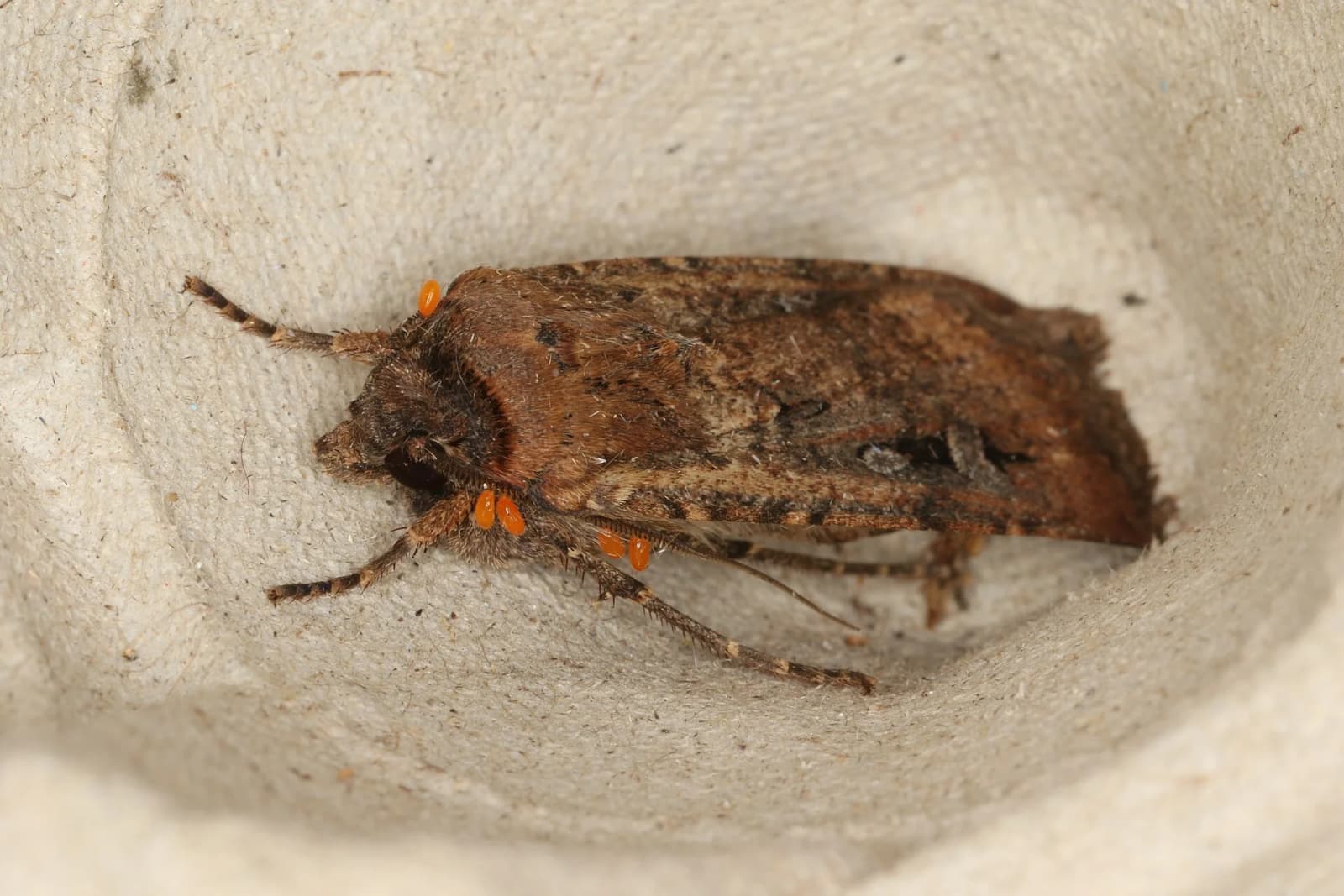
Australia's Bogong moth can steer its long night-time migration using Earth's magnetic field alone, sensing the angle of the field lines rather than their north-south polarity, according to a study published in the journal Nature on 18 November 2026 by researchers from Lund University in Sweden and partner institutions in Germany and Australia.
The paper, titled "Bogong moths navigate with a light-dependent geomagnetic inclination compass", was led by Hui Chen of Lund University, with zoologist Eric Warrant as senior author. The other authors are Linnea Rosberg, David Dreyer, Bo Leberecht, Henrik Mouritsen and Pauline Fleischmann. The team included researchers from Carl von Ossietzky University Oldenburg, the Australian National University and the University of South Australia.
What did the scientists find?
They found that the moths carry a magnetic "inclination compass" that works only in the presence of violet-blue light. The moth (Agrotis infusa) migrates twice a year, travelling up to 1,000 km between its breeding grounds and a small number of summer resting sites in the Australian Alps, the paper notes.
Inclination is the angle between Earth's magnetic field and the ground. According to the researchers, it grows steeper as one travels south and shallower towards the north, which gives an animal a way to tell direction without relying on whether the field points north or south.
How were the experiments done?
The team caught migrating moths using a light source and took them to a laboratory built from non-magnetic materials near Adaminaby in Australia's Snowy Mountains. There, each moth was tethered in a flight arena surrounded by magnetic coils, which let the scientists change the local magnetic field while recording the direction in which the insect tried to fly.
Under a randomised artificial starry night sky, the moths still flew in their inherited migratory direction using the magnetic field alone. When the field was turned by 180 degrees, or when its inclination was inverted, they flew the opposite way. When only the polarity was reversed, they did not turn.
Orientation also disappeared when violet-blue light (wavelengths between 380 and 500 nanometres) was filtered out of the lighting, or when the moths were exposed to weak broadband radio-frequency fields between 150 kHz and 60 MHz. The authors say this points to a light-dependent magnetic sense based on a "radical pair" mechanism – the same broad type of mechanism proposed for migratory birds.
Why does it matter?
The same Lund group reported in Nature in 2025 that Bogong moths use the stars as a compass and kept their course when clouds hid the sky, suggesting a magnetic back-up. The new paper says what that back-up is. The moths therefore have two independent compasses, one based on the stars and one on the magnetic field.
"It is remarkable that two such different groups of animals use the same basic principle to detect Earth's magnetic field," Warrant said, referring to insects and birds, whose evolutionary paths split about 700 million years ago, according to the university's release carried by Phys.org. Fleischmann, of Oldenburg, said the findings suggest "there are probably several types of magnetoreception", with migratory and non-migratory animals possibly using the field differently.
In announcing the 2025 study, Lund University said the Bogong moth is listed as endangered in Australia, largely because of drought linked to climate change.
What is still unknown?
The study shows how the moths use the magnetic field but not the molecules that detect it. "The next step is to understand in greater detail how this mechanism works," Warrant said.
Photo source · Donald Hobern, CC BY 2.0