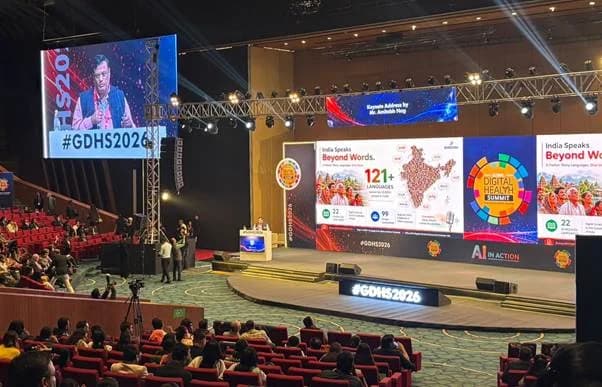
The government's language-AI platform BHASHINI showed how doctors at AIIMS New Delhi, JIPMER and Army hospitals are using speech-to-text in Indian languages to write prescriptions and clinical notes, at the Global Digital Health Summit (GDHS) 2026 at Bharat Mandapam in New Delhi, which ended on 21 November 2026. Amitabh Nag, CEO of the Digital India BHASHINI Division, gave a keynote on the summit's final day on breaking language barriers in healthcare, according to the Ministry of Electronics and IT release on the concluding day.
What is BHASHINI and what did it show?
BHASHINI is run by the Digital India BHASHINI Division under the Digital India Corporation of the Ministry of Electronics and Information Technology (MeitY). It supports 36 Indian text languages, 23 Indian voice languages and 35 international languages, and its ecosystem has logged more than 11 billion inferences, with about 24 million processed daily, the ministry said in an earlier release on 21 November.
The two-day summit, held on 20 and 21 November under the theme "Implementing Artificial Intelligence – AI in Action", featured a BHASHINI stall with three institutional partners:
- AIIMS New Delhi has linked BHASHINI's speech-to-text facility with NIC's eHospital prescription module so that doctors can dictate prescriptions.
- JIPMER has integrated e-BHASHINI with its e-Sushrut hospital management system for voice-based case histories, inpatient notes and discharge instructions.
- The Directorate General of Medical Services (Army) uses BHASHINI in its Dhanwantri system to turn doctors' spoken clinical notes into typed text.
Is it already in use at AIIMS?
Yes, and it is being expanded. Prof Dr Vivek Tandon, Professor In-charge of the Computer Facility at AIIMS, said in the ministry's release that doctors gave positive feedback during a pilot in Neurology and Neurosurgery and that the application "is now being rolled out across the institute".
Maj Gen Sandeep Bhalla of the Army's medical services said the force is "a multi-ethnic and multilingual organisation" and that the speech-to-text tool would save doctors time and let patients speak in the language of their choice. Dr Anand A of JIPMER's IT wing said the hospital's aim was that "language should never be a barrier to quality healthcare".
What is Data Daan for Health?
In his keynote, Nag highlighted Data Daan for Health, an effort to build healthcare datasets by recording the everyday phrases people use to describe symptoms in Indian languages and mapping them to medical terms. The ministry's example was the Hindi phrase "पैर में पानी भर गया है", which corresponds to the medical term oedema. The aim is to help AI systems understand how patients actually describe their complaints.
The stall also demonstrated Shrutlekh for real-time multilingual transcription and translation, the BHASHINI mobile app, Granthika for collecting written and oral language resources, and an AI-powered healthcare persona for voice-based interaction.
Why it matters
Nag said in the keynote that language is a critical but often overlooked layer of digital healthcare, and that care explained in a patient's own language, whether Bodo, Marathi, Punjabi or Maithili, can feel more reassuring. In a statement, he said the work with AIIMS, JIPMER and the Army showed multilingual AI being built into clinical workflows "from patient documentation to prescriptions".
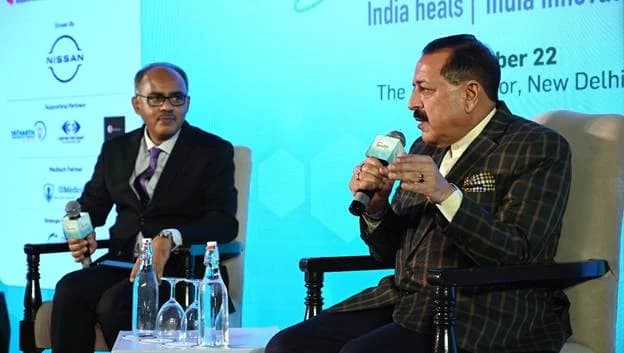
The releases did not give figures on how many doctors or patients currently use these tools, or a timeline for the AIIMS-wide rollout. The summit coincided with other health-technology discussions in the capital, including Union Minister Jitendra Singh's remarks on health research shifting towards prevention and genetics.