The European-Japanese spacecraft BepiColombo entered orbit around Mercury on 21 November 2026, ending an eight-year cruise from Earth, according to the European Space Agency (ESA) as reported by the journal Nature. The joint mission of ESA and the Japan Aerospace Exploration Agency (JAXA) becomes only the second mission to orbit the innermost planet, after NASA's MESSENGER, which circled Mercury from 2011 to 2015.
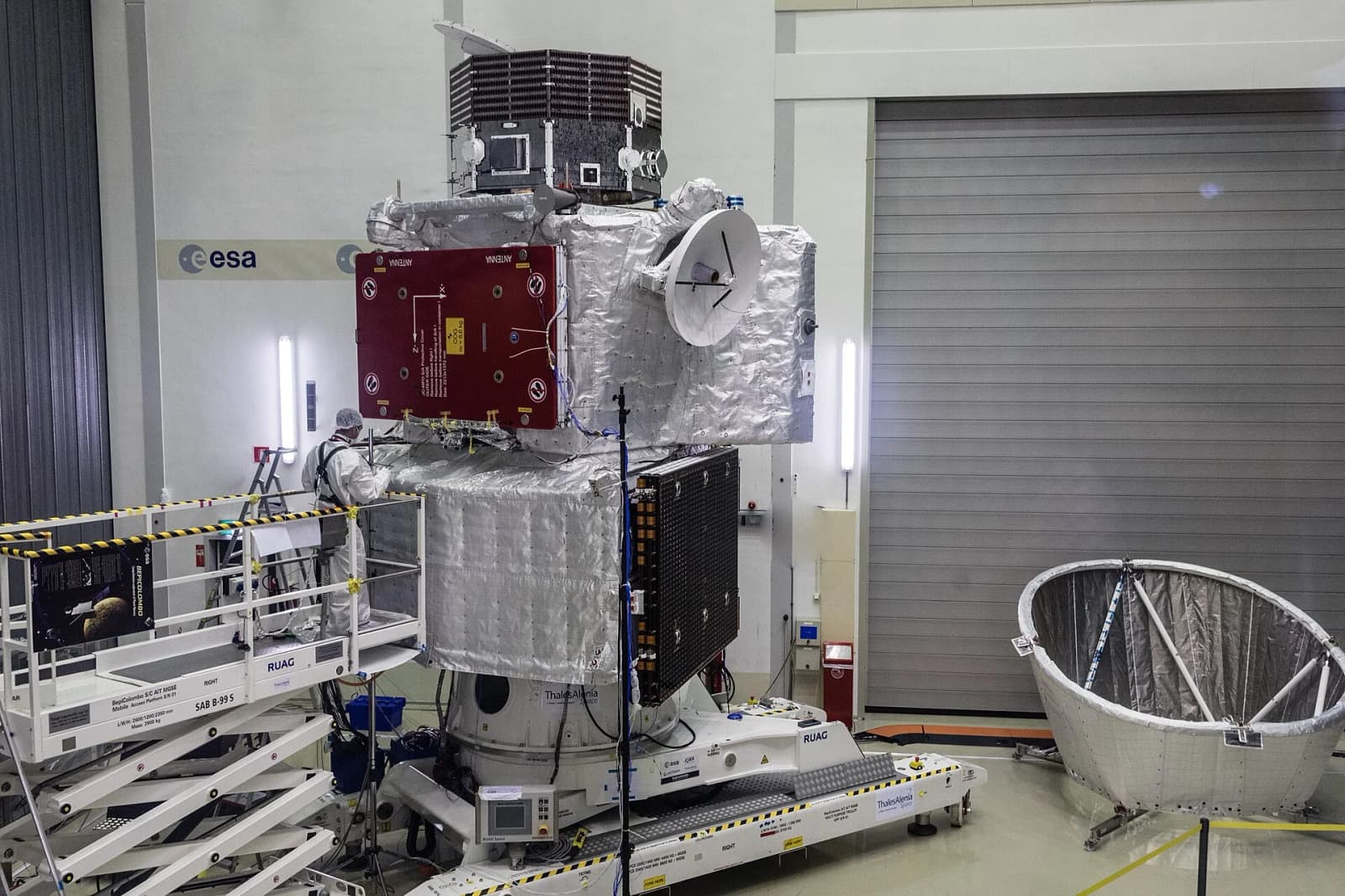
The spacecraft is still a single stack made of two science orbiters: ESA's Mercury Planetary Orbiter (MPO) and JAXA's Mercury Magnetospheric Orbiter, known as Mio. Over the next few months they will split up and move into separate orbits.
What happened on 21 November?
The orbit insertion was the main event of BepiColombo's arrival phase. Space.com reported that the insertion burn was scheduled to begin at 18:24 GMT (11:54 pm IST) on 21 November and last about 37 minutes. ESA then announced that the European-built orbiter had placed the stack into orbit around Mercury, Nature reported. The science magazine Eos, published by the American Geophysical Union, reported that the joined spacecraft approached from Mercury's night side and settled into an elliptical orbit.
Mercury is hard to reach because a spacecraft falling towards the Sun picks up speed and has to shed a great deal of energy to be captured by the small planet's weak gravity. "Energetically, it takes more energy to go to Mercury than to go to the outer Solar System," Emma Bunce, a University of Leicester scientist and one of the mission's lead researchers, told Nature.
A long road since 2018
BepiColombo launched in October 2018 on an Ariane 5 rocket from French Guiana and has flown past Earth, Venus and Mercury several times to lose speed. Its arrival was originally planned for December 2025 but slipped by about a year after a problem reduced the electrical power available to the electric thrusters of the Mercury Transfer Module (MTM), the propulsion stage that carried the orbiters.
The ESA mission updates page records that the MTM separated from the stack on 3 September 2026. On 15 September all instruments on MPO were switched on together for the first time since that separation, and early checks showed them in good health.
What happens next?
The two orbiters will stay joined until they reach Mio's planned orbit, after which they are due to separate on 9 and 10 December 2026, according to ESA. Mio will trace a stretched orbit between roughly 500 km and 11,000 km above Mercury to study the planet's magnetic field and its interaction with the solar wind. MPO will then lower itself step by step until about March 2027, reaching an orbit between roughly 400 km and 1,500 km to study the surface, Nature reported.
ESA says the mission's science phase is set to begin in April 2027. The mission aims to study Mercury's interior, including its large iron core, the origin of its magnetic field and how a planet so close to its star formed and evolved.
Instruments already tested
Some instruments have already been tried out on the way in. The University of Leicester said on 20 November that the Mercury Imaging X-ray Spectrometer (MIXS), the only UK-led science instrument on BepiColombo, recorded its first light by observing the Crab Nebula, a supernova remnant about 6,500 light-years away. The university described MIXS as the first imaging X-ray telescope on a planetary science mission and said it showed no stray light or radiation damage. MIXS will map the chemical elements on Mercury's surface by detecting X-rays the surface gives off.
Why it matters
With two orbiters working at the same time, BepiColombo will be the first mission to study Mercury from two spacecraft at once, ESA says. One will watch the planet's magnetic environment while the other maps the surface, giving scientists two complementary views of the planet at the same time.
Photo source · European Space Agency, CC BY-SA 3.0 IGO