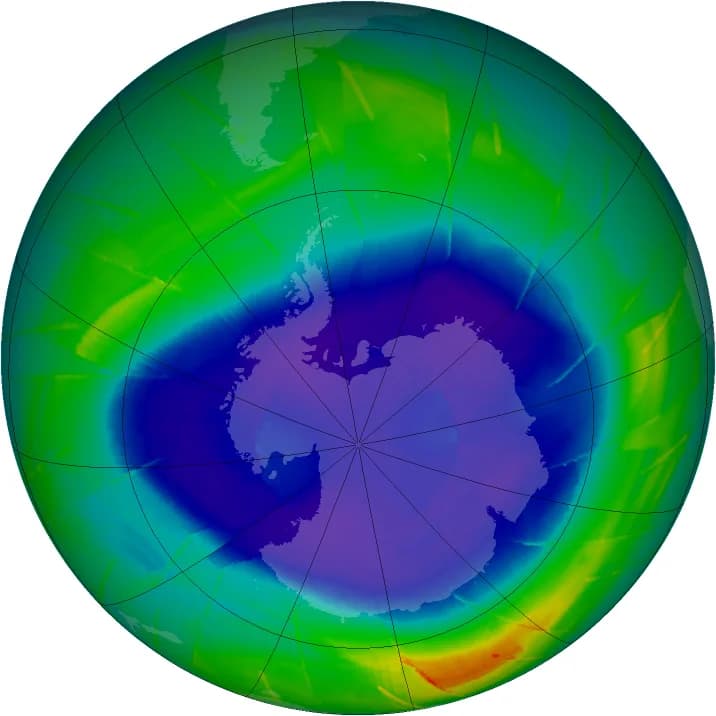
The seasonal ozone hole over Antarctica expanded to 27.3 million square kilometres on September 20, 2026—its widest area in a decade and 31% above the 20-year average—yet European Space Agency (ESA) scientists say global recovery of the protective stratospheric layer remains on course.
Reported by ESA on November 26 using Copernicus Sentinel-5P satellite data, the 2026 extent marked a sharp contrast with 2025, when the annual hole ranked as the fifth smallest since 1992. Separate measurements from NASA and the US National Oceanic and Atmospheric Administration (NOAA) on November 4 placed the September 7 to October 13 average at 25 million sq km, the seventh largest on record.
Why the 2026 Ozone Hole Expanded
- Persistent polar vortex: An unusually strong and long-lasting polar vortex trapped frigid air above Antarctica, preserving stratospheric temperatures cold enough for chemical reactions on polar stratospheric clouds to destroy ozone well into spring.
- Wide area, average depth: Despite sprawling roughly 6.5 million sq km beyond the two-decade seasonal norm—larger than the Antarctic continent itself—Tropomi spectrometer readings from Sentinel-5P showed ozone depletion depth stayed close to average.
- Annual seasonal cycle: Typically forming in August, peaking between mid-September and mid-October, and closing by late December, the hole fluctuates annually based on stratospheric winds and temperatures rather than rising emissions.
Montreal Protocol Progress and Future Monitoring
First identified by British Antarctic Survey researchers in 1985, severe Antarctic ozone depletion was traced to chlorofluorocarbons (CFCs), which release chlorine atoms in the stratosphere 15 to 35 kilometres above Earth's surface. Global phase-outs mandated by the Montreal Protocol continue to reduce ozone-depleting substances steadily.
Looking ahead, ESA noted that upcoming observations from Copernicus Sentinel-5 aboard MetOp Second Generation A-type satellites and the Altius mission will deliver higher-resolution vertical ozone profiles, helping climate agencies track long-term healing across the coming decades.