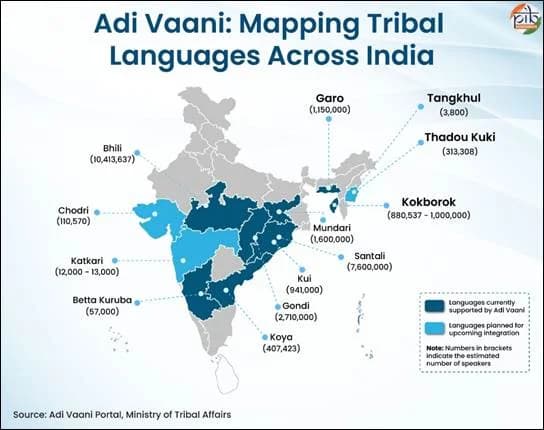
Adi Vaani, the Ministry of Tribal Affairs' AI-based translation platform for tribal languages, now offers text translation in nine languages and has crossed 35,000 Android downloads, according to a government backgrounder released on Sunday, 15 November 2026. The ministry is also weighing whether to turn it into a National Tribal Language Repository, the Press Information Bureau (PIB) said.
What Adi Vaani does
The platform was launched on 1 September 2025 and built by a consortium led by IIT Delhi, with BITS Pilani, IIIT Hyderabad, IIIT Nava Raipur and the Tribal Research Institutes (TRIs) of Jharkhand, Odisha, Madhya Pradesh, Chhattisgarh and Meghalaya, PIB said. More state TRIs joined later.
It began with Santali, Bhili, Mundari and Gondi. As of 15 October 2026, its tools included:
- text translation between supported tribal languages and languages such as Hindi and English;
- speech-to-text and speech-to-speech translation;
- optical character recognition for scanned documents and images;
- video subtitling; and
- more than 300 language primers and 24 dictionaries.
PIB put its monthly users at around 6,500. The backgrounder says the platform works with 13 tribal languages in all, from Bhili and Mundari to Kokborok, Betta Kuruba, Thadou Kuki, Tangkhul and Chodri, with some of these still being integrated.
Built on community data
Many tribal languages have few written records and little digital text or speech, which has left them outside mainstream language technology, the note said. Adi Vaani relies on native speakers who contribute words, sentences and voice recordings through TRIs and AdiKosh, the platform's word bank. Language experts check the material before it is used to train AI models.
The project aims to gather about 1,00,000 sentence pairs and 100 hours of speech for each language. By 15 October 2026, state TRIs had contributed around 13.9 lakh text sentences across ten languages and roughly 300 hours of speech, according to PIB. Models are retrained as more data comes in.
Why it matters
Citing Census 2011, the backgrounder said India has about 10.45 crore Scheduled Tribe people, around 8.6% of the population. PIB said tools like Adi Vaani could help in several areas:
- Schools: the National Education Society for Tribal Students has pointed to the possible use of the primers in more than 525 Eklavya Model Residential Schools with over 1.7 lakh students.
- Health: the platform carries translated awareness material on sickle cell disease.
- Markets and services: translation can help tribal entrepreneurs read market information and scheme details.
Towards a national repository
A Working Group on Tribal Languages, chaired by Tribal Affairs Secretary Ranjana Chopra, met for the first time on 15 October 2026. It includes the Central Institute of Indian Languages, IITs, universities and experts on endangered languages, PIB said. The meeting discussed making Adi Vaani a single national repository of corpora, primers, dictionaries and community stories.
Proposals placed before the group include a national baseline of tribal languages, digital archives and multilingual teaching material, district-level resource groups of trained tribal youth, and a two-year action plan with quarterly reviews.
What comes next
The ministry will circulate the agenda items and prepare a roadmap, according to the backgrounder. An upgraded version of the platform, an iOS app and five more languages were introduced at a conclave in Mysuru on 24 August 2026, PIB added.