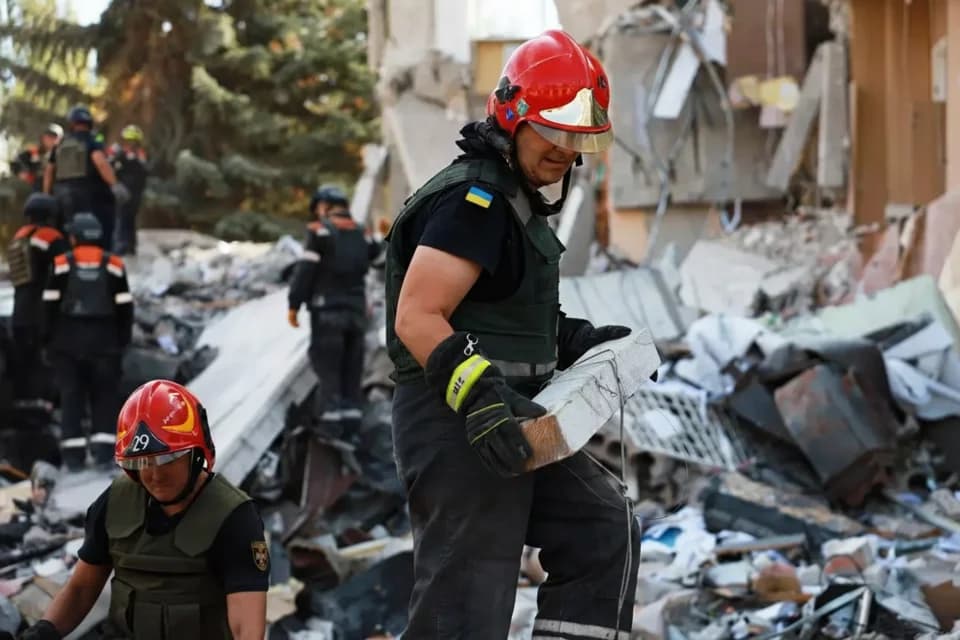
Ukraine has ended a two-week search of the rubble in the front-line village of Komyshuvakha, where a Russian air attack on 2 November is now known to have killed 72 people. Ukrainian officials say Russian forces went on striking the site while bodies were being recovered, an accusation on which Moscow has not commented.
Final toll: 72 dead, four missing
Interior Minister Ivan Vyhivskyi announced the end of the search and rescue operation on Facebook on 16 November, the Ukrainian state news agency Ukrinform reported. He put the death toll at 72, up from the 55 reported in the first days, and said four people are still missing. Four people pulled out in the first hours after the attack remain in hospital.
According to the minister, the dead include emergency workers, police officers, staff of a school and an administrative services centre, municipal workers and medical personnel. One of them was a teacher who had been running online lessons for evacuated children from the shelter, Ukrinform reported. Forensic experts carried out dozens of DNA tests to identify the remains.
The BBC, citing Ukraine's State Emergency Service (DSNS), reported that the toll makes Komyshuvakha the second deadliest single incident of the war.
What happened on 2 November
Komyshuvakha lies in the Zaporizhzhia region, a few kilometres from the front line. Ukraine says Russia carried out two attacks in succession on a humanitarian aid centre there. According to the BBC's reconstruction, people had gathered after a local Telegram group said aid would be handed out between 10:00 and 12:00 local time. Ukrainian authorities say a first strike at 09:45 hit buildings above ground and killed one woman.
Police bodycam footage analysed by BBC Verify, filmed about an hour later, records radio warnings of a second strike and people being told to run to the underground shelter, before a large explosion is heard. Ukraine says the shelter was hit by a 3,000 kg aerial bomb. Two weapons specialists consulted by the BBC, Trevor Ball of Armament Research Services and former UK National Crime Agency investigator Chris Proops, said the crater and recovered fragments were consistent with a FAB-3000 fitted with a guidance kit.
'Clearly marked' rescue vehicles hit, says Ukraine
Vyhivskyi said Russian forces struck the village 11 times during the operation, and that nine of those attacks were aimed directly at the search site, according to Ukrinform. Three police officers and four rescuers were injured and equipment was damaged. The DSNS gave the BBC similar figures, adding that two rescue dogs were hurt and five vehicles damaged.
An officer of Ukraine's SBU security service investigating the attack, identified by the BBC only as Oleksiy, said the rescue vehicles were "clearly marked" and accused Russia of "deliberately destroying humanitarian equipment". "The enemy knows perfectly well that what is being carried out there is essentially a humanitarian operation to search for the dead," he said. BBC Verify said it had confirmed police videos from the day after the attack in which rescuers shout "drone, drone" and run for cover.
Russia's position
The BBC said it asked Russia's Defence Ministry about the Komyshuvakha attacks and received no reply. A general statement issued by the ministry on 2 November said Russian forces had targeted energy and transport infrastructure used by Ukraine's military. The BBC noted that the village has no military or industrial facilities but is close to a key route used for Ukrainian troop movements, supplies and evacuations. Officials have said soldiers who came to help with the rescue are among the dead, the broadcaster reported.
Legal experts' view
Ben Saul, professor of international law at the University of Sydney, told the BBC the strike "appears to be either a deliberate attack on civilians or civilian objects - a war crime - or an indiscriminate attack - also a war crime". Yale University's Samuel Moyn said "directly targeting rescuers or their equipment is a gross violation of international humanitarian law". The allegations have not been tested by any court.