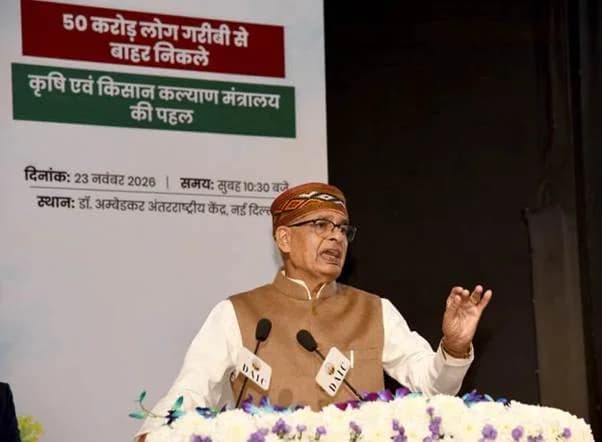
Union Agriculture and Rural Development Minister Shivraj Singh Chouhan on 23 November 2026 chaired a one-day joint workshop of his two ministries at the Dr Ambedkar International Centre in New Delhi to review their role in reducing poverty, and said the government's next task is to stop people who have escaped poverty from slipping back and to lift the remaining 2.6 to 2.7 per cent of the population above the line, according to the Agriculture Ministry.
The ministry cited a recent World Bank report as saying that nearly 500 million people in India have moved out of poverty and that extreme poverty has fallen from 27.1 per cent to 2.6 per cent. Chouhan called this an "extraordinary, unimaginable and unprecedented miracle" and credited Prime Minister Narendra Modi's leadership as well as officials at every level.
Who took part in the workshop?
The workshop brought together staff from four departments: Agriculture and Farmers' Welfare, Rural Development, Land Resources, and Agricultural Research and Education. Ministers of State Bhagirath Choudhary and Kamlesh Paswan attended, along with Secretaries Atish Chandra, Rohit Kansal and Dilip Kumar, and ICAR Director General M. L. Jat. The ministry said Chouhan deliberately invited section officers and assistant section officers, not just senior officials, and at one point left the stage to sit among employees and ask for their suggestions.
What figures did the ministries present?
According to the ministry's account of the presentations:
- India's decadal agriculture growth rate has reached 4.45 per cent, which Chouhan said was higher than the 3 to 3.5 per cent typical during the Green Revolution.
- More than ₹4.66 lakh crore has been paid directly to farmers under PM-KISAN; foodgrain output stands at 376.56 million tonnes and horticulture output at 386.91 million tonnes.
- ICAR said every rupee spent on agricultural research and education returned ₹13.85, and ₹20.81 in animal husbandry research; 3,436 crop varieties have been released since 2014, 93 per cent of them climate-resilient.
- Over 10 crore women are linked to self-help groups under DAY-NRLM, and 3.76 crore have become 'Lakhpati Didis'.
- PMAY-Gramin has built 3.99 crore houses and PMGSY has created 7.99 lakh km of all-weather rural roads.
- Watershed works under PMKSY have covered 3.40 crore hectares and directly benefited 61.15 lakh farmers, with farm incomes rising by up to 70 per cent, the ministry said.
The release also said rural households are now assured of 125 days of work under the Viksit Bharat – G RAM G scheme. These figures are the ministries' own and were presented at an internal review; the release did not give independent estimates.
Why it matters
The Agriculture and Rural Development ministries run several of the country's largest welfare and income-support programmes, from PM-KISAN to rural housing and jobs. Chouhan's emphasis on preventing a return to poverty points to protecting vulnerable households from shocks, not just counting those who have crossed the line.
What happens next?
Chouhan invited staff to write to him with ideas on the budget, changes to existing schemes or new initiatives to raise farm incomes, and said suggestions had already come in on PM-KISAN and e-NAM. He said he would hold informal, department-wise meetings with junior staff, and asked officials to take the departments' work to the public. Looking ahead, he named targets for 2029, 2030–31 and Viksit Bharat@2047, and said free trade agreements should help Indian farm products compete in global markets.
The Rural Development Ministry is also set to launch its Nayi Chetna 5.0 gender campaign on 25 November.
Photo source · PIB