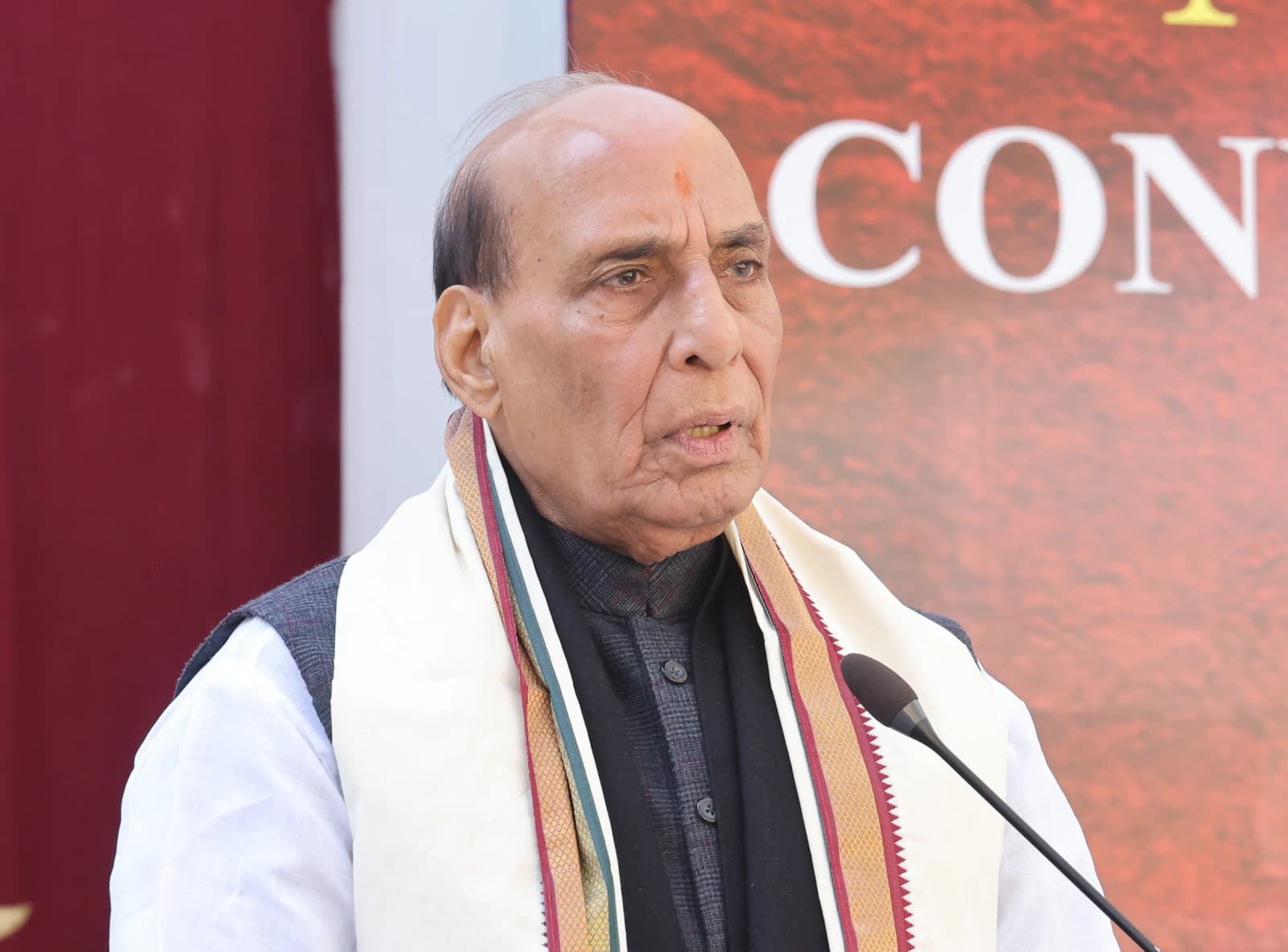
Defence Minister Rajnath Singh on 26 November 2026 asked the National Defence College (NDC) in New Delhi to turn the research done by its senior officer-students into practical policy advice for the government, while warning that the security environment around India is becoming more complex. He was speaking at the convocation and valedictory ceremony of the college's 66th course.
What did Rajnath Singh say about threats?
Mr Singh said traditional military threats now exist alongside cyber-attacks, disinformation, economic coercion, supply-chain disruption and other forms of hybrid warfare, according to the Ministry of Defence press release. He said these were blurring the line between internal and external security, and between peace and conflict.
He pointed to a shifting global balance of power, new centres of strategic influence and changes in traditional alliances. India's location, long land borders, maritime interests and growing international role placed it in a complex strategic setting, he said, calling for planners to anticipate risks and prepare institutions for future threats while still responding to immediate ones.
What changes did he ask the NDC to make?
He asked the college to link its teaching more closely to real policymaking. His suggestions, as listed by the ministry, were:
- The NDC, in consultation with the Ministry of Defence, should pick a few major national security challenges for detailed study in every course, on subjects such as India's neighbourhood, border management, maritime security, critical technologies, economic security and critical infrastructure.
- Serving senior military officers, civil servants and other authorities should be able to formally put real operational and policy problems to course participants.
- Selected studies should end in reports with "specific, practical and actionable" recommendations, formally submitted to the Ministry of Defence and other ministries.
- Strategic gaming exercises should use emerging technologies to create more realistic scenarios.
"Every course at NDC should leave behind not merely a graduating batch of trained strategic leaders, but also a body of research, analysis and policy recommendations," Mr Singh said, according to the release.
Who attended the course?
The ministry said 122 officers took the 47-week course, which runs from January to November. They included officers from the defence forces, civil services and police, and 40 foreign officers from 24 countries, among them Australia, Bangladesh, Japan, Russia, Saudi Arabia, the UK and the USA.
Mr Singh welcomed new sessions on artificial intelligence, robotics, unmanned vehicles, aerospace and semiconductors, and a dedicated AI module. He also referred to the course's Executive MBA in Strategic Leadership and Public Policy, offered with the Indian Institute of Technology (IIT) Madras.
Why it matters
The NDC trains officers expected to hold senior security and policy posts. The minister's call is for that training to feed directly into government decisions, rather than stay in classrooms. The speech came the same day India and the UAE agreed to speed up co-development and co-production of defence equipment at a meeting in Abu Dhabi.
What happens next?
The ministry's release does not say when or how the NDC will adopt the minister's suggestions. NDC Commandant Air Marshal Manish Kumar Gupta and IIT Madras Dean (Faculty) Professor K Murali attended the ceremony.
Photo source · Press Information Bureau (handout), Government of India