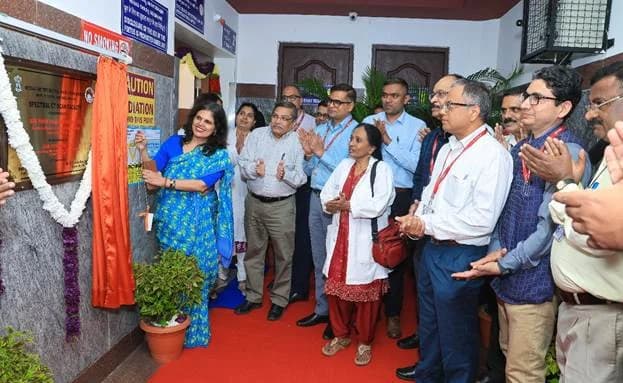
Union Health Secretary Punya Salila Srivastava on 27 November 2026 inaugurated an advanced spectral CT facility in the Emergency Block of the National Institute of Mental Health and Neuro Sciences (NIMHANS) in Bengaluru, Karnataka, and used the visit to review the institute's national programmes on mental health, suicide prevention, addiction treatment and brain health, according to a Ministry of Health and Family Welfare release.
The review brought out several new figures, including that the government's Tele-MANAS tele-mental health service has now crossed 50 lakh calls.
What does the new scanner at NIMHANS do?
The scanner is meant to speed up emergency diagnosis, especially for stroke and other conditions affecting the brain's blood vessels, where minutes can matter. The ministry said the facility uses GE's Revolution Apex Elite, a 256-detector-row CT system with spectral imaging and AI-based image reconstruction, and that it will run round the clock to handle the heavy patient load at the Emergency Department.
According to the release, the system can help doctors quickly identify brain haemorrhage and arterial blockages, and can also be used to evaluate heart and vascular disorders, complications after procedures, and patients with multiple injuries. It is designed for neurological, cardiac, vascular and whole-body imaging in both adults and children.
How far has Tele-MANAS reached?
Tele-MANAS (Tele Mental Health Assistance and Networking Across States) has passed the milestone of 50 lakh calls, the ministry said. The programme has grown through integration with other helplines, awareness drives, counsellor training and accreditation, and quality-assurance measures. Its vision for 2027-32 focuses on widening access, improving service quality and linking the service more closely with the wider health system.
Addiction treatment and suicide prevention in numbers
The Centre for Addiction Medicine at NIMHANS, one of six centres supported under the ministry's Tobacco Control and Drug De-addiction Programme, treated 25,913 people with addictive disorders between January and October 2026, the release said, with more than 7,000 of them receiving follow-up through telemedicine. Its Addiction Rx mobile app has recorded about 19,600 downloads across 145 countries, and the Tobacco Quitline it runs has received over 36,000 calls. The centre is also working on AI-enabled tools to help spot addiction early, particularly among young people.
On suicide prevention, the NIMHANS N-SPRITE centre, which follows the four pillars of the National Suicide Prevention Strategy of 2022, reported that its Urban Self-Harm Study (USHAS) has recorded 42,382 cases since 2022. Of these, 31,557 survivors received interventions, and the reported re-attempt rate was 1.3%. The centre now operates in 37 government hospitals across Karnataka.
Ms Srivastava was also briefed on the institute's recently launched student wellness centre, which offers counselling, short-term therapy and twice-weekly psychiatric consultations to students.
Why does this matter beyond Bengaluru?
Several of the programmes reviewed are being positioned as templates for the rest of the country. The Karnataka Brain Health Initiative (KaBHI), run by NIMHANS with the state government and developed in consultation with NITI Aayog, has carried out 2.61 lakh screenings and treated 32,630 patients, and the ministry's National Task Force on Brain Health has proposed it as a model for a national effort.
A proposed hub-and-spoke network for head trauma and stroke care in Karnataka would add a Neurohub at KMCRI in Hubballi and an Acute Stroke Emergency and Assessment Centre at NIMHANS, aiming to get patients to timely emergency neurological care through regional hubs and referral links. The review also covered a joint capacity-building programme with the Central Institute of Psychiatry in Ranchi and LGB Regional Institute of Mental Health in Tezpur to train psychiatrists, clinical psychologists, psychiatric social workers and nurses.
What happens next?
The ministry said it will continue to support early diagnosis, addiction care, suicide prevention and brain health work. The next steps flagged in the release include the 2027-32 plan for Tele-MANAS, expanded training and digital consultation at the addiction centre, and the proposed Karnataka stroke and trauma network, for which no timeline was given.
Public health has been a busy beat this week: the Health Ministry's pavilion at the trade fair in New Delhi drew around 1.5 lakh visitors for free check-ups, and Karnataka recently opened a 250-bed district hospital in Hosapete.
Photo source · Press Information Bureau (PIB), Government of India