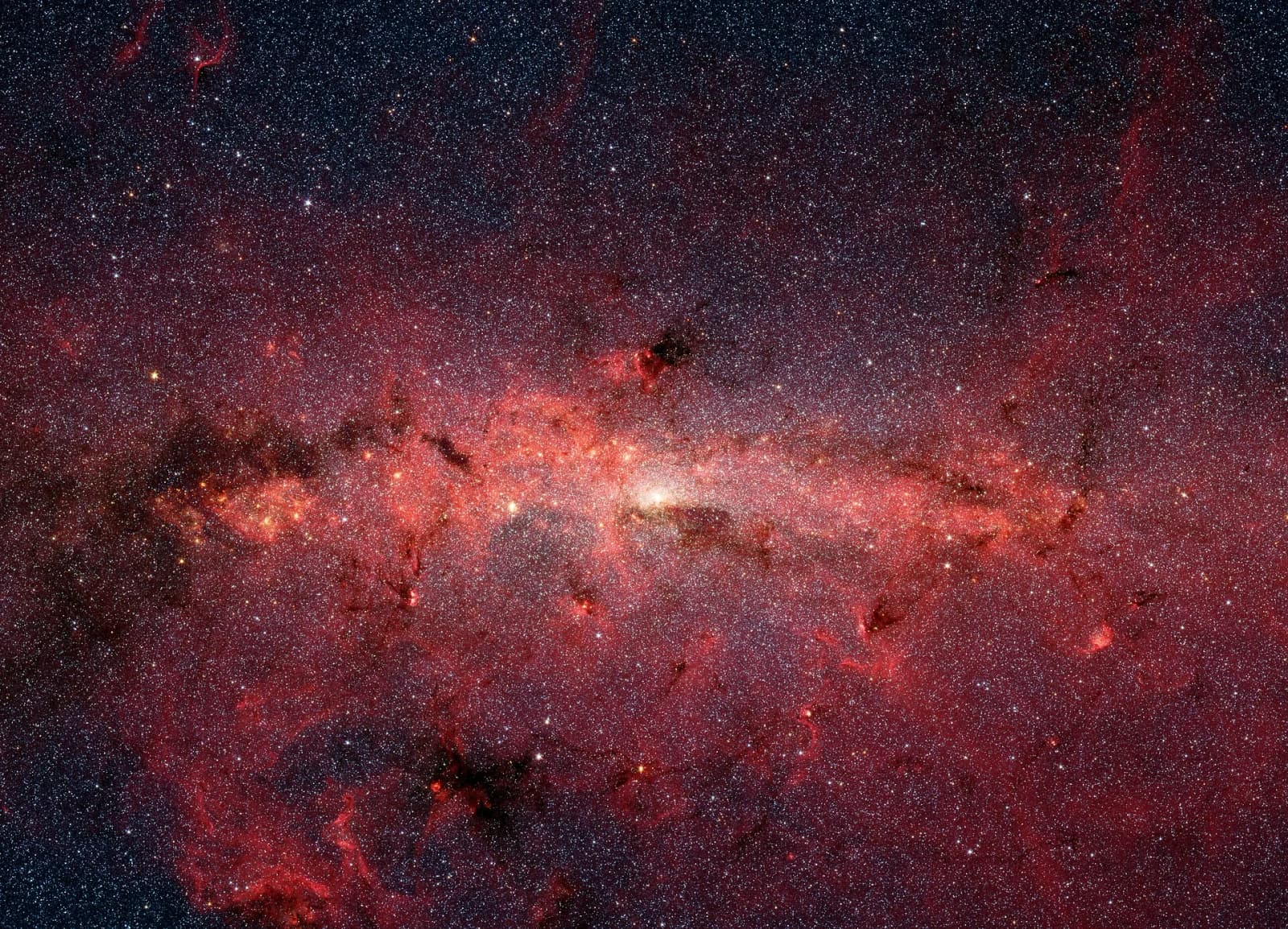
Infrared observations from NASA's SPHEREx space telescope demonstrate how longer wavelengths reveal the densely obscured heart of our galaxy behind 13 billion years of accumulated cosmic dust, the agency highlighted in an Astronomy Picture of the Day feature on November 25, 2026.
Why Near-Infrared Fades While Mid-Infrared Penetrates
Unlike household dust composed of pollen, debris, and skin cells, interstellar dust particles are hundreds of times smaller and consist of tiny compounds of oxygen, carbon, and other heavy elements expelled by dying stars across cosmic history.
In multi-wavelength false-colour imagery collected by SPHEREx, shorter near-infrared light—such as 1.2 microns—scatters off and is absorbed by these dense clouds, leaving the Galactic Center largely hidden behind dark lanes. Longer mid-infrared wavelengths, however, pass cleanly through the dust clouds and reach the telescope, illustrating a scattering principle related to why sunsets appear red on Earth.
By mapping the Galactic Center across sequential infrared bands, SPHEREx enables astronomers to separate foreground dust structure from star-forming regions and stellar populations clustered near the Milky Way core.