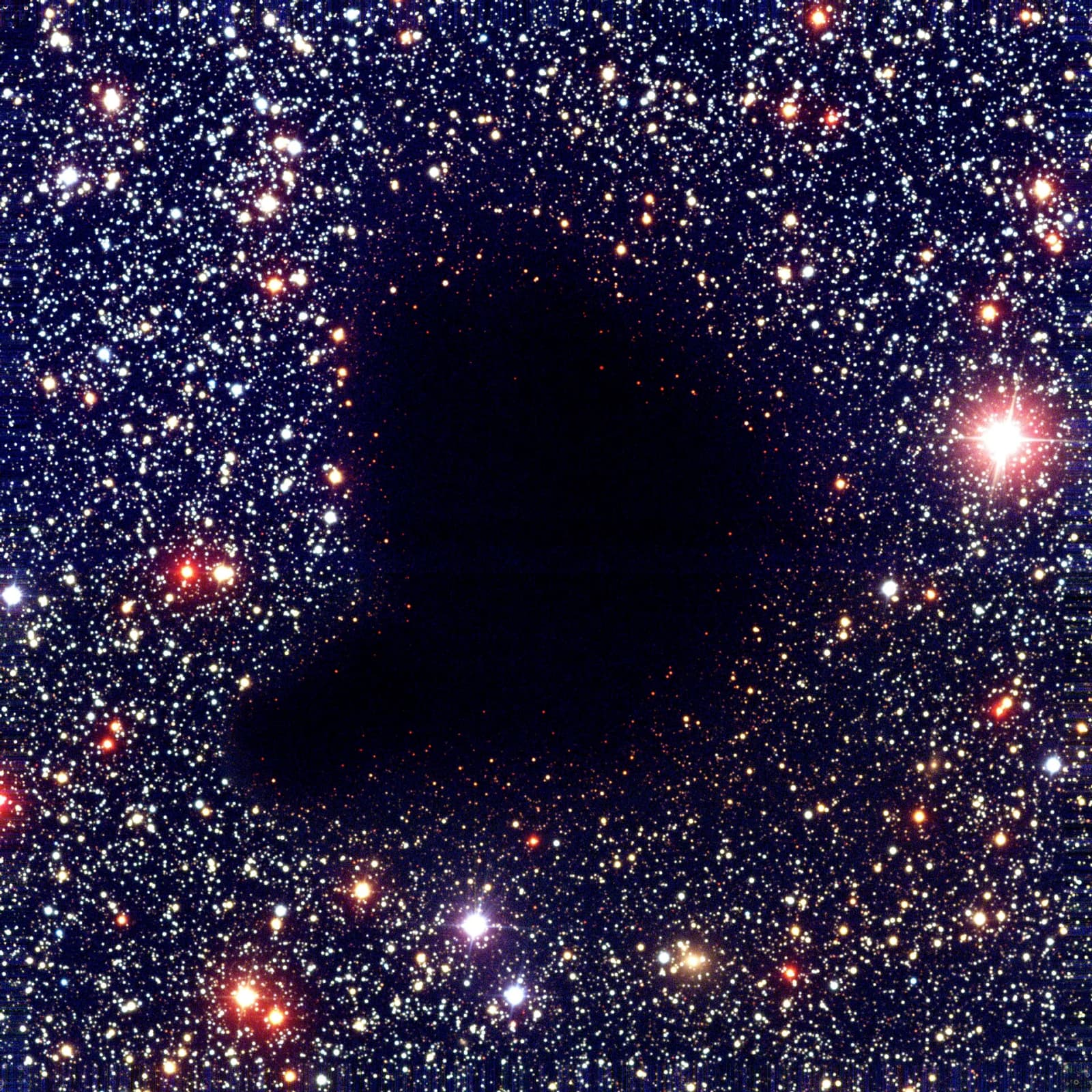
NASA featured the dark molecular cloud Barnard 68 as its Astronomy Picture of the Day on November 29, 2026, illustrating how dense pockets of interstellar dust and gas blot out visible starlight and serve as potential cradles for new stars.
Why Barnard 68 Looks Like a Hole in the Sky
Located in the direction of the constellation Ophiuchus (the Snake Carrier), Barnard 68 appears against a rich field of Milky Way stars as an opaque silhouette devoid of light. Rather than being an empty void, the region contains a heavy concentration of cold dust grains and molecular gas that absorbs virtually all visible light emitted by stars behind it.
Because no foreground stars appear across its core, astronomers have determined that Barnard 68 sits relatively close to Earth, with measurements placing it roughly 500 light-years away and spanning about half a light-year across.
Infrared Views and Future Star Formation
Shielded from external starlight by their own dust, the interiors of dark absorption nebulae rank among the coldest and most isolated environments in the cosmos. While astronomers still study the exact mechanisms that assemble clouds like Barnard 68, observations indicate that Barnard 68 itself is likely on course to gravitationally collapse and give rise to a new star system.
Although optical telescopes capture only a black outline, infrared instruments can penetrate the dust layers directly, revealing faint background stars behind the cloud and offering insight into how dense molecular cores evolve toward stellar birth.