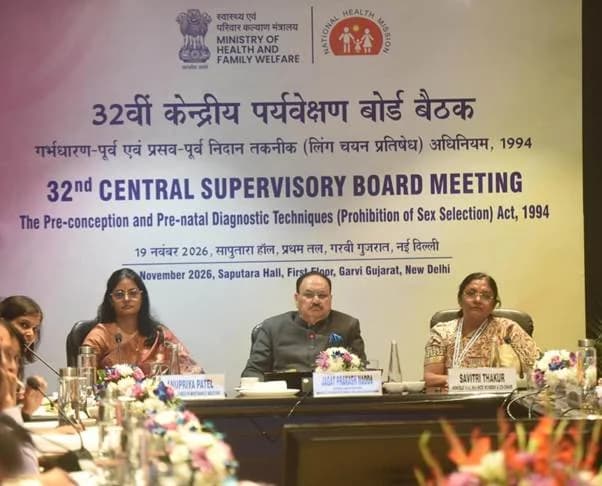
Union Health Minister Jagat Prakash Nadda on 19 November 2026 chaired the 32nd meeting of the Central Supervisory Board (CSB) in New Delhi to review how states and Union Territories are enforcing the Pre-conception and Pre-natal Diagnostic Techniques (Prohibition of Sex Selection) Act, 1994, the law that bars sex determination of a foetus. According to the Health Ministry's release, the Sample Registration System (SRS) 2024 report puts India's sex ratio at birth at 918, with several states and Union Territories recording improved figures.
The meeting was held at Saputara Hall in Garvi Gujarat, New Delhi, according to the banner in the official photograph. Union Ministers of State Anupriya Patel (Health and Family Welfare) and Savitri Thakur (Women and Child Development) attended along with Union Health Secretary Punya Salila Srivastava.
What did the board decide?
The ministry's account does not list any formal decision or rule change. It says the board discussed recommendations of the High-Level Committee on Non-Financial Regulatory Reforms in the context of strengthening the Act, and that members put forward suggestions to keep the law in step with new challenges.
Discussions, the ministry said, covered the use of digital processes, training of Appropriate Authorities (the officials who register and inspect diagnostic facilities under the Act), engagement with doctors, targeted interventions and the sharing of good practices between states.
What did Nadda ask the states to do?
Nadda asked states and Union Territories to carry out regular inspections of registered facilities and to follow up promptly on violations. He said the Act's approach needed fresh perspectives because diagnostic technology keeps changing, and called on regulators, state governments, enforcement agencies and other stakeholders to keep talking so that meaningful recommendations emerge.
Closing the meeting, he said technology must be used to advance healthcare and social inclusion and must not be allowed to enable sex selection or gender discrimination, the release said.
What other speakers said
- Anupriya Patel said a balanced sex ratio is critical for holistic development, and that education and a change in mindset are essential to close the gender gap.
- Savitri Thakur pointed to the Beti Bachao Beti Padhao scheme as a tool for promoting the value of the girl child, and stressed sustained awareness and community participation.
- Punya Salila Srivastava called for coordination between the Centre and states and for using the ministry's digital initiatives in an integrated way. She said effective enforcement needs continued engagement with stakeholders, including medical professionals.
Why it matters
A sex ratio at birth of 918 means 918 girls are born for every 1,000 boys. The Central Supervisory Board is the national body that reviews how the PC&PNDT Act is enforced, and its emphasis on inspections and digital monitoring shows where the Centre wants states to focus. Ultrasound clinics and other registered diagnostic centres are likely to see that push first, through more inspections.
What is still not known
The release did not give state-wise sex ratio figures, the number of violations detected, or a timeline for any amendment arising from the reform committee's recommendations. Any formal change to the rules would need a separate notification from the ministry.