Railway Minister Ashwini Vaishnaw said on 20 November 2026 that India's first high-speed rail service will begin in 2027, with the Surat–Vapi stretch in Gujarat set to open first. In a post on the newsletter platform Substack, reported by the Press Trust of India from New Delhi, the minister said the remaining corridor up to Mumbai would be opened in phases after that.
When will India's first bullet train run?
According to the minister, the first service is slated for 2027, beginning on the Surat–Vapi section. He did not give a month for the launch in the remarks carried by PTI. Track trials of the indigenous trainset are expected by mid-2027, so the opening date will depend on how quickly testing and the remaining works progress.
How much of the corridor has been built?
Vaishnaw shared progress figures as of September. They include:
- 456 km of pier work and 371 km of viaduct completed;
- six lakh noise barriers installed along a 299 km stretch;
- 9,300 overhead electrification masts put up across 206 km of viaduct;
- four mountain tunnels excavated, and civil work finished at eight stations, where architectural finishing is now under way;
- work in progress at three rolling stock depots at Sabarmati, Surat and Thane.
The undersea tunnel near Thane
In Maharashtra the line runs through a 21 km tunnel, 7 km of which passes beneath Thane Creek. The minister described it as India's first undersea rail tunnel. About 5 km of this tunnel has been dug using mountain-tunnelling methods. Two tunnel boring machines were launched from Vikhroli and Sawli in July 2026; each has a 13.6-metre cutterhead, weighs more than 3,000 tonnes and is 96 metres long. Vaishnaw compared each machine to a building "as tall as a 4-storey building".
Made-in-India trains
Integral Coach Factory (ICF) and BEML are building an indigenous trainset called B28, designed for 280 kmph. The first body frame has been completed and is undergoing structural tests. A faster B35 trainset, designed for 350 kmph, is planned as the next step. The minister also said key components of the electrification system, including major transformers, mast cross arms and feeder and protection wires, are being made in India.
Why has the project taken so long?
The project was announced in 2017. Vaishnaw said work in Maharashtra could not start for about two and a half years because state permissions and land acquisition were pending, and the COVID-19 pandemic caused a further delay of around two years. Full-scale construction began only in 2021, which he said meant "serious construction is just five years old". The same figures were carried in a PTI report published by Telangana Today.
What it means for travellers
For passengers in south Gujarat, the Surat–Vapi opening would be the first chance to ride a high-speed train in India. Travellers between Mumbai and Gujarat will have to wait for the phased extension of the line, for which no dates were given.
What is confirmed so far is the minister's 2027 target and the progress figures he cited; the railway ministry has not yet announced a fare structure or a timetable for the first section.
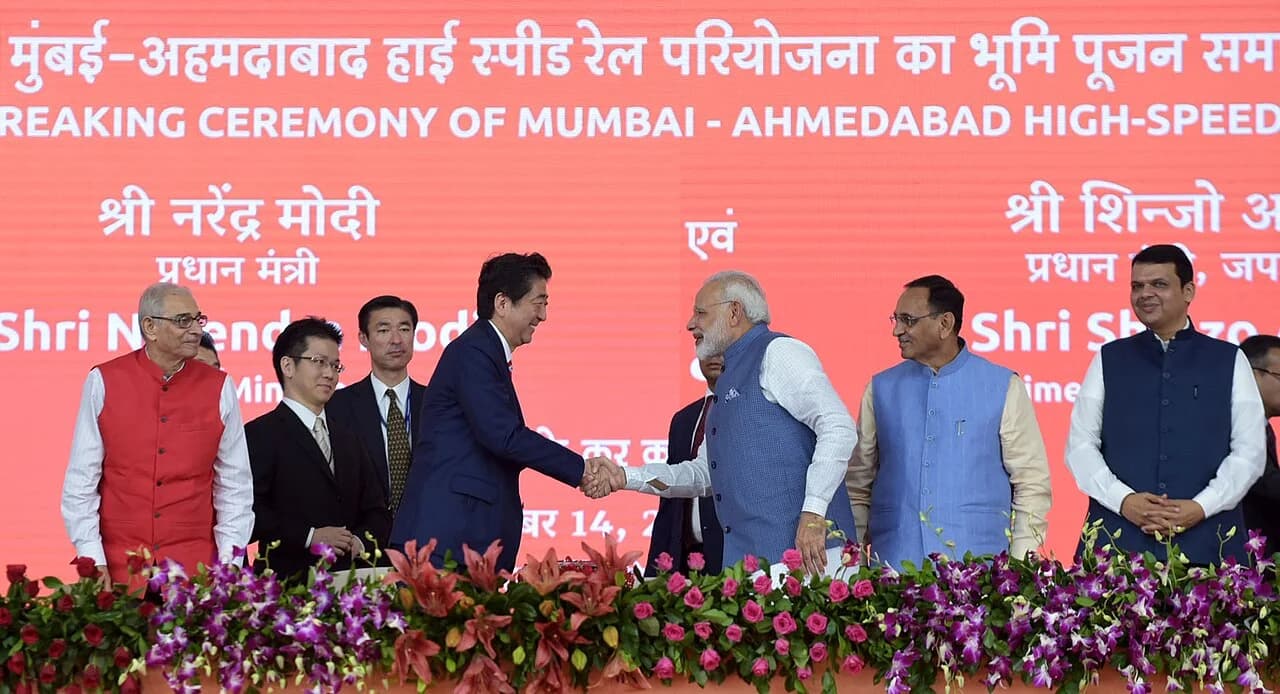
Photo source · Prime Minister's Office, GODL-India