About 3.76 crore rural women in self-help groups (SHGs) had become "Lakhpati Didis" by June 2026, and households in the scheme saw their average monthly income rise by 61 percent, according to a government backgrounder released on Sunday, 15 November 2026.
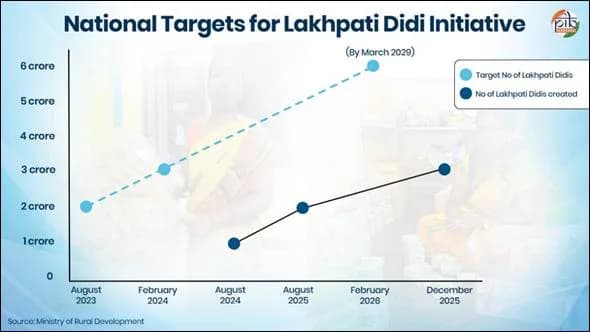
The Press Information Bureau (PIB) note, based on Ministry of Rural Development material, said the government now aims to create six crore Lakhpati Didis by March 2029, double the earlier target.
Who counts as a Lakhpati Didi
Under the initiative, a Lakhpati Didi is an SHG member whose household earns at least ₹1 lakh a year. PIB said the benchmark looks at total household income, not the woman's individual earnings, and counts income from eligible farm and non-farm activities after expenses. The income is expected to hold up across farming seasons or business cycles.
The initiative is run through the Deendayal Antyodaya Yojana-National Rural Livelihoods Mission (DAY-NRLM), launched in June 2011. As of 12 November 2026, DAY-NRLM had brought about 10.13 crore women into 94.40 lakh SHGs, the backgrounder said.
What the IIM Ahmedabad study found
PIB cited an independent evaluation by IIM Ahmedabad that covered 6,531 respondents in 17 states and union territories. It reported:
- a 61 percent increase in average monthly household income; and
- a 61.7 percent increase in average monthly savings in Lakhpati Didi households.
The backgrounder also said 5.70 crore women had been identified as "Potential Lakhpati Didis" by June 2026.
How the target kept rising
According to PIB, the government announced the initiative on 15 August 2023 with a goal of two crore women. The interim Budget of February 2024 raised it to three crore. One crore women had reached the income mark by August 2024 and two crore by August 2025, and the three-crore target was met by December 2025, ahead of schedule, the note said. In February 2026 the goal was revised to six crore by March 2029.
How women are identified and supported
The note described a five-stage process. Potential beneficiaries are identified through the SHG network and the LokOS digital platform. Household income and spending are recorded in a Digital Aajeevika Register, which began in May 2024. Trained Community Resource Persons then prepare individual business plans, and women receive three years of coordinated help with training, finance, livelihood assets and market access. National and state missions monitor progress, and state missions validate the reported results.
Consultations with states identified 12 priority livelihood sub-sectors, including bamboo, honey, goat rearing, poultry and tasar silk, PIB said.
Checks on the numbers
The backgrounder said the government added checks in 2025-26 to flag unusual income entries, and asked state missions to reconcile discrepancies and certify their figures, which it said made progress assessments more credible. Other recent steps listed include an app for individual enterprise loans in February 2026, an upgraded LokOS in May 2026, and a public Lakhpati Didi dashboard launched on 29 June 2026.
What it means and what is next
PIB said the initiative aims to move rural women beyond subsistence activities through diversified livelihoods, financial inclusion, skills and enterprise support. Meeting the new goal would require adding about 2.24 crore more Lakhpati Didis between June 2026 and March 2029, based on the figures in the note.