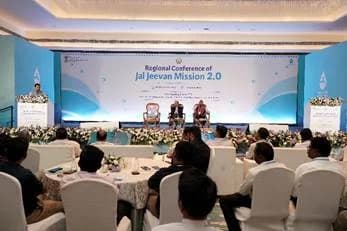
The Centre has told states that the next phase of its rural drinking water programme must go beyond laying pipes and fixing taps, and focus on whether water actually flows reliably and safely every day. The message came at the close of the first Regional Conference on Jal Jeevan Mission (JJM) 2.0 in Tiruchirappalli, Tamil Nadu, on Saturday, the Ministry of Jal Shakti said.
From tap connections to dependable service
Addressing the concluding session, Ashok K. K. Meena, Secretary of the Department of Drinking Water and Sanitation (DDWS), said JJM 2.0 aims to ensure regular, reliable and safe supply, with a long-term goal of round-the-clock potable water directly from household taps, according to the ministry.
He said the formal handover of village water schemes to gram panchayats, called Jal Arpan, should not be treated as a ceremony but as the start of a lasting partnership between the state government, the implementing department and the panchayat. He also suggested that officials attending Jal Arpan events drink water straight from village taps to build public confidence in its quality.
Meena said panchayats would need continued technical support, handholding and training to run water services, including training for elected representatives using material adapted to local conditions. Pointing to rising water stress, he urged states to use the mission's Decision Support System to plan rainwater harvesting, groundwater recharge and other source sustainability measures.
Field visits on the Cauvery
The second day of the two-day conference was given over to field visits. Meena's team started at the historic Grand Anicut (Kallanai) on the Cauvery, then inspected riverbed collector wells and headworks at Vadugakudi before joining the Jal Arpan Diwas celebration at Palamaneri village, the ministry said. There, members of the village water and sanitation committee described how household tap connections had changed their daily lives, and women from a Sujalam Shakti group demonstrated water testing with field test kits.
Five teams in all, led by senior officials, visited infrastructure at Vadugakudi, Thiruchinampoondi, Thindukarai, Nochiyam and Keelaanbil and took part in handover events in Palamaneri, Ambedkar Nagar, Theeranmanagar, Ayyampalayam and Puthu Uthamanur. The events included the handing over of scheme documents and as-built drawings to panchayats, along with community pledges and water quality demonstrations.
Kamal Kishore Soan, Additional Secretary and Mission Director of the National Jal Jeevan Mission, drank water directly from a household tap during his village visit and encouraged other officials to do the same, the ministry said. He stressed that panchayats should be assured of continued support from implementing departments, especially for major repairs and breakdowns.
Reform deadlines and what comes next
Summing up the deliberations, Joint Secretary D. Senthil Pandian said action points, responsible agencies and timelines had been fixed after a departmental summit in September 2026, followed by consultations with the ministries of Panchayati Raj, Skill Development, Tribal Affairs and Rural Development. The JJM 2.0 reforms he listed include formal handover of assets to panchayats, operation and maintenance policies, dedicated district technical units, water quality monitoring, digital mapping through Sujalam Bharat and source sustainability planning.
He asked states to stick to the reform timelines they have committed to ahead of a national-level review proposed for February 2027. Five regional conferences are planned as part of that review process, and Tiruchirappalli was the first, bringing together seven states and union territories. On the first day, Union Jal Shakti Minister C. R. Paatil called for faster completion of pending works and for key structural reforms to be put into operation, the ministry said.
Why it matters
The conference signals a shift in emphasis for the mission, from building infrastructure to making villages capable of running and paying for their own water systems. How quickly states complete handovers, train panchayats and secure operation and maintenance funding will be tested at the February 2027 review.