The Indian Navy frigate INS Sahyadri sailed out of Japan's Yokosuka naval base on 12 November 2026, wrapping up India's participation in Exercise Malabar 2026, the four-nation naval drill that brings together the navies of India, Japan, the United States and Australia.
The Ministry of Defence said in a release on 13 November that the exercise had concluded successfully, with the ship's departure marking the end of a deployment that began when it arrived at Yokosuka on 4 November.
What the sea phase involved
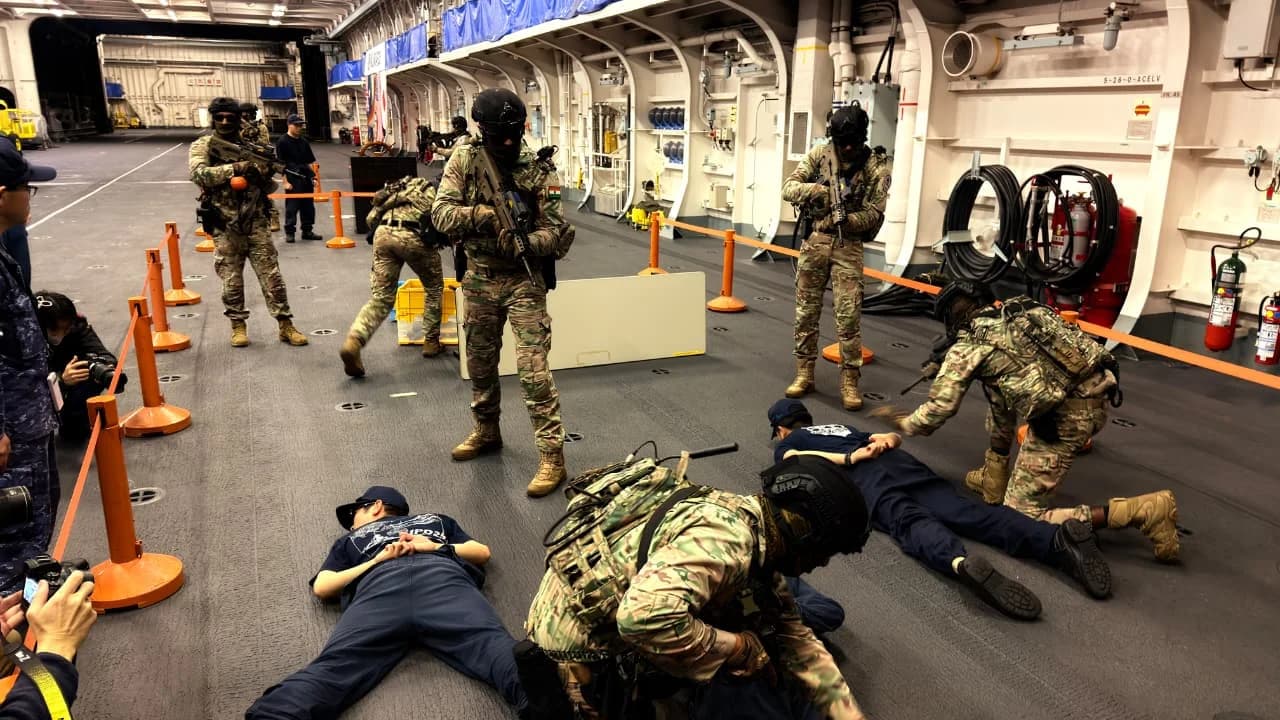
According to the ministry, the sea phase covered a broad range of drills. These included anti-submarine warfare exercises, visit, board, search and seizure (VBSS) drills, maritime interdiction operations, gunnery firings, replenishment at sea and cross-deck helicopter landings, in which helicopters operate from the decks of partner warships.
The ministry said these activities gave the participating navies an opportunity to improve interoperability, operational coordination and their understanding of each other's procedures.
Harbour phase at Yokosuka
Before heading out to sea, the four navies held a harbour phase at Yokosuka, home to a major Japan Maritime Self-Defense Force (JMSDF) establishment. The ministry said this phase included operational coordination meetings, cross-ship visits, sports fixtures and cultural programmes aimed at building rapport among personnel.
When INS Sahyadri arrived on 4 November, it was received by the JMSDF. An earlier ministry release said the welcome ceremony was attended by Vice Admiral Yagi Koji, Commandant of the Yokosuka District, and R Madhu Sudan, Deputy Chief of the Indian Mission in Japan.
The ship
INS Sahyadri is an indigenously built guided-missile stealth frigate of the Indian Navy's Eastern Fleet. It belongs to the Shivalik class, the first class of stealth frigates designed and built in India, and was constructed at Mazagon Dock in Mumbai.
Why Malabar matters
Malabar began in 1992 as a bilateral exercise between India and the United States. Japan later became a regular participant and Australia rejoined in 2020, since when the drill has been held with all four countries that also make up the Quad grouping. The exercise is widely seen as a measure of how closely the four navies can operate together in the Indo-Pacific.
The ministry said the successful conclusion of this year's edition reaffirmed the participating navies' shared commitment to maritime cooperation and collective security in the Indo-Pacific region. It linked India's participation to MAHASAGAR, short for Mutual and Holistic Advancement for Security and Growth Across Regions, the government's stated vision for maritime engagement with partner countries.
What comes next
The ministry did not announce the frigate's next port of call. The host and dates for the next edition of Malabar have also not been announced so far.
PS · Press Information Bureau (PIB)