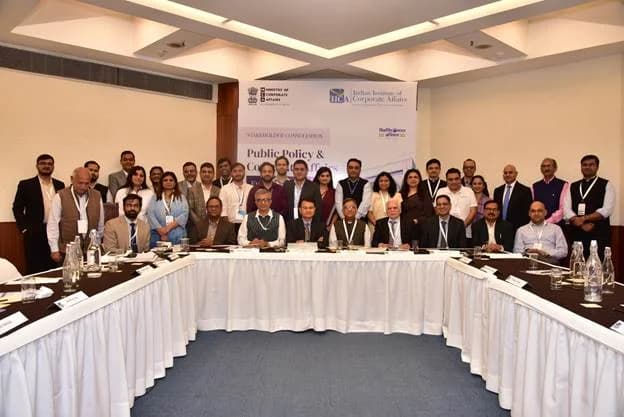
Public policy work inside Indian companies needs to move from a mindset of "control" to one of "trust", participants at a stakeholder consultation organised by the Indian Institute of Corporate Affairs (IICA) in New Delhi argued, according to a release issued by the Ministry of Corporate Affairs on 14 November 2026.
The consultation, titled Public Policy & Corporate Affairs: Evolving Roles & Professional Development, was held at the India Habitat Centre. The ministry described it as a high-level gathering but did not specify the exact date, saying only that it took place recently. IICA functions as a think tank under the Ministry of Corporate Affairs.
What the consultation set out to do
According to the ministry, the meeting had three aims: to define the scope of the public policy function within organisations, to identify the capabilities that professionals in this field need, and to look at how learning pathways could be strengthened so that they serve both organisational goals and national priorities.
More than 50 senior representatives took part. They came from listed and multinational companies, consulting and advisory firms, think tanks, industry associations, academia and civil society, and were joined by senior government officials and policy researchers.
Voices from government and industry
Gyaneshwar Kumar Singh, Director General and CEO of IICA, gave the inaugural theme address. He called for continuous and meaningful dialogue between the public and private sectors and linked the exercise to IICA's broader mandate of building capacity in both government and industry. He said the way organisations understand policy, contribute to it and use it in decision-making has a bearing on the quality of governance and the wider business environment.
Several former senior civil servants spoke at the opening session:
- Amarjeet Sinha, former Secretary to the Government of India, pressed for collaborative governance and predictable policy, with businesses engaging regulators before, during and after a policy change.
- Dr Anup K. Pujari, also a former Secretary, spoke of the need to develop mid- and late-career professionals into a cadre capable of bridging the public and private sides of the regulatory system.
- Arun Goyal, another former Secretary, pointed to the private sector's growing role in how regulatory bodies function and how regulation is developed, a role he said goes well beyond liaison.
From the corporate side, Rajiv Agarwal, Chief Corporate Affairs Officer at Tata Consultancy Services, stressed communication and behavioural skills and the need to align policy work with internal stakeholders and company strategy. Richard Rekhy, Vice Chairman of Grant Thornton Bharat, said policy professionals require financial acumen and an understanding of national and global value chains to advise business leaders, adding that evidence should be the basis of trust.
Three tracks of discussion
The deliberations were split into three tracks: the public policy and corporate affairs function itself, the changing role of the people who perform it, and their education and professional development.
Participants identified two core tasks for the function: helping an organisation understand what a policy means for its strategy, and contributing credibly to policy debates. They also discussed how responsibility should be divided with legal, compliance and business teams, and how early policy specialists should be involved in strategic decisions.
The group outlined the skills expected at different career stages. These included a working knowledge of how governments and regulators make decisions, economic and data-based reasoning, and risk and stakeholder management, together with the judgement to weigh institutional priorities against the public interest.
Why it matters
Public policy and corporate affairs roles have expanded as businesses deal more directly with regulators. By treating the field as a profession that needs structured training rather than informal liaison work, IICA is signalling that the government wants such engagement to be better informed on both sides.
What happens next
On capacity building, participants favoured a multidisciplinary, case-based curriculum, flexible formats suited to working professionals, and internships with government. Dr Niraj Gupta, Head of IICA's School of Corporate Governance & Public Policy, described the meeting as the beginning of a sustained effort to give the emerging profession an institutional anchor. The consultation ended with a roadmap under which IICA will work with industry bodies and academic institutions to support the profession, the ministry said.
PS · PIB